Best AI Visibility Tools in 2026, Compared by Plan and Prompt Limit
The best AI visibility tracking tools for small teams are the cheapest plans that hold every buyer question you want to track, on the engines your buyers use. The lowest price on a pricing page often can't do that. A team with 30 questions finds a 25-prompt plan doesn't fit, whatever it costs.
So which plan holds your list? Which engines come included, and which cost extra? How often does the tool check?
We checked each vendor's pricing and documentation on 20 November 2026, so you can skip the twelve open tabs.
Key takeaways
- The right AI visibility tracking tool depends on prompt count, included engines and run frequency, in that order.
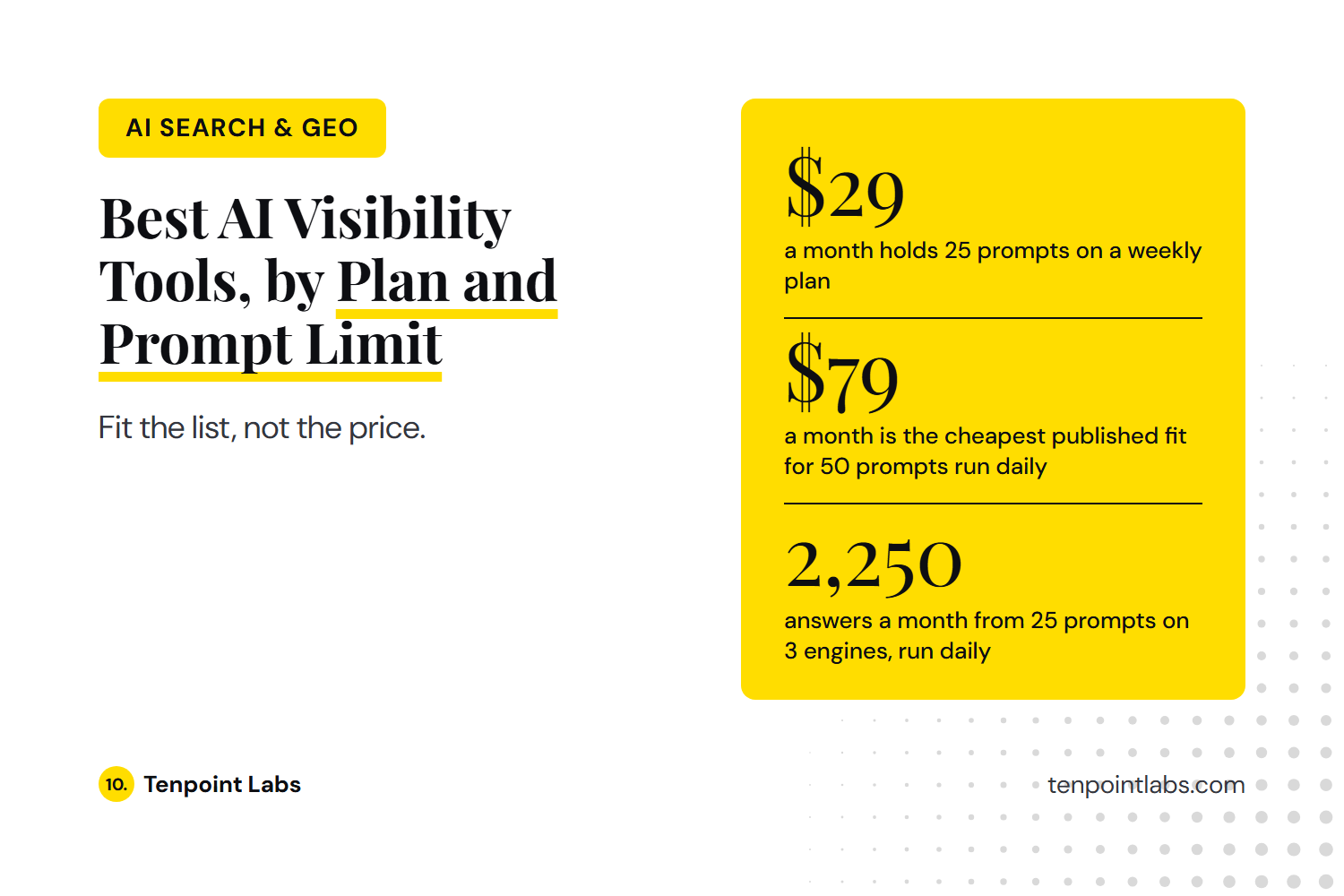
- At 25 prompts, plans start at $29 a month; at 50 prompts with daily runs, the cheapest published fit among these ten tools is $79.
- Several entry plans hold fewer prompts than they first appear to, because credits are spent per engine and per run.
- A tracker samples AI answers to your chosen questions. It doesn't see every buyer's conversation.
Which AI visibility tools should you shortlist?
The right AI visibility tool depends on how many prompts you track, which engines you need and how often runs happen, not on the lowest advertised price.
The table lists ten tools by entry price, lowest first. "Not published" means the vendor's own pages don't say.
Quick picks, with conditions:
- Smallest budget, weekly is fine: Firemark Lite holds 25 prompts on three engines for $29.
- Daily runs at 50 prompts: Firemark Starter ($79) or Peec Starter ($95), depending on which engines you need.
- Already paying for a suite: Semrush, Ahrefs or SE Ranking add AI tracking to tools you already log into.
- Many brands or clients: SE Visible's Agency plan, Firemark's custom Agency and Enterprise plan, or Profound.
Google AI Overviews and AI Mode are separate surfaces in Google Search's AI features, and Firemark, Otterly, Peec, Scrunch and AthenaHQ count them as two engines.
What does an AI visibility tool measure?
An AI visibility tool asks a fixed set of buyer prompts in AI engines and records whether your brand is named, linked or cited, and who appears instead.
The core numbers are mentions (your brand named in the answer), citations (your page linked as a source, as in ChatGPT search answers), competitor presence and position in the answer. Most tools add sentiment.
Share of voice is calculated differently by each vendor, so two tools' percentages can't be compared side by side. Our guide to AI citations vs mentions explains the difference, and the GEO tools comparison goes deeper on metric definitions.
Prompt tracking isn't search volume, website traffic or revenue attribution. It tells you what AI says when asked your questions, which is useful and also narrower than it sounds. Clicks are thinner still: Google users clicked a traditional result in 8% of visits with an AI summary, against 15% without one, in a Pew Research Center analysis.
How did we compare these tools?
Each tool was checked against its own pricing and documentation pages on 20 November 2026, using the same criteria for every vendor.
The criteria were prompts included, engines included, run frequency, countries, stored answers and sources, competitors, seats, MCP and API access, export and the total monthly bill. MCP is an open-source connection standard that lets an assistant like Claude or ChatGPT read and work with the tool's data. Nothing here comes from a hands-on test across tools, and vendor prices change often, so check before you buy.
Three units get mixed up constantly.
A prompt is one question. A check, credit or answer is one prompt asked once on one engine. A run asks every prompt on every engine in your plan.
The 10 best AI visibility tracking tools
The ten AI visibility tracking tools below are ordered by entry price, and each gets the same short review: fit, small-basket plan, strengths and limits.
Firemark
Firemark tracks how often ChatGPT and Google's AI name your brand, on flat monthly plans set by prompts, engines and run frequency.
Lite costs $29 a month for 25 prompts on ChatGPT, AI Overviews and AI Mode, run weekly or monthly. Starter costs $79 for 100 prompts, adds Gemini and allows daily runs. Perplexity starts on Growth at $199.
Strengths: Every plan includes unlimited seats, CSV export, a read-only API and an MCP server with 31 tools, where every change waits for your approval.
Limits: US English by default, monthly billing only, and one free run of 10 prompts instead of a trial.
Choose something else if: you need daily runs for $29, or markets beyond US English and French- or Spanish-speaking countries.
See the plans on Firemark.
Otterly.AI
Otterly.AI runs daily tracking on every plan, priced in credits, where one credit is one prompt checked once on one engine.
Lite costs $29 a month for 20 prompts on 3 of 7 engines. Standard costs $189 for 160 prompts and adds 2,000 API and 2,000 MCP requests a month. Lite can't buy extra credits, so 25 prompts on three engines means Standard.
Strengths: Daily runs from the cheapest plan, unlimited brands, countries and team members, and a choice of seven engines including Claude and Copilot.
Limits: Claude answers use extra credits, and the step from Lite to Standard is $160.
Choose something else if: your list sits between 21 and 160 prompts and $189 feels steep.
HubSpot AEO
HubSpot AEO tracks brand mentions in ChatGPT, Gemini and Perplexity inside HubSpot, suggesting prompts from your CRM data.
It's in beta and costs $50 a month on its own, or comes included in HubSpot's Marketing Hub bundle. HubSpot's pages don't publish a prompt quota or run frequency, so ask before you plan around 25 or 50.
Strengths: AI visibility sits next to campaign and CRM data, with sentiment and competitor presence.
Limits: No AI Overviews listed, beta status and no published quota.
Choose something else if: Google's AI answers matter to your buyers.
Ahrefs Brand Radar
Ahrefs Brand Radar sells custom prompt tracking in checks, from $50 a month for 2,500 checks across the platforms you select.
Each prompt is checked on every selected platform at each update, so 25 prompts on three platforms daily uses about 2,250 checks. Overage costs $0.02 per check, and a Claude update uses 8 checks. Paid Ahrefs plans include 5 to 20 prompts free.
Strengths: Flexible cadence, Claude available, and a separate AI Visibility Index (from $199).
Limits: Budgeting in checks takes arithmetic, and the index is a different product from your own prompt list.
Choose something else if: you want a flat price per prompt.
Peec AI
Peec AI tracks 50 prompts daily on three models you choose for $95 a month on its Starter plan.
The model menu includes ChatGPT, Perplexity, AI Overviews, AI Mode, Gemini and Bing AI Mode. An extra model costs $30 a month on annual billing.
Strengths: Unlimited users, competitors and languages, with MCP and CSV export on every plan.
Limits: One country on Starter, and the API starts on Pro ($245).
Choose something else if: you need four engines for under $100. Our Peec AI alternatives list covers the switch.
Semrush AI Visibility Toolkit
Semrush's AI Visibility Toolkit tracks 25 prompts daily for $99 a month per domain, with mentions from ChatGPT, Google AI, Gemini and Perplexity.
Semrush's help docs say each teammate needs another $99 toolkit license, and each extra domain or location costs $99. Semrush offers a 7-day free trial.
Strengths: Prompt research and competitor reports inside a tool many SEO teams already use.
Limits: Per-user and per-domain pricing adds up fast for a team.
Choose something else if: several people need access and a tool with unlimited seats would cost less.
SE Visible and SE Ranking
SE Visible tracks 75 prompts daily with unlimited seats for $89 a month, or $71 a month billed annually.
That's about 11,250 AI answers a month across 5 engines on Basic. Core costs $189 for 200 prompts and unlimited locations. SE Ranking's own SEO Core plan ($129) also includes 25 AI prompts a day across five engines.
Strengths: 75 daily prompts with unlimited seats for under $100, plus a 14-day trial.
Limits: Claude tracking sits on the $399 Agency plan.
Choose something else if: you only need 25 prompts and weekly runs.
Scrunch
Scrunch sells one self-serve plan at $250 a month with 15,000 AI answers across eight platforms, run daily.
At 25 prompts on all eight platforms, a month of daily runs uses about 6,000 answers; at 50 prompts, about 12,000. Both fit.
Strengths: The widest engine list among plans under $295, including Copilot, Grok and Meta AI, plus a 7-day trial, exports and MCP.
Limits: One brand, five seats and five competitors, with the API on Enterprise.
Choose something else if: your budget sits under $100.
AthenaHQ
AthenaHQ prices tracking in credits, where one credit is one AI answer, with 3,600 credits for $295 a month on Starter.
If runs are daily, 25 prompts on three engines use about 2,250 credits, which fits. At 50 prompts, daily runs need about 4,500, so you'd run weekly or buy extra credits, priced on request.
A free tier gives 300 credits on five engines, including AI Overviews. Our AthenaHQ alternatives roundup covers similar tools.
Strengths: 11 models, unlimited topics and prompts, and one month of credit rollover.
Limits: The API and extra credits cost extra, at prices you have to ask for.
Choose something else if: you want 50 prompts daily at a published price.
Profound
Profound lists a tailored Enterprise plan only, with daily prompt runs on up to 10 answer engines and a price set by quote.
Exports, API, MCP and regional tracking are part of the plan. Our Profound review and Profound vs AthenaHQ vs Peec comparison go further.
Strengths: Broad engine coverage and enterprise features in one contract.
Limits: No published price and no self-serve plan.
Choose something else if: you have a few dozen prompts and want to start this week.
Which tool fits a few dozen prompts?
The best AI visibility tool for 25 to 50 buyer questions is the cheapest plan that holds your full list on the engines you need, at the run frequency you need.
What do 25 and 50 prompts cost?
A 25-prompt list costs from $29 a month on a weekly plan, and a 50-prompt list with daily runs costs from $79 among plans with a published quota.

The table assumes one brand, ChatGPT plus AI Overviews at minimum, US English, one user and monthly list prices.
Suite users pay these figures on top of their existing plan.
Why aren't prompts, answers and credits equal?
A prompt is one question, and each run asks it on every engine, so answers and credits grow with engines and run frequency.

25 prompts on 3 engines, run daily for 30 days, is 2,250 answers a month. At 50 prompts it's 4,500. Otterly's credits, Ahrefs' checks, AthenaHQ's credits and Scrunch's answers all count this way, which is why a plan that sounds roomy can run dry by day 20.
A cost-per-prompt league table would mislead here, because a weekly and a daily plan holding 25 prompts buy different amounts of data.
Do you need daily runs?
Weekly runs suit a first baseline and slow-moving categories, while daily runs suit active competitor monitoring, launches and fast-changing answers.
- Weekly baseline: Firemark Lite at $29, or any daily plan run less often.
- Daily competitor watch at 50 prompts: Firemark Starter ($79) or Peec Starter ($95).
- Already own a suite: Semrush, Ahrefs or SE Ranking, if the engines match.
- A required engine is missing: check add-on prices before upgrading the whole plan.
- You need to read cited pages: pick a tool that stores full answers and sources.
Keep branded prompts ("what is [your brand]") in a separate list from unbranded buying prompts ("best tool for [problem]"). A brand usually appears when a prompt names it, and that high number can hide a blank on the questions new buyers ask. And 25 or 50 is a comparison scenario here, not a statistical minimum.
How do you choose for your team?
Choose on required engines, prompt count and run frequency first, then on reporting, seats and integrations your team will use every week.
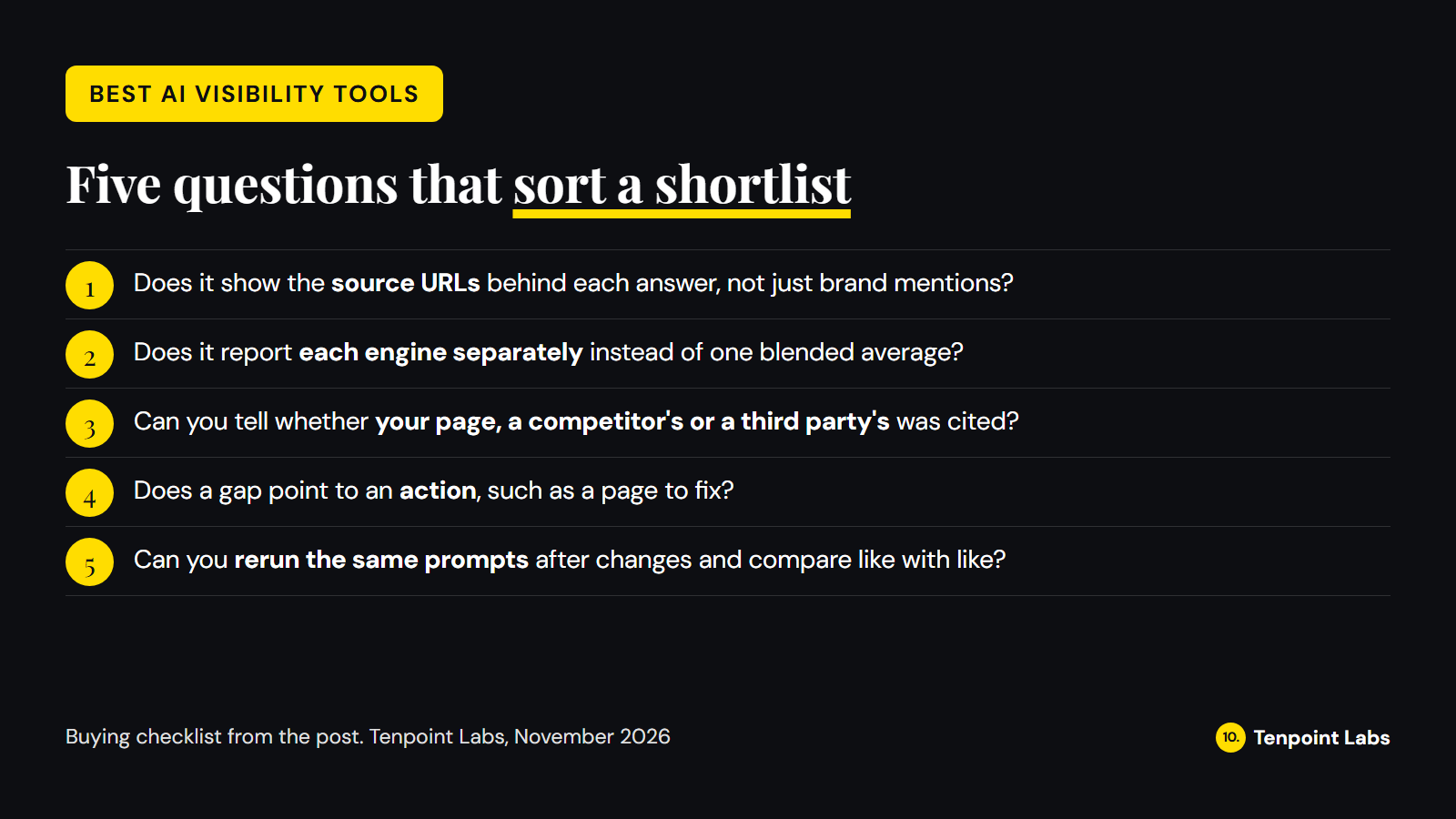
Five questions sort most shortlists quickly:
- Does it show the source URLs behind each answer, not just brand mentions?
- Does it report each engine separately instead of blending them into one average?
- Can you tell whether your page, a competitor's page or a third-party page was cited?
- Does a gap point to an action, such as a page to fix or a list to get onto?
- Can you rerun the same prompts after changes and compare like with like?
MCP access varies a lot, from read-only to tools that can edit your prompts, so check what each plan allows.
Can you start for free?
Several tools offer a free run, credit tier or trial, but a one-time check is a snapshot, not ongoing tracking.
Firemark gives one free run of 10 prompts on four engines. AthenaHQ's free tier has 300 credits.
Scrunch and Semrush offer 7 days and SE Visible 14 days, while Otterly and Peec offer trials without a published length. Paid Ahrefs plans include 5 to 20 prompts.
A spreadsheet works for a first baseline: ask 15 to 20 buyer questions in each engine, log named and linked separately, and repeat on a schedule. Our guide on how to measure AI share of voice walks through the method. Move to a tool when the copying and pasting starts eating your Fridays.
How reliable are AI visibility results?
AI visibility results are samples that change from run to run, so read trends across consistent runs rather than any single result.
The same prompt can name different brands in two sessions on the same day. In a SparkToro study from January 2026, 600 volunteers ran 12 prompts through ChatGPT, Claude and Google's AI 2,961 times, and the brand lists were highly inconsistent.
Models set up to give repeatable output still drift, with accuracy swings up to 15% across identical runs in one 2024 study. Tools collect answers in different ways, through a logged-out web session or through an API, and neither is exactly what a signed-in buyer with a chat history sees. No tracker can tell you precisely how your brand appears to every user.
More runs make the pattern in your sample clearer, but they don't fix a prompt list that asks the wrong questions.
Keep the prompts, engines and method fixed, and note any change to them. A score that moves after you publish a page shows a change; it doesn't prove the page caused it.
What comes after choosing a tool?
Load your real buyer questions, capture a baseline, look at which pages get cited where competitors appear, and act on the biggest gap first.
- Write 25 to 50 questions a buyer types before building a shortlist.
- Run them for two to four weeks to set a baseline.
- Open the cited pages where competitors appear and you don't.
- Fix one page, or get onto one list AI already cites.
- Compare the same prompts, engines and run schedule a month later.
Tracking finds the gap. Content and distribution close it.
Tenpoint Labs turns the gaps your AI visibility tool finds into a content plan your team can ship. Schedule a Founder Call to plan the fixes, or Get Your Free AI Visibility Audit.
FAQs about AI visibility tools
What is the best AI visibility tool for a small team?
The best AI visibility tool for a small team is the cheapest plan that holds the full prompt list on the engines its buyers use. At 25 prompts with weekly runs, Firemark Lite costs $29. At 50 prompts with daily runs, Firemark Starter ($79) and Peec Starter ($95) are the lowest-priced fits we found.
How many prompts should I track?
Most small teams can start with 25 to 50 buyer questions for one brand, split into branded and unbranded prompts. Fewer prompts make the numbers jump around from run to run. Add prompts when you add a product, market or audience, not just to fill a plan.
Can I track brand mentions in ChatGPT and Google AI Overviews?
Most AI visibility tools track both ChatGPT and Google AI Overviews, though HubSpot AEO lists ChatGPT, Gemini and Perplexity without AI Overviews. Google AI Mode is a separate surface, launched in March 2025, and Firemark, Otterly, Peec, Scrunch and AthenaHQ count it as its own engine.
Do AI visibility trackers show what real users see?
AI visibility trackers show a sample of answers to your chosen questions, collected through a logged-out session or an API. A signed-in buyer with a chat history may see something different. Read trends across consistent runs, not single answers.
Can Semrush or Ahrefs replace a dedicated tracker?
Semrush and Ahrefs can replace a dedicated tracker if their engines and prompt limits fit your list. Semrush includes 25 daily prompts for $99 per domain, and Ahrefs prices in checks from $50. A dedicated tracker may cost less once you add users or more engines.
The cheapest plan on the page isn't the cheapest plan for your prompt list. Count your questions, pick your engines, decide on daily or weekly, and the shortlist gets short quickly. Prices were checked on 20 November 2026 and change often.