Which AI Platforms Do B2B Buyers Use, and Which Should You Check First?

Ask your sales team "which AI platforms do B2B buyers use?" and you'll hear ChatGPT, a pause, then three different guesses. ChatGPT leads every segment in G2's 2026 buyer survey, with Gemini second in each one, while Copilot, Claude and Perplexity have smaller pockets of strength. Those pockets decide whether a third platform belongs in your first check, so let's look at what the research supports, where it stops, and how to check your own buyers.
Key takeaways
- ChatGPT has the largest reported share in every industry, company size and role G2 surveyed in March 2026.
- Gemini is second in every segment G2 lists, peaking at 28% among retail respondents.
- Copilot reaches 13% at companies above 5,000 staff and Claude 12% in engineering and R&D, which may justify checking them earlier.
- Your own customers are your strongest evidence: ask them, read your AI referrals, and test their buying questions.
Which AI platforms do B2B buyers use?
ChatGPT has the largest reported share among B2B software buyers, with Gemini second in every segment, in G2's March 2026 survey of 1,076 B2B decision makers.
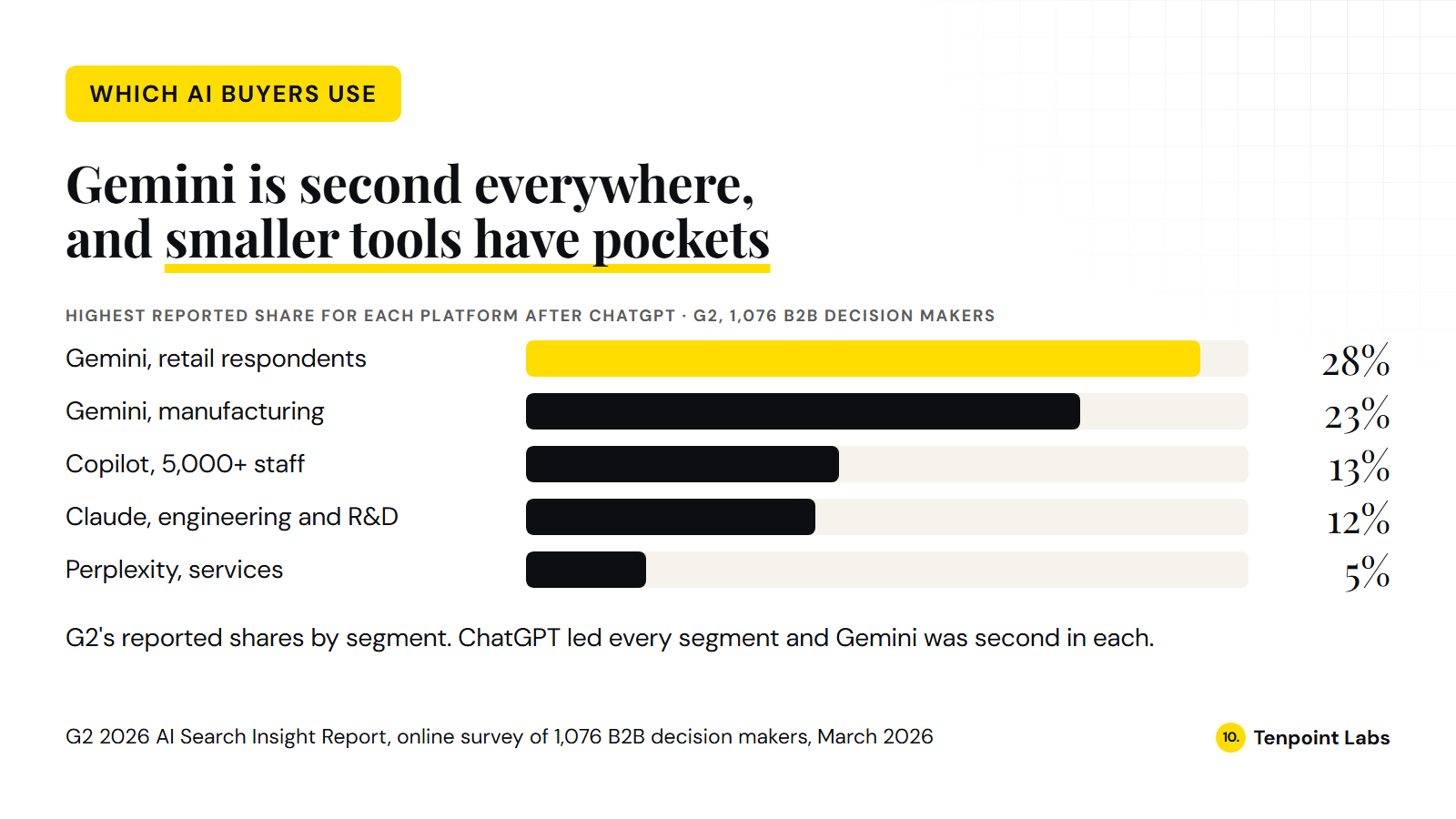
ChatGPT's share runs from 53% in manufacturing to 66% in technology, and its overall share grew from 47% to 62% between G2's 2025 and 2026 readings. Copilot, Claude and Perplexity sit in single digits in most segments, but each has a pocket where it's stronger.
G2 runs a software review site, so it has a stake in AI search mattering, and its sample is software buyers worldwide. Its public charts don't give the exact question wording or the sample size behind each segment, so these are G2's reported shares, not full adoption rates. The table below compares where each platform is strongest in G2's data, what other research adds, and where that evidence stops.
ChatGPT's lead narrows deeper in the funnel. G2 puts it at 73% of buyers in discovery and 53% in consideration, while Gemini rises from 14% to 22%.
Why do buyer studies disagree?
Buyer studies disagree because G2 asks which chatbot buyers prefer, while Similarweb measures which websites each platform's users visit.
Similarweb's platform persona study labels Gemini's audience tech enthusiasts, because its users are 4.8 times as likely as the average Google searcher to visit graphics and web design sites. G2 finds Gemini strongest among retail buyers and service teams. Both can be true, since one dataset covers web users in general and the other covers people buying software.
Neither study says what each engine cites, which our ChatGPT vs Perplexity comparison looks at separately.
Public referral trackers add a third view by counting clicks from chatbots to websites. They're rolling pages that rewrite their figures each month, which makes a single month a poor basis for a plan.
Private tools blur all three views. Forrester's buyer research, published January 2026, found 61% of business buyers use AI tools their employer provides. More than half of the business buyers who use ChatGPT or Copilot run private versions behind the firewall.
What three questions should you separate?
Three questions decide which AI platform deserves your attention: who uses it, whether it recommends your business, and whether it sends you qualified buyers.
- Who uses it? Audience research like G2 and Similarweb answers this, at the level of a market rather than your own customer list.
- Does it recommend you? Repeated tests of buying questions answer this, because one answer can change from one ask to the next.
- Does it send buyers? Referral data, sales conversations and "how did you hear about us" answers help establish this one.
A platform can attract exactly the right people and never name you. A platform that names you in every answer may still be one your buyers rarely open, which makes for a lovely chart and an empty pipeline. Getting named is its own job, covered in our GEO playbook for B2B.
How does priority change by business?
ChatGPT and Gemini are the first two checks for most B2B businesses, and the buyer's industry, size and role decide which third platform joins them.
Here's how G2's figures play out for three common cases. Each is a starting hypothesis, and your own customers get the final say.
Where should a retail software vendor start?
A retail software vendor should check ChatGPT and Gemini first, because retail buyers in G2's survey gave Gemini 28%, its highest share in any industry.
ChatGPT still leads retail at 57%. Gemini's retail share is double its 14% in financial services and healthcare, so a retail tech brand that checks only ChatGPT skips the tool 28% of G2's retail respondents preferred. Gemini users sit inside Google's ecosystem, so Google's AI Overviews and AI Mode make sense to check in the same pass.
Where should a security vendor start?
A cybersecurity vendor's third platform depends on who evaluates, because G2's engineering and IT respondents report different chatbot mixes.
Engineering and R&D respondents gave Gemini 25% and Claude 12%, Claude's highest share by function. IT respondents lean on ChatGPT at 64%, with Claude at 4%, so an IT-led evaluation points to ChatGPT and Gemini, and an engineering-led one adds Claude.
Similarweb found Gemini's users, measured across the general web, 3.1 times as likely as the average Google searcher to visit computer security sites. Selling to companies above 5,000 staff? Add Copilot, which reaches 13% there.
Where should an agency start?
An agency selling to senior leaders should put ChatGPT first, because G2's senior management respondents gave it 68%, the highest of any role.
The C-suite gave ChatGPT 66% and Gemini 23%, so Gemini is the second check here too. If you sell to professional services firms, services was the one industry where Perplexity reached 5%. Similarweb describes Perplexity sessions as research that gets an answer and moves on, which suits a buyer checking a shortlist, though it doesn't show those users buy more often.
How do you check your own buyers?
You can check your own buyers in three steps, cheapest first: ask recent customers, read AI referral data, and test their buying questions.

- Ask the last ten customers who signed. Add one question to onboarding or the sales handover: "Which AI tools did you use while comparing vendors?" Ten recent customers are relevant first evidence. They may miss other buyer segments, so pair their answers with broader research and referral data.
- Read your AI referrals. ChatGPT adds utm_source=chatgpt.com to the links it sends, according to OpenAI's publisher FAQ, so tagged visits can be filtered in GA4, though some arrive untagged. Bing Webmaster Tools' AI Performance report reports citations of your pages across Copilot, Bing's AI summaries and selected partner integrations, so its figures aren't Copilot alone, and a citation isn't a click. Referral counts are a floor, because an unlinked mention produces no directly attributable referral click, even if the reader searches for you later.
- Test the questions buyers ask. Nearly two-thirds of buyers in G2's survey open with a category or competitor prompt, so write those questions first. Ask each on the platforms from steps 1 and 2, repeat over several runs, and log which brands each answer names.
Use unbranded prompts that describe a problem and name nobody to test discovery. Test branded and competitor prompts separately, to check comparisons, accuracy and how answers describe you.
A tracking tool runs step 3 on a schedule. Firemark, an AI answer tracker, tracks ChatGPT, Perplexity, Gemini, Google AI Overviews and AI Mode, so Claude and Copilot still need a manual check if your customers named them. Once the runs pile up, AI share of voice turns them into one comparable number.
Which platform should you check first?
Check ChatGPT first and Gemini second, then add any platform your own customers name, before spreading effort to the rest.
ChatGPT leads every segment G2 measured and Gemini is second in each, so skipping either is hard to justify for a B2B business. The third slot is where published research helps least and your customers help most. When a platform keeps naming a competitor, an AI citation tracker shows which sources it leans on.
Two exceptions are worth planning for. G2 suggests Microsoft 365 bundling may explain Copilot's 13% at large enterprises, so enterprise sellers should check it early. G2 reads its role data as suggesting technical evaluators use more tools, so a developer tool with engineering buyers may need Claude in the first pass.
How we check buyer platforms at Tenpoint Labs
Tenpoint Labs finds out which AI platforms a client's buyers use before deciding which answers to track.
The playbook. Strategy starts from the client's own sources, including call transcripts and customer feedback, so the AI tools buyers mention shape the tracked engines and buyer questions.
The data behind it. Those mentions sit alongside the client's Search Console and GA4 data, including AI referrals, and repeated runs of buyer questions across engines.
What you see in your seat. Every client gets a seat in Tenpoint Analytics, which tracks AI answers across ChatGPT, Gemini, Perplexity, Google AI Mode and AI Overviews alongside search and pipeline data.
FAQs
Which AI chatbot do B2B buyers use most?
ChatGPT has the largest share among B2B software buyers in G2's 2026 survey of 1,076 decision makers, at 62% overall. Gemini is second in every segment G2 lists, with Copilot, Claude and Perplexity well behind in most.
Do B2B buyers use Claude?
G2's 2026 survey reports a small share for Claude, highest among technical roles. It reached 12% among engineering and R&D respondents, its highest share by function, and 2% to 10% by industry.
Does Microsoft Copilot matter for B2B marketing?
Copilot matters most when you sell to large companies, where G2 reports a 10% to 13% share. Forrester also found business buyers four times as likely as consumers to use it, often in private versions.
Do B2B buyers use Perplexity?
Perplexity holds a small share of B2B buyers' chatbot preference, from 0% to 5% by industry in G2's survey. Similarweb describes its sessions as research-shaped, which makes it relevant at evaluation, though that doesn't prove its users buy more.
How do I know which AI platforms my buyers use?
Asking recent customers which AI tools they used while comparing vendors is the most direct way to find out. Back it up with AI referral data in GA4 and repeated tests of your buyers' questions on each platform.
Want to know which engines name you?
Get Your Free AI Visibility Audit and we'll show you which AI engines name you for your buyers' questions, and which name a competitor instead. Next time someone asks whether you're in ChatGPT, you'll have the answer for Gemini too, and a view on which platform comes third.