Which AI Citation Tracker Shows the Sources AI Actually Cites?
The right AI citation tracker is the one whose source view lists the exact URLs and domains AI cites for your prompts. A count of how often your brand appears won't do that.
Eight tools offer some version of the list today, and they differ on classification, gap views and exports. This roundup compares them on the source layer only, using vendor pages and documentation checked on 2 November 2026.
If you've been told you have a citation gap, the number alone doesn't help. A percentage can't be handed to a writer. The list of pages filling that gap can, because the list is where the work plan starts.
Key takeaways
- A citation tracker earns its price when it lists cited URLs per prompt and per engine.
- Semrush, Peec AI, Otterly.AI, AthenaHQ, Profound, Similarweb, Ahrefs Brand Radar and Firemark all expose cited sources, at different depths.
- Most tools classify sources by type, but only some rank gaps for you; the rest hand you a table and expect you to sort it.
- Every tracker samples answers, so treat the source list as evidence of a pattern, not proof of influence.
What should an AI citation tracker show?
An AI citation tracker should show which URLs and domains an AI answer linked to, for each prompt you track, on each engine you track. That's the source layer, and it's different from a mention count. A mention means the answer named your brand; a citation means the answer pointed at a page, as we explain in our guide to AI citations versus mentions.
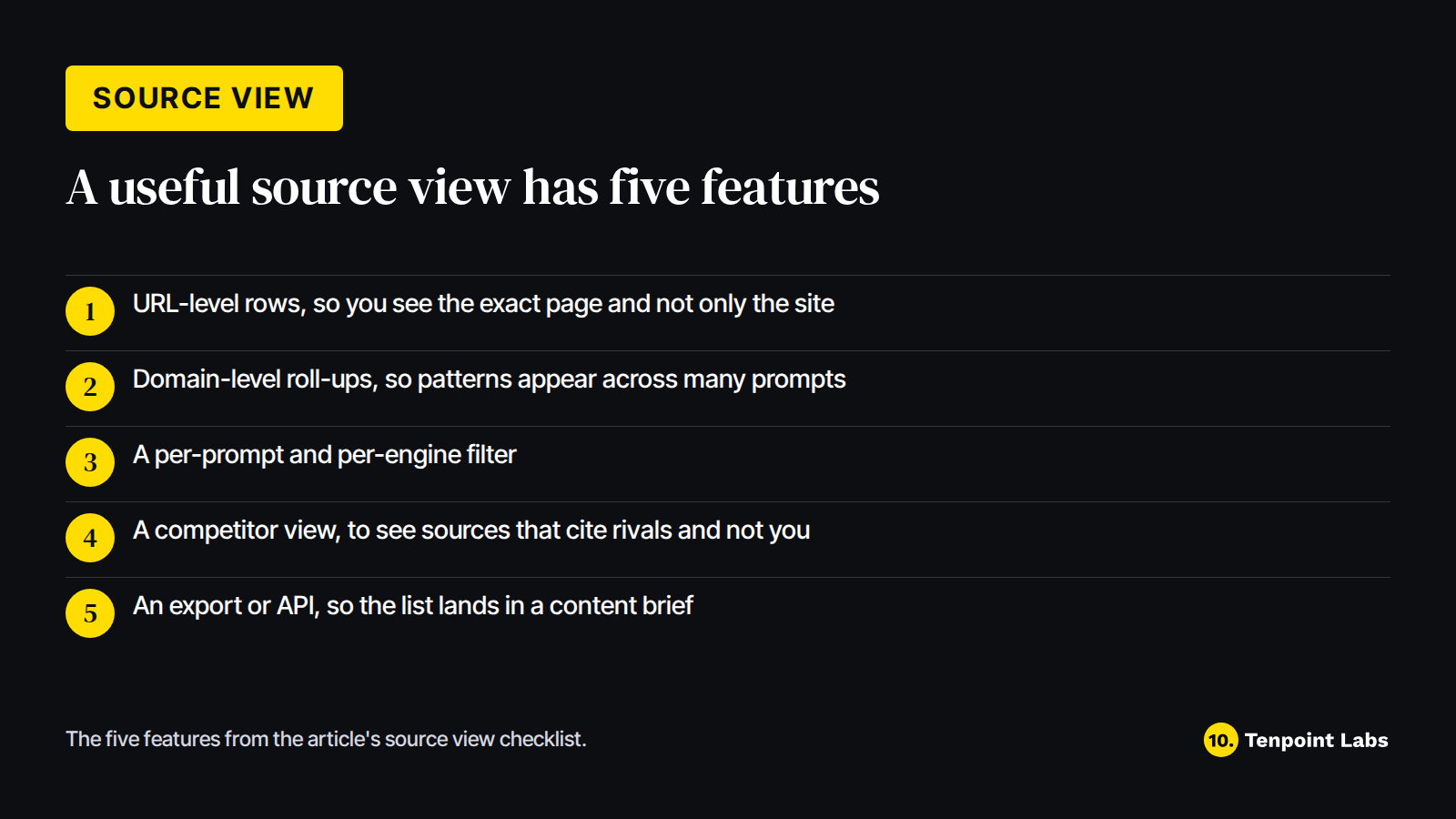
A useful source view has five features:
- URL-level rows, so you can see the exact page and not only the site.
- Domain-level roll-ups, so patterns appear across many prompts.
- A per-prompt and per-engine filter, because the cited sources can differ by platform.
- A competitor view, so you can see sources that cite rivals and not you.
- An export or API, so the list leaves the dashboard and lands in a content brief.
Citation data beats a mention count for one reason: a count can't show which pages the answer linked to. Some tools also record sources the model retrieved but didn't link, so check how each vendor defines the word.
How do the tools compare on sources?
The eight tools all list cited sources, but they differ on classification, gap views and how the data leaves the product. The table below records what each vendor states on its own pages as of 2 November 2026.
"Not stated" means we couldn't find the feature described on a public vendor page, not that it doesn't exist. For a wider feature comparison, see our Profound, AthenaHQ and Peec comparison.
Which tools list the cited sources?
Each of the eight tools below lists cited sources, and the order here is alphabetical so nobody reads rank into it.
Ahrefs Brand Radar
Ahrefs Brand Radar counts a citation each time AI links to your pages or domains as a source, and it shows which pages and domains get cited for a topic.
Its index covers more than 400 million search-backed prompts, generated by Ahrefs, across AI Overviews, AI Mode, ChatGPT, Perplexity, Gemini and Copilot. Your own questions go in as Custom Prompts, and every paid plan except Starter includes a monthly allowance of checks for them. The page doesn't describe source types or a gap score, so expect to do the sorting yourself.
AthenaHQ
AthenaHQ's documentation describes a Source Domain Analytics view for each domain AI platforms have cited. It shows citation rate, citations and platform coverage, plus a Pages table of every cited URL with a first-seen date.
Each source carries a type tag (Owned, Competitor, Partner or Third-party), and the table exports to CSV. AthenaHQ also documents API and MCP access, subject to your plan. Brand and competitor mention data comes from crawling the cited URLs, which tells you whether your name sits on the page AI chose. A separate Outreach view lists the distinct cited URLs with a citation percentage for each.
Firemark
Firemark runs a set of buyer prompts on five engines: ChatGPT, Perplexity, Google AI Overviews, Google AI Mode and Gemini. It collects in US English and lets you read full answers in the app for 13 months.
Its Sources screen lists cited sources, and you can download a CSV from the Prompts screen with one row per prompt and engine, including the cited domains, answer verdict, position and sentiment. The MCP server lets Claude and ChatGPT read cited pages for any one site, plus a source-gaps list of sites cited where a competitor is named and you aren't. Sources are sorted into Owned, Competition, Earned, Social and Other types, and each site shows how many answers citing it name your brand and how many name a competitor and not you. Because the data is reachable over MCP, you can work with it from the Claude or ChatGPT account you already use, build charts there and pull the underlying answers, rather than working inside a built-in assistant.
Otterly.AI
Otterly.AI says it tracks every domain and URL cited in AI answers, checked daily, with link-position changes over time. A product update lets you filter cited URLs by domain, break them down by domain category, and see whether your brand is mentioned on the cited page. It covers ChatGPT, Gemini, Perplexity, Copilot, AI Overviews and AI Mode, and it publishes a public API for pulling reports into your own workflow.
Peec AI
Peec AI defines sources as the URLs a model accessed while answering, and citations as the subset explicitly referenced in the final answer. Its Sources and citations view works at domain and URL level.
Sources are sorted into five types: Editorial, Corporate, UGC, Reference and Own website. Peec says each type points to a different action, such as PR outreach for editorial or community work for UGC. A built-in Gap Analysis ranks sources where competitors appear and your brand doesn't by Gap Score, and data leaves through a REST API, MCP or a Looker Studio connector.
Profound
Profound's citations page says it shows every cited URL for each prompt it monitors, including citations that go to competitor domains. Every cited source gets a category: Owned, Competitor, Earned Media, PR Wire, Social or Institution.
Some are assigned automatically and you can override them. Citation data exports as CSV or JSON.
Semrush
The Sources report in Semrush's Prompt Tracking shows the most cited domains and pages across your prompts. A Pages view lists how many tracked prompts cite each URL and how often the associated answers mention your brand. That is a count of mentions in the answers, not of your brand appearing on the cited page. In one example campaign in Semrush's guide, 20 prompts surfaced 49 source pages in Google AI Mode and 40 in ChatGPT. You can filter by social platforms, knowledge bases and other domains, and export to Excel, CSV or Google Sheets.
Similarweb
Similarweb's Citation Analysis, part of its AI Brand Visibility product, lists the domains and URLs cited by ChatGPT, Google AI Mode, Gemini and Perplexity. Each domain gets a Domain Influence Score, the share of answers for a topic that cite the domain, so it shows how often a domain is cited rather than causal influence, and each URL carries a source category, a topic and the number of prompts it appears in. The tool also shows competitor pages earning citations, so you can compare footprints.
Which one should you pick?
Pick the tracker that fits where you already work, then check its source view against the five features above. Our view: classification and gap scores are conveniences, and the URL-level list is the requirement. You can sort a spreadsheet, but you can't invent rows a tool never captured. A few common situations:
- You already pay for Semrush or Ahrefs. Check what source reporting your existing plan includes before you buy another tool.
- You need source types and a ranked gap list. Peec AI states both on its pages. Semrush, Profound, Otterly.AI, AthenaHQ, Firemark and Similarweb classify sources too, though they stop short of a gap score.
- You want the data in your own tools. Peec AI, Otterly.AI, Profound and Firemark each state an API, MCP or CSV route. AthenaHQ and Semrush export to CSV and spreadsheets, and AthenaHQ also documents an API and MCP. Firemark is built to be driven from Claude or ChatGPT, so you work with the data in an assistant you already use, not in a separate one built into the platform.
- You need a specific engine covered. Engine lists differ by tool and, in some cases, by plan, so check the vendor's list against the engines your buyers use before you commit.
Whichever you choose, run ten of your real buyer prompts through the trial and see whether the cited URLs make sense to you. If the list is full of pages you can't act on, you've bought a spreadsheet with a login. If you also report share of voice, our guide to measuring AI share of voice covers the counting rules.
What can't a citation tracker tell you?
A citation tracker can't tell you why an AI chose a page, and it can't promise the same list tomorrow. Trackers sample answers on a schedule, and SparkToro's January 2026 research found that AI tools gave the same list of recommended brands twice in fewer than 1 in 100 attempts. That single study covered brand lists rather than cited URLs, but it's the reason sampling over many runs matters. A source that appears once in a sample shows that page was cited in that captured answer. It doesn't show a recurring pattern or why the page was chosen.
Two other limits are worth keeping in mind. First, a cited page isn't necessarily an influential one, because an answer can cite several pages and lean on one. Second, collection methods vary, and a logged-out tracker may not reproduce what a signed-in buyer sees, so your buyers may see a different list.
The fix is to treat the source list as a hypothesis. A visibility score is a weather report, and the source list is the map, so prioritise domains that recur across prompts and engines, and look into a one-off citation only when the page matters to a prompt you care about.
What do you do with the list?
You turn the source list into three groups of work: pages to improve, pages to earn a place on, and communities to join. Our citation gap analysis method walks through the full process, and the short version is below.
- Mark the cited pages you own and compare them to the competitor pages cited for the same prompt. Say a rival's best-of post is cited on eight of your twenty prompts and your product page on none: that post is a candidate brief. Check that it's relevant, what evidence your page lacks and whether an existing page could answer the same question before you write or replace anything.
- Find the third-party domains that recur, such as review sites, editorial publishers and directories, and plan outreach or listings for the ones that are relevant.
- Check forums and social threads in the list. If a thread gets cited, a useful and disclosed reply from a real person can do more than another blog post.
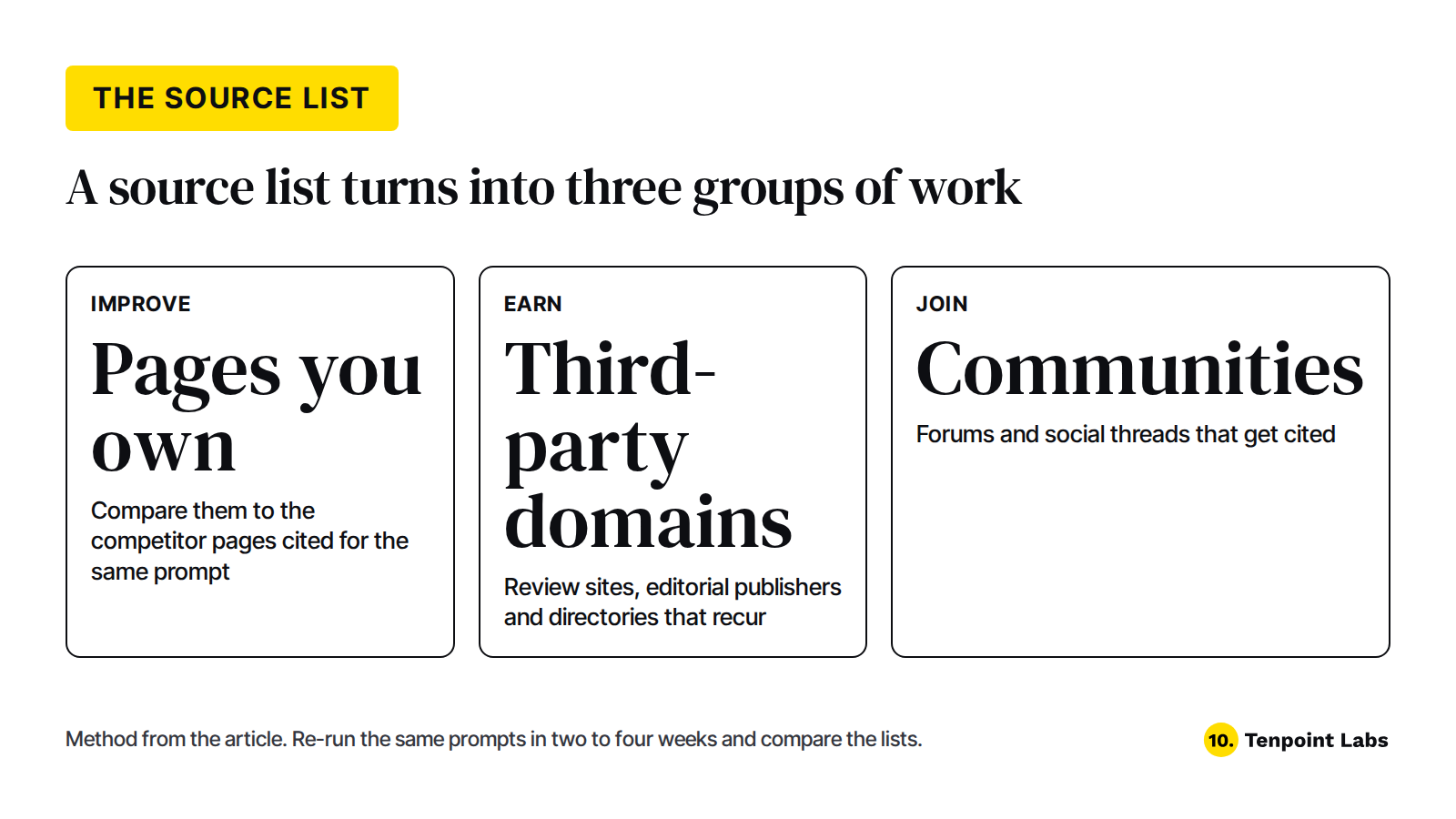
Then re-run the same prompts in two to four weeks and compare the lists.
FAQ
What is an AI citation tracker?
An AI citation tracker is a tool that runs your prompts on AI engines and records which URLs and domains the answers cite. Better ones also classify the sources and compare you against competitors. It's different from a mention tracker, which only records whether your brand name appeared.
Can I track AI citations for free?
You can track citations by hand for a few prompts by running them in each engine and logging the linked sources in a spreadsheet. It works for a handful of prompts and gets slow beyond a few dozen, because answers change between runs. Some vendors offer free trials, so test a paid tool on your own prompts before buying.
Do AI citation trackers work across ChatGPT, Perplexity and Google?
Engine coverage differs by tool and, in some cases, by plan. The lists on vendor pages mix ChatGPT, Perplexity, Gemini, Copilot, Google AI Overviews and AI Mode, so check yours against the engines your buyers use. Cited sources can also differ by engine, which is why a per-engine filter matters.
Is a citation the same as a backlink?
A citation isn't a backlink, though both are links to a page. A backlink is a link another site gives you, while a citation is a source an AI answer chose to show. One page can have many backlinks and no citations, and the reverse.
Does AI feature traffic show in Search Console?
Search Console now reports your own visibility in generative features, but not the third-party sources an answer cited. Google launched Search Generative AI performance reports in June 2026 as a separate view. For the cited sources you need a citation tracker.
The source layer is where a citation gap becomes a task list. Tenpoint Labs is one team that reads these lists for clients, alongside Search Console and GA4 data, and turns them into on-site and off-site work you can see in our case studies. For a second pair of eyes on yours, book a founder call.