Generative Engine Optimization Tools Comparison by What Each Measures
A generative engine optimization tools comparison usually starts with features and ends in confusion, because the tools differ less in what they offer than in the unit they count. Two dashboards can watch the same brand, the same prompts and the same week, and still report different numbers for good reasons.
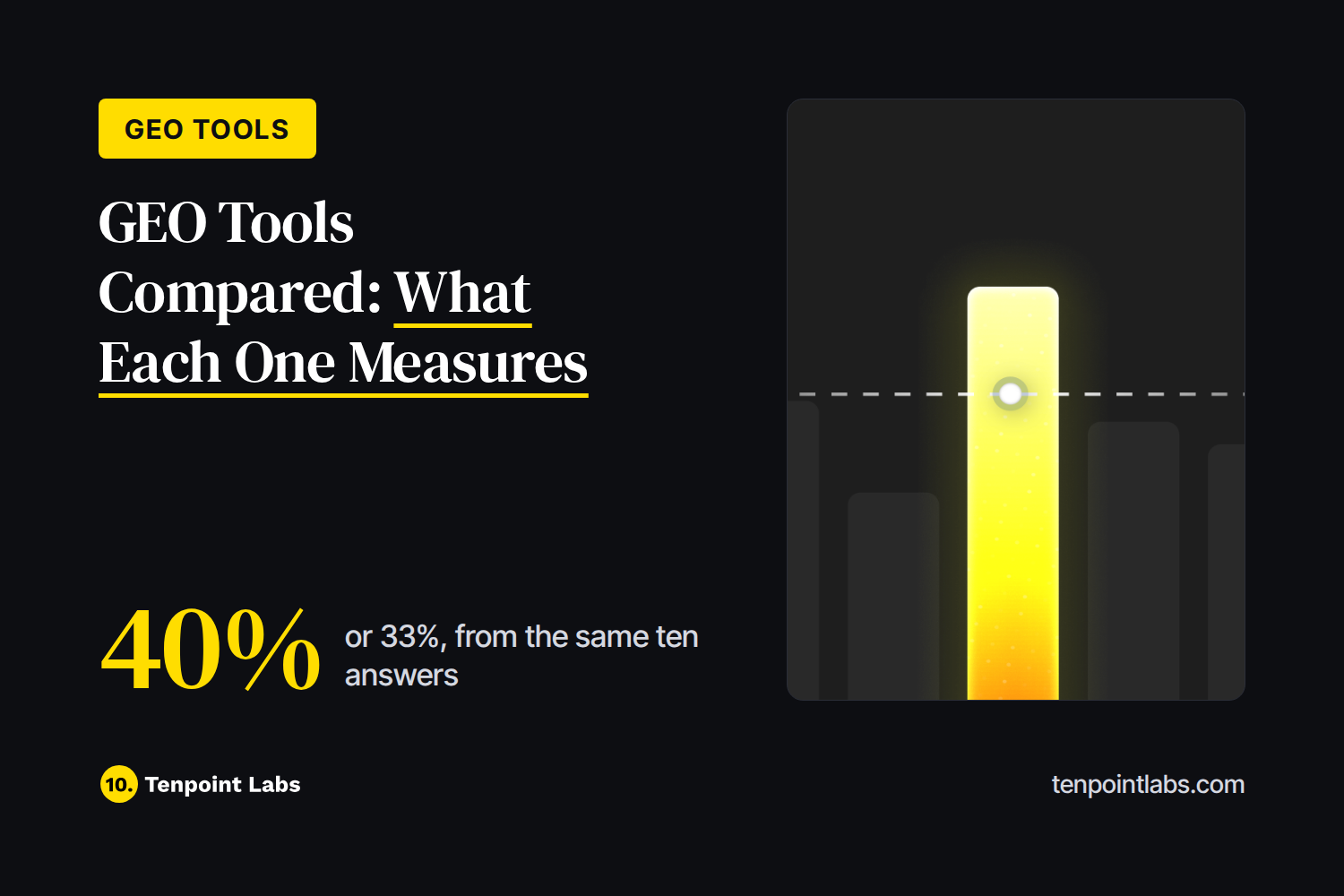
Why would one tool put a brand at 40% share of voice while another says 33%? Which one is wrong? Is either?
Neither has to be wrong. Each is dividing by something different, and the definition pages say so in plain print that few readers ever open.
Key takeaways:
- GEO tools measure up to five things: named, cited or linked, position, sentiment, and what happens next.
- "Share of voice" is at least three formulas wearing one label, so a number only means something next to its denominator.
- Position and sentiment scales differ by vendor and can't be compared across tools.
- Five questions on any vendor's definition page tell you what a number counts before you trust a trend.
What Does a GEO Tool Measure?
A GEO tool measures up to five things: whether the brand is named in an answer, whether its site is cited or linked, where it ranks, how the answer describes it, and what happens after the answer. Coverage is thickest on the first and thins out toward the last.
- Named. The brand's name appears in the answer text. Peec and Profound call the share of responses that do this visibility, Otterly calls it brand coverage, and Ahrefs counts mentions.
- Cited or linked. The answer lists the brand's site as a source. Ahrefs tracks cited pages and pages "found in" a response, a wider group that also includes pages retrieved in the background and never cited.
- Position. Where the brand sits relative to others, measured as a rank, a third of the answer, or a citation order.
- Sentiment. Whether the mention reads positive, neutral or negative, scored on each vendor's own scale.
- What happens next. Traffic, clicks or recommended actions. Firemark says plainly that it records what answers say and not what people do afterward.
Even the word mention shifts between tools. Semrush counts the prompts that include the brand, Ahrefs counts responses where the brand appears at least once, and Otterly scores each prompt as 1 or 0, so a brand named three times in one answer still counts once.
A mention without a citation gives readers no link to click, and a citation without a mention can still feed the answer. AI citations versus mentions covers why the two move separately.
Generative Engine Optimization Tools Comparison Table
Seven tools describe their metrics in seven vocabularies, and the table lists each vendor's own term for the five things. It was built from each vendor's documentation as read on 2 November 2026, and "not covered" means the vendor pages we read didn't define it, not that the tool lacks it. Check the live product before relying on a blank.
Several vendors go past counting answers. Semrush's AI Visibility metrics page lists topic opportunities, source opportunities and a site-audit score for AI readiness, and Ahrefs adds cited-domain and cited-page reports. Firemark's method page lists what it doesn't track, such as clicks, visits and accuracy, and describes no recommendation layer.
Why Does Share of Voice Differ?
Share of voice differs between tools because vendors divide by different things, and some use the label for a different metric altogether: answers collected, total brand mentions, or search-volume-weighted impressions. The label stays the same while the denominator changes.
Here are the three families, straight from the documentation:
- Share of answers (often called visibility). Peec calls it visibility, and Otterly calls it brand coverage, and neither labels it share of voice. Profound's visibility score divides by responses that name at least one brand. Firemark labels its answers-over-answers count share of voice. Otterly leaves out Google AI Overview checks where no overview appeared.
- Share of mentions. Profound's share of voice is the brand's mentions divided by all brand mentions, and Otterly's and Peec's work the same way. Semrush describes the percentage of mentions against competitors.
- Share of weighted impressions. Ahrefs sums Google search volumes for the prompts where a brand appears (each prompt takes the volume of the highest-volume keyword whose People Also Ask results show it), then reports the brand's share of impressions against the other tracked brands.

A small example shows how far apart they land. Say ten answers each name at least one of three tracked brands, and brand A appears in four of those answers. Across all ten answers the brands collect twelve mentions, four of them A's.
Answer-based visibility is 4 of 10, or 40%. Mention-based share of voice is 4 of 12, or 33%. Peec's docs draw the same line between the two. The arithmetic is illustrative and no tool is involved.

The third family is hard to reproduce by hand. Ahrefs publishes the method, but it needs Ahrefs keyword volumes, and the result estimates search demand for the prompts, which differs from counting AI answer views.
A blended number is easier to put in a slide, and that is the fair case for it. The case ends where the formula goes unprinted. Measuring AI share of voice walks through the calculation step by step.
How Do Position and Sentiment Compare?
Position and sentiment can't be compared across tools, because each vendor defines rank and tone on its own scale. A position of 2 in one dashboard and "first third" in another describe different facts.
Peec reports an average rank against the other brands mentioned, where 1 is first. Profound rolls position into a ranked score. Firemark records which third of the answer holds the first mention, and Semrush's prompt tracking reports where a citation of the domain typically falls, first or second or later.
Sentiment splits the same way. Peec scores tone from 0 to 100 using the language around a mention. Otterly subtracts negative mentions from positive ones, divides by total mentions and multiplies by 100.
Firemark records three labels, and only when the brand is named.
Most of these scores don't check whether the sentence is true. Profound's FactCheck layer and Peec's fact-checking are the exceptions: each compares the claims an answer makes against facts you supply. Firemark's method page says outright that it doesn't test accuracy, so a glowing, wrong description still reads as positive there.
For a wider tour of the category, LLM SEO tools covers what else the platforms bundle.
How Do You Check a Tool's Number?
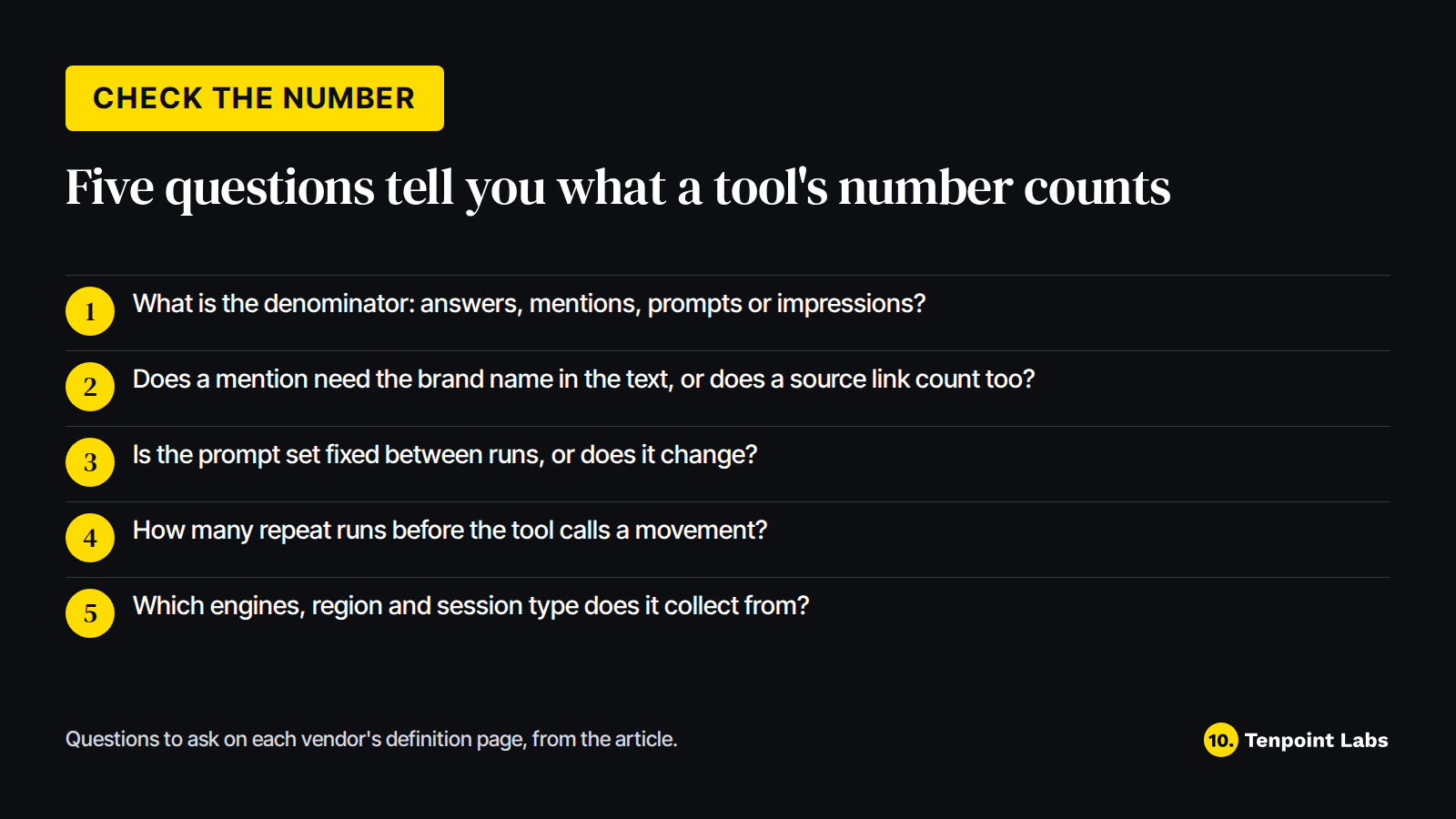
Five questions on the vendor's definition page tell you what a tool's number means before you trust it. The answers sit in the documentation, usually one click from the dashboard.
- What is the denominator: answers, mentions, prompts or impressions?
- Does a mention require the brand name in the text, or does a source link count too?
- Is the prompt set fixed between runs, or does it change?
- How many repeat runs does it take before the tool calls a movement?
- Which engines, region and session type does it collect from, and is that the consumer app or an API?
Question 4 matters more than it looks. AI engines don't give the same answer twice, so a single run is a sample.
Firemark's method page, for one, reports movement only after three comparable runs and a change of 5 points or more, and draws a 95% range around each engine. A tool that doesn't state its rule leaves you to guess.
Question 5 matters just as much. The same page says Firemark asks from a US location, in English, from logged-out sessions, so a signed-in person with a long history can get a different answer. Every tool has some version of that limit, and the good ones print it.
The sceptics have a fair point. Critics in practitioner forums argue that any prompt list is invented, so a count measures your own questions and not real conversations. One answer is to keep the prompts fixed and judge direction over exact levels. Another is a vendor database built from real prompts, as Semrush and Ahrefs offer, with the source named.
Then run the same 20 prompts through two tools before trusting either trend. If the direction matches, you've learned something. If it doesn't, you've learned something cheaper. When you're ready to choose between specific tools, Profound versus AthenaHQ versus Peec is the place for it.
How We Do This at Tenpoint Labs
Tenpoint Labs reports named and cited results separately, against a fixed prompt basket, with the definition printed beside every number. That keeps a movement from being an artifact of a changed formula.
The playbook is a fixed set of buyer prompts per client, repeated on the same schedule across the major answer engines, with competitors held constant. We log which sources each answer cites, because the cited pages are the ones worth earning mentions on.
The data behind it is client-specific, so we describe the method and keep the figures private. In your seat, Tenpoint Analytics shows AI search visibility next to Search Console and pipeline data, so a rise in mentions can be checked against what buyers did next.
FAQs
What is a GEO tool?
A GEO tool is software that tracks whether AI answer engines name, cite or link your brand. It sends a set of prompts, your own or the vendor's database, to engines such as ChatGPT, Perplexity and Google AI Overviews, then scores each answer. Some also suggest topics or sources to target.
What is the best GEO tool?
The right GEO tool depends on which number you need. Tools that count answers suit a simple visibility trend, tools that count citations suit source planning, and suites such as Semrush and Ahrefs suit teams already inside those platforms. Compare their definitions first and their feature lists second.
Why do two GEO tools report different share of voice?
Two GEO tools report different share of voice because they divide by different things. One tool divides by answers collected and may label that share of voice, another divides by total brand mentions, and a third weights mentions by search volume. The same raw answers can show 40% in one dashboard and 33% in another.
Is a GEO tool the same as an SEO tool?
No. A GEO tool samples what AI engines say when asked your prompts, while an SEO tool tracks rankings, links and traffic on search results pages. They answer different questions, and GEO versus SEO versus AEO explains where they overlap.
Can I compare scores between GEO tools?
Direction compares better than levels. A rise in both dashboards over several runs is a reasonable signal, while a score of 40 in one tool and 33 in another says nothing about which is better. Pick one tool for trend reporting and keep its prompt set fixed.
What Should You Do Next?
Pick one tool, read its definition page, and write down its denominator before you read its first chart. A dashboard with a number on it feels like a measurement, and the denominator tells you what was measured. If you'd like a second pair of eyes on which numbers to trust, schedule a Founder Call.