Is Your SEO Ranking Drop Real, or Did Your Tool Get Bad Data?
Your rank tracker flags an SEO ranking drop on Monday morning, and by lunch someone is asking whether the page needs a rewrite. Nobody can say for sure, because just one tool is reporting it, and a tracker can record a page that differs from what searchers saw. That leaves you with a hard call: rewrite a page that may be fine, or sit on a drop that may be real.
Until Search Console shows it too, the drop is unconfirmed. So we're discussing an evidence standard and a decision table for making that call, and we'll stop before recovery, because there's nothing to recover until the drop is confirmed.
Key takeaways
- Trackers can record pages that depart sharply from a keyword's usual results
- Search Console is the check built on real searches
- A drop is confirmed when it persists in clicks and position
- Every alert goes in one bin: act, monitor, or question the data
What Did Nozzle Find, and What's Unproven?
Nozzle's poisoned SERPs study looked at how often Google's page-one results for a keyword leave out most of the sites that usually appear there. Between September 13 and November 3, that happened on 15.0% of the page-one results Nozzle checked. Before that period, it was 0.17%. The 15.0% is an average across the whole period, and the rate was higher at the end: on November 3 alone, it was 30.5%.
A poisoned SERP is a Google results page where fewer than half of the keyword's usual sites appear on any page, and nothing on the page flags it. That's Nozzle's label for a departure from the keyword's history, not a proven mechanism. The swapped-in sites are real sites, which is why a tracker stores the page as a ranking change.
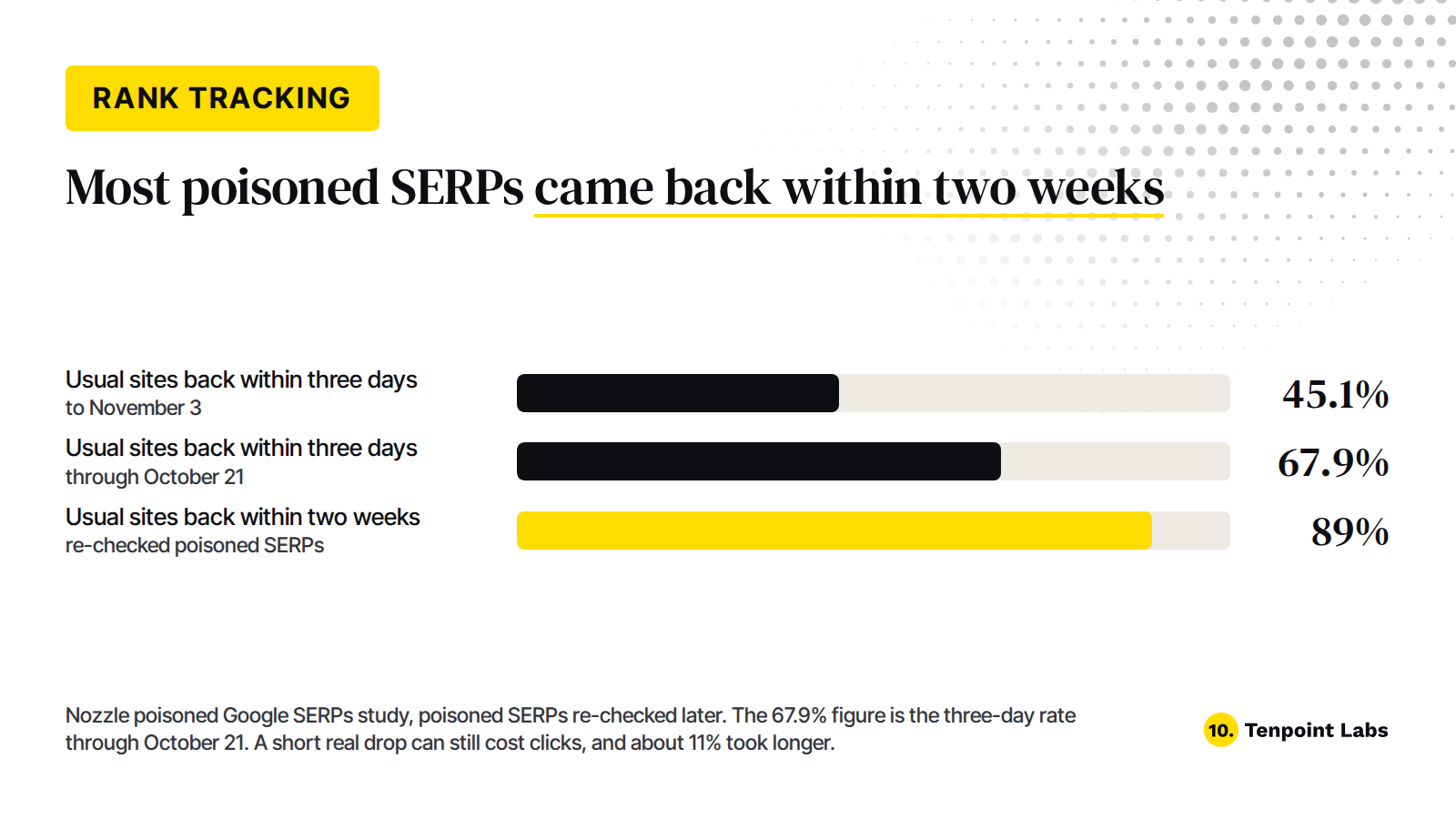
Part of the effect on a tracked site follows from that definition, since a poisoned SERP is missing more than half of the usual sites, but the jump is still large. The study says that where a project's own site is one of a keyword's usual sites, it fell outside the top 10 on 63.7% of poisoned SERPs, against 2.6% before. It also says that among poisoned SERPs re-checked later, 45.1% had their usual sites back within three days (67.9% through October 21) and 89.0% within two weeks.

Several things remain unproven. Nozzle reads the pattern as Google's response to AI scraping, and PPC Land reported on October 19 that Google had made no public statement about it.
Nozzle's test also compares each SERP with the sites that keyword usually showed between August 20 and September 9, in a sample of the SERPs it tracks for its customers. That measures how far a page departs from history. It isn't a simultaneous test of humans against scrapers, and it doesn't show that your tracker was affected.
Nozzle and DemandSphere both track SERPs for customers, and the Nozzle study is Nozzle's own. DemandSphere, a rank-tracking vendor, reported the same class of problem separately.
DemandSphere put spurious results at about 11% of its daily SERPs in a post on October 7, and called that figure not final. For October 23, it reported that 6.7% of the pages it collected were poisoned.
Those are different dates and different methods, so they don't contradict Nozzle's figure. DemandSphere's later delivery checks use a different unit, ranks flagged in each delivery of 1,722, and read 2.67% on October 26 and 0.46% on November 3. They don't show poisoning falling, because Nozzle's page-one rate stayed near 30% across those days.
Each rate describes that vendor's own collection on that day, not every tracker.
Charles Floate, in a September 28 post that DemandSphere embedded, voiced the practitioner suspicion bluntly, as an observation rather than a measurement: "Ahrefs, SEMRush and ALL the rank trackers seem to be bugging out BIG TIME right now vs. actual SERPs."
How Does Bad Data Cost You Money?
Bad ranking data costs money when a team acts on it before checking it. Here's a hypothetical.
A tracker reports that a page ranking fourth for a core term has fallen out of the top 10. Someone books a rewrite, two people spend a week on it, and the new version ships. Search Console shows impressions and clicks for that page were flat the whole time.
The old page wasn't broken, and now it's been improved anyway. The tracker, for its part, recovered by Thursday and never mentioned it.
Is Your SEO Ranking Drop Real?
A ranking drop is confirmed when Search Console shows the same decline in position and clicks for the same queries and pages. Run these five checks in order.
- Pull the same queries and pages in Search Console, and match the country, device and dates your tracker uses.
- Read clicks and impressions next to position. Search Console averages the position value for all impressions, as Google's help page explains, so it won't match a single tracker fetch.
- If Search Console doesn't confirm the drop, check whether it persists. We use two weeks as the lookback, because 89.0% of re-checked poisoned SERPs in Nozzle's data had their usual sites back within that time. It's our rule of thumb, not Nozzle's, and it has a miss rate: about 11% took longer, and Nozzle says poisoning now lasts longer. A short real drop can still cost clicks.
- Check whether it travels. DemandSphere's heuristic is that updates usually move correlated sets of keywords, concentrated in a vertical, and are usually confirmed, while poisoning turns up on scattered individual fetches across unrelated queries at the same time. It's a vendor hypothesis: Nozzle's data shows poisoning clustering by industry (29.8% of US legal SERPs against 6.5% of US pet SERPs) and by query type, so a cluster doesn't prove a real update.
- Compare against the keyword's usual results over several weeks, not yesterday's, and check page 2. On desktop, Nozzle found page 2 poisoned 1.5 times as often as page 1.
Continued impressions alone don't rule out a real decline, since a page can slide in position and still earn impressions. The strong signal is the combination: position and clicks confirmed in Search Console, across weeks.
Search Console can't confirm or rule out a drop on queries with only a handful of impressions. And checking a second tracker helps only if the second tracker collects independently of the first, and trackers differ for ordinary reasons too, which our post on why trackers disagree covers.
What Did Our Own Data Show?
We checked one tracker movement against Search Console, and Search Console couldn't confirm a drop. On one B2B site we analyzed, a rank tracker showed a low-volume non-brand keyword falling from the lower half of page one to the bottom of page two over a month. It was the one large drop in that site's tracker project.
Search Console showed no decline for the same page. Average position stayed near 16 in the three weeks before and the three weeks after, with a handful of impressions and no clicks in either. That average already differs from the tracker's page-one starting point, a reminder that the two tools measure different things.
A drop on that little traffic costs a graph, not a pipeline.
That doesn't make it poisoning. With so few impressions, Search Console can't confirm or rule out a decline, and two single-day tracker readings a month apart are a thin basis for any conclusion. Nozzle doesn't show that our tools or clients were affected, and we're not claiming they were.
Act, Monitor, or Question the Data?
Every ranking alert belongs in one of three bins: act, monitor, or question the data. Our position is that one tool on one day doesn't earn a rewrite, because a screenshot of a single tracker is a rumor with a chart. This table sorts the common patterns.
| Signal | Call | What to do |
|---|---|---|
| Tracker and Search Console both down for the same queries and pages, on desktop and mobile | Act | The drop is confirmed, so start the diagnosis with no wait |
| Tracker down, Search Console flat, one collection day | Question the data | Leave the page alone and re-check at the next collection |
| Tracker down, Search Console flat for two weeks or more | Monitor | Run a manual check with the tracker's country and device |
| Many unrelated keywords drop and return on the same day | Question the data | Suspect collection first, and check the Google Search Status Dashboard |
| Clicks down, position and impressions flat | Act | Position isn't the cause, so look at click-through rate, AI Overviews and demand |
| Search Console shows a drop clustered on one topic or page set, matching a confirmed Google update | Act | Check the Google Search Status Dashboard, then diagnose |
The second and third rows save the most work, and neither needs a meeting. In both, the tracker says one thing and Search Console says another, and Search Console is the source with real searches behind it. It has limits of its own, which is why the checks above look at position, impressions and clicks together.
The Google Search Status Dashboard lists confirmed ranking updates and incidents, so an empty one doesn't rule out a collection fault.
Row five is a different cause, covered in our guide to AI Overviews for B2B content.
What About AI Visibility Reports?
Any report built on collected results needs collection-quality checks, and AI visibility reports are no exception. A tool that samples answers samples a proxy of what a buyer saw, so ask what it collected and how it flags a bad fetch.
Our comparison of AI citation trackers shows what each tool's source view reports. None of this shows that AI tracking is unreliable.
FAQs
How do I know if my ranking drop is real?
Confirm it in Search Console. A confirmed ranking drop appears as lower position and fewer clicks for the same queries and pages, and it persists across weeks. A drop that only one tool reports, for one collection day, isn't confirmed.
Why did my Google rankings drop suddenly?
A sudden drop has several possible causes, including a real change in Google's results, a location or device mismatch, and a tracker that recorded a page that departs from the keyword's usual results. Check Search Console first. If clicks and position are flat there, rule out a location or device mismatch, then suspect the tracker's collection.
Can a rank tracker show the wrong position?
A rank tracker can show the wrong position. It records the page Google served to it, and that isn't always the page searchers saw. Nozzle's study found that between September 13 and November 3, 15.0% of the page-one results it checked left out most of the sites that usually appear there. Other vendors measure different rates. Trackers also differ from Search Console because Search Console averages position across impressions.
How long should I wait before acting on a ranking drop?
Wait up to two weeks if Search Console doesn't confirm the drop. If Search Console shows lower position and fewer clicks for the same pages, you don't need to wait.
What should I do after a confirmed ranking drop?
Diagnose the cause before changing anything: recent site changes, technical issues, a confirmed Google update, and competitor moves. This article stops at confirmation, and recovery guides cover the rest.
Check the Claim Before You Act on It
Your tracker's alert is still a claim until Search Console agrees. Run the five checks, sort the alert into a bin, and leave the page alone if the data hasn't earned a rewrite. At Tenpoint Labs, we read Search Console next to tracker data for every client inside Tenpoint Analytics, so a drop gets verified before anyone opens the page editor.