GEO and AI Search Statistics: What the Evidence Supports
In early August 2025, ChatGPT cited Reddit in close to 60% of the prompt responses Semrush tracked. By mid-September, that share had fallen to around 10%. Both numbers are accurate, and quoting either one without its date would mislead anyone who read it. That's the problem with most generative engine optimization statistics: the systems they describe change faster than the roundups that repeat them.
Five numbers from this page
- About 1.08% of website traffic came from AI referrals across 13,770 domains, May to Sep 2025. How much traffic AI sends →
- More than 84% of citations in ChatGPT, Claude, Gemini and Perplexity answers come from earned and third-party sources (Muck Rack, Sep 2026). Which sources AI answers cite →
- 8% to 67%: that's how far estimates of cited URLs that also rank in Google's top 10 range, depending on the engine. Does ranking predict citations? →
- Only 23.1% of brand mentions in AI answers are backed by a citation to the brand's website. Mentions vs citations →
- 0.664 vs 0.218: branded web mentions correlate with AI Overview visibility far more than backlinks do. What correlates with AI visibility →
Every statistic in the sources section, with its source, date and grade, is in the table at the end of the page.
How should you read these numbers?
Every statistic on this page carries one of three grades, and the grade tells you how hard you can lean on it. The grades come from our audit of 350 widely cited marketing claims, explained on our content marketing stats hub.
High confidence means independent research with a disclosed method and sample. Useful with caveats means vendor or platform research with a stated sample and period. Directional means the date isn't stated, the sample is thin, or the data comes from one site.
AI platform and citation data needs to be collected within 12 months to count as a current benchmark, and marketer surveys within 24. A few older figures appear because no newer equivalent exists, and each one carries its collection date.
This page covers 48 of the 89 GEO and AI search figures in our verified stats dataset. Search-specific figures, such as how often AI Overviews appear and what happened to clicks, live on our SEO statistics page.
How many people use AI assistants?
About 44% of US adults say they use ChatGPT, and roughly one in four use an AI chatbot every day, according to Pew's probability-based panel of 5,119 adults. Platform-reported user counts are larger, but they're unaudited company statements.
| Statistic | Source | Data collected | Grade |
|---|---|---|---|
| 44% of US adults say they use ChatGPT, up from 34% in 2025 and 18% in 2023 | Pew Research Center | Feb 2026 | High confidence |
| 24% of US adults use Gemini, 17% Copilot, 14% Meta AI, 8% Grok and 6% Claude | Pew Research Center | Feb 2026 | High confidence |
| 24% of US adults use AI chatbots daily, including 12% several times a day | Pew Research Center | Feb 2026 | High confidence |
| ChatGPT has more than 1 billion weekly active users | OpenAI | Aug 2026 | Useful with caveats |
| ChatGPT's share of worldwide generative AI web visits fell from about 76% to roughly 53%, while Gemini rose to around 27% to 28% | Similarweb | Jun 2025 to May 2026 | Useful with caveats |
The Similarweb shift matters more for GEO than the user counts. A brand that only checks ChatGPT is now watching about half of generative AI web visits, not three quarters.
How much traffic does AI send?
AI platforms send a small slice of website traffic, about 1.08% across 13,770 domains in Conductor's 2025 benchmark, though that slice is growing quickly. ChatGPT supplies most of it.
| Statistic | Source | Data collected | Grade |
|---|---|---|---|
| AI referral traffic was 1.08% of all website traffic across 13,770 domains in 10 industries | Conductor | May to Sep 2025 | Useful with caveats |
| IT websites received 2.8% of traffic from AI referrals, the highest of 10 industries | Conductor | May to Sep 2025 | Useful with caveats |
| ChatGPT accounted for 87.4% of AI referral traffic across 10 industries | Conductor | May to Sep 2025 | Useful with caveats |
| Monthly AI-referred sessions across 166 websites grew 9.9 times | Previsible | Nov 2024 to May 2026 | Directional |
| ChatGPT accounted for 92.4% of 6.77 million AI-referred sessions across 166 websites | Previsible | Nov 2024 to May 2026 | Directional |
| AI-driven traffic to US retail sites grew 62% year over year | Adobe | Jul 2026 | Useful with caveats |
| AI-referred visitors to US retail sites converted at a 60% higher rate than non-AI traffic | Adobe | Jul 2026 | Useful with caveats |
Conductor's data is now just over a year old, so treat 1.08% as a dated baseline. Previsible's 166 properties weren't sampled to represent the web.
The conversion figures need the most care. Adobe's 60% covers US retail, not B2B lead generation, and the widely quoted 4.4x AI visitor multiplier failed our checks entirely. For a measured B2B comparison, see the Orbit Media study covered on our content marketing stats hub.
Which sources do AI answers cite?
Short answer: AI answers lean heavily on sources brands don't own, and which sources they lean on can swing within weeks. Each engine also draws on a different source pool.
of citations in ChatGPT, Claude, Gemini and Perplexity answers come from earned and third-party sources.
Share of brand mentions in AI answers to commercial queries that come from third-party pages.
Journalism's share of AI citations, May to September 2026.
Top-mentioned websites shared across ChatGPT, Perplexity and Google AI Overviews.
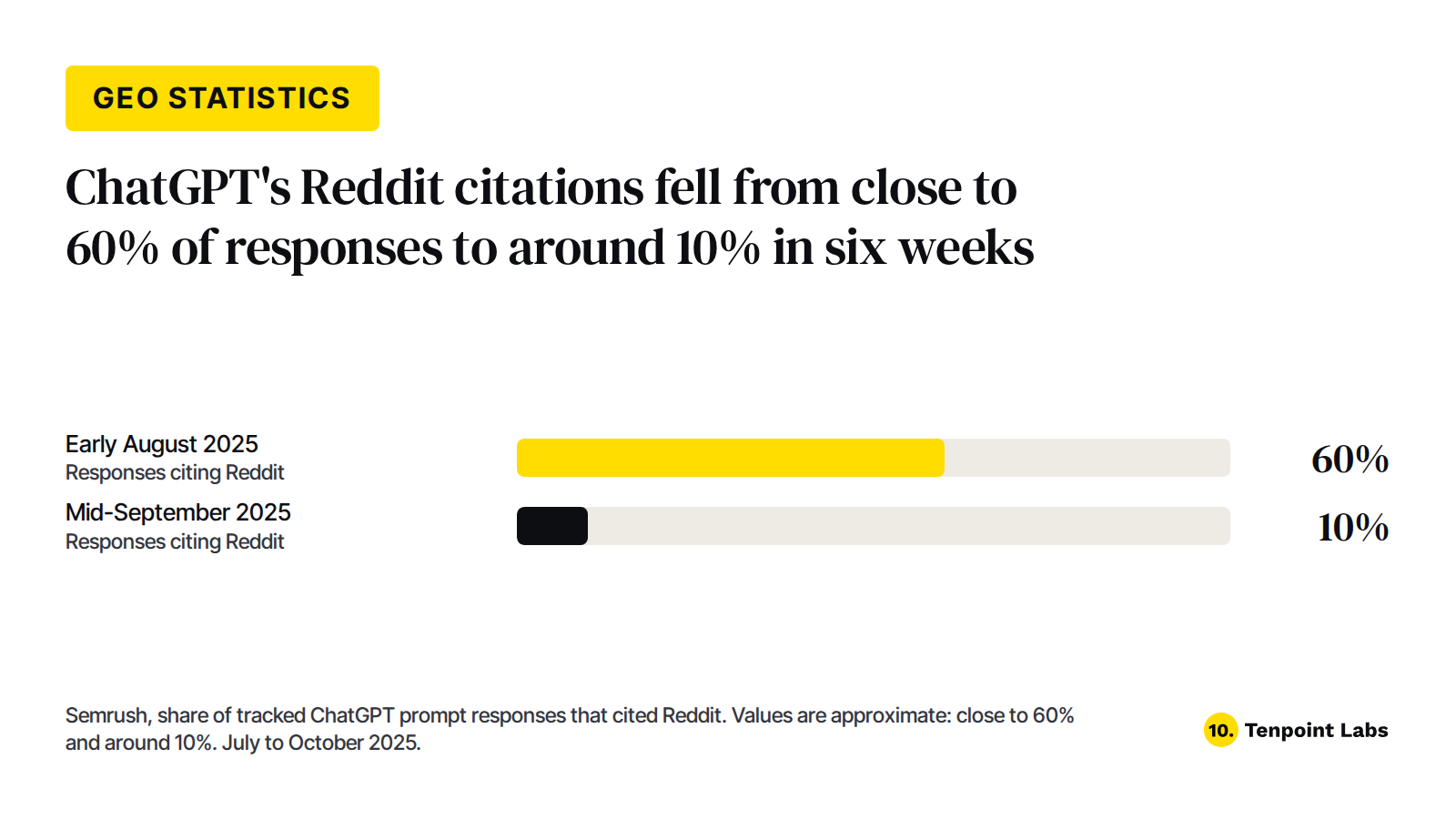
The catch: The Reddit swing is the best argument on this page for dating every citation figure. A source share can move by 50 points inside six weeks, so a single snapshot describes a week, not a pattern. Muck Rack counts citations while AirOps counts brand mentions, and AirOps doesn't state when its data was collected, so its 85% stays directional.
What to do with it: Each engine draws on a different source pool, so a citation strategy built for one assistant may do little for another. Track more than one engine, and quote any source share with its date.
Method notes: Ahrefs found only 7 of the top 50 most-mentioned websites shared across ChatGPT, Perplexity and Google AI Overviews (June 2025). In US Google AI Mode, Ahrefs found reddit.com held 18.1% and youtube.com 17.0% of citations among the 50 most-cited sites (November 2026). Wix AI Search Lab puts listicles at 21.9% of website citations, ahead of articles at 16.7%, without stating a collection date. All seven statistics behind this section are in the table at the end of the page.
Last reviewed: 23 Nov 2026
Our research on what AI answers cite adds our own data on this question.
Does ranking on Google predict citations?
Ranking on Google helps, but much less than most assume, and the overlap depends on the engine. Studies put the share of cited URLs that also rank in Google's top 10 anywhere from 8% to 67%.
| Statistic | Source | Data collected | Grade |
|---|---|---|---|
| About 67% of URLs cited in AI Overviews and about 35% in AI Mode overlap with Google's top 10 | Semrush | Not stated (Jul 2025) | Directional |
| 38% of pages cited in Google AI Overviews also rank in Google's top 10 for the same query | Ahrefs | Jan 2026 | Useful with caveats |
| 28.6% of URLs cited by Perplexity rank in Google's top 10, versus about 8% for ChatGPT, Gemini and Copilot | Ahrefs | Jul 2025 | Useful with caveats |
| Only 12% of URLs cited across ChatGPT, Gemini, Copilot and Perplexity rank in Google's top 10 for the same prompt | Ahrefs | Jul 2025 | Useful with caveats |
Semrush doesn't state when its data was collected, so its row stays directional. The spread is still useful. Google's own AI features overlap with its rankings far more than standalone assistants do, which fits Google's guidance that standard SEO practices remain relevant to AI Overviews and AI Mode.
A widely quoted figure, that 76% of AI Overview citations rank in the top 10, failed our checks as outdated. Ahrefs' own March 2026 study puts it at 38%.
How often do mentions come with citations?
Mentions and citations rarely arrive together. In BuzzStream's study of 12,000 AI responses, only 23.1% of brand mentions were backed by a citation to the brand's own site in the same answer.
| Statistic | Source | Data collected | Grade |
|---|---|---|---|
| 61.7% of AI citations are "ghost citations": the AI links the brand's site but never names the brand | Semrush | Not stated (Jun 2026) | Directional |
| ChatGPT cites a brand's site in 87% of its appearances but names it in only 20.7%; Gemini names brands in 83.7% but cites them in 21.4% | Semrush | Not stated (Jun 2026) | Directional |
| Only 23.1% of brand mentions in AI answers are backed by a citation to the brand's website | BuzzStream | Not stated (Jun 2026) | Directional |
The ChatGPT and Gemini split is the practical finding. The two engines behave almost as mirror images, so a team tracking only mentions will undercount ChatGPT, and a team tracking only citations will undercount Gemini. Our guide to AI citations versus mentions covers how to measure both.
Free AI visibility audit
Is AI naming you, or a competitor?
Our free audit runs your buyers' questions through ChatGPT, Perplexity and Google AI, shows who gets named in your category, and ranks what to fix first. Delivered in 3 days.
Get the free audit →What correlates with AI visibility?
Brand mentions across the web correlate with AI visibility more strongly than backlinks do. Ahrefs found a 0.664 correlation for branded web mentions in AI Overviews against 0.218 for backlinks, across 75,000 brands.
| Statistic | Source | Data collected | Grade |
|---|---|---|---|
| YouTube mentions show the strongest correlation with brand visibility in ChatGPT, AI Mode and AI Overviews, about 0.737 | Ahrefs | Not stated (Dec 2025) | Directional |
| Branded web mentions correlate with AI Overview visibility at 0.664, compared with 0.218 for backlinks | Ahrefs | Not stated (May 2025) | Directional |
| 26% of the 75,000 brands studied had zero mentions in Google AI Overviews | Ahrefs | Not stated (May 2025) | Directional |
| Brand search volume showed a 0.771 correlation with ChatGPT visibility, the strongest in Seer's technology dataset | Seer Interactive | Not stated (Mar 2026) | Directional |
| Paid search spend showed no relationship with ChatGPT visibility across four industries | Seer Interactive | Not stated (Mar 2026) | Directional |
| Sites with over 32,000 referring domains are 3.5 times more likely to be cited by ChatGPT than sites with up to 200 | SE Ranking | Not stated (Nov 2025) | Directional |
Correlation isn't cause, and in this table the direction may run backwards. Well-known brands earn more mentions, more searches and more links, and they also get named more by AI. That doesn't mean a mention campaign will make an unknown brand visible.
The finding to hold onto is the gap between mentions and backlinks. It points toward PR and earned coverage as the stronger lever for AI visibility, which matches the citation data in the earlier section.
Do freshness and structure matter?
Recently updated, clearly structured pages show up more often in AI citations. Seer found 75% of pages cited by ChatGPT, Gemini and Perplexity had been updated within the previous year.
| Statistic | Source | Data collected | Grade |
|---|---|---|---|
| 75% of cited pages had been updated within the previous year, and 88% within two years | Seer Interactive | Mar to Jun 2026 | Useful with caveats |
| URLs cited by AI assistants are on average 25.7% fresher than URLs in Google's organic results | Ahrefs | Not stated (Jul 2025) | Directional |
| 68.7% of pages cited by ChatGPT followed a sequential heading structure, against 23.9% of Google's top results | AirOps | Not stated (Jul 2025) | Directional |
| Nearly four in five pages cited by ChatGPT include at least one list section, against 28.6% of Google's top results | AirOps | Not stated (Jul 2025) | Directional |
Seer's figure is the strongest here, with 7,683 cited pages and a stated window. The structure findings describe pages that were cited, not pages that became cited after a rewrite.
Does GEO optimization actually work?
The best-known controlled evidence comes from the 2023 academic study that named generative engine optimization. Adding citations, quotations and statistics to content boosted its visibility in generative engine responses by over 40%.
| Statistic | Source | Data collected | Grade |
|---|---|---|---|
| Adding citations, quotations and statistics boosted visibility in generative engine responses by over 40% | Aggarwal et al. (Princeton, Georgia Tech, AI2, IIT Delhi) | 2023 | Useful with caveats |
| Citing sources raised visibility 115.1% for sites ranked fifth, while top-ranked sites fell 30.3% on average | Aggarwal et al. | 2023 | Useful with caveats |
| On Perplexity.ai, GEO methods improved source visibility by up to 37% | Aggarwal et al. | 2023 | Useful with caveats |
The study is old and ran mostly on a simulated engine, so read it as proof of concept rather than a current benchmark. The second row is the one people skip. The same changes that lifted lower-ranked pages reduced visibility for pages already at the top, so optimization redistributes attention as much as it adds to it.
How are prompts and searches changing?
ChatGPT prompts that trigger web search are getting longer, and most of them don't match any known keyword. Between early 2025 and early 2026, the average search-triggering prompt grew from 4.7 to 8.7 words.
| Statistic | Source | Data collected | Grade |
|---|---|---|---|
| The average ChatGPT prompt that triggered web search grew from 4.7 to 8.7 words | Semrush | Early 2025 vs early 2026 | Useful with caveats |
| Between 65% and 85% of ChatGPT prompts matched no keyword in Semrush's 27-billion-keyword database | Semrush | Oct 2024 to Feb 2026 | Useful with caveats |
| ChatGPT used web search on 34.5% of queries, down from 46% in late 2024 | Semrush | Feb 2026 | Useful with caveats |
| 95% of Gemini 3 fan-out queries had zero global search volume, with 10.7 fan-out queries per prompt | Seer Interactive | Nov 2025 | Directional |
These numbers explain why keyword tools undercount AI demand. If most prompts match no keyword and most fan-out queries have no measured volume, a keyword list can't stand in for a prompt panel. Our post on query fan-out shows what that looks like in practice.
How are marketing teams responding?
Most search professionals now monitor AI visibility, but few marketers track it consistently. Only 27% of marketers in Page One Power's survey said they consistently track whether their brand appears in AI answers.
| Statistic | Source | Data collected | Grade |
|---|---|---|---|
| Only 27% of marketers consistently track whether their brand appears in AI answers | Page One Power | Mar 2026 | Useful with caveats |
| 92% of search professionals monitor AI search visibility for at least some sites, up from 78% in 2025 | SEOFOMO | Aug 2026 | Directional |
| 69% of search professionals say clients or decision makers have budget for AI search optimization, up from 38% | SEOFOMO | Aug 2026 | Directional |
| 35% of search professionals can't say what share of revenue AI search brings, and 46% put it at 0% to 5% | SEOFOMO | Aug 2026 | Directional |
| Share of AI voice versus competitors is the share-of-voice metric B2B tech CMOs most often report to CEOs, cited by 33% | 3Thinkrs | Aug 2025 | Directional |
The gap between the first two rows is about who was asked. SEOFOMO surveyed 171 search specialists, who track this channel for a living, while Page One Power surveyed 600 marketers in general. Both can be true at once.
The revenue row is the one to bring to a budget meeting. Over a third of practitioners can't attribute AI search revenue at all, so a dashboard that stops at mentions leaves the hardest question unanswered. The CMO Survey's figure on how many companies already use GEO sits on our stats hub.
Which GEO statistics failed our checks?
Several of the most repeated GEO statistics failed our checks, usually because the number was narrower than the way it's quoted or couldn't be traced at all. Here are eight that still circulate.
| Claim as it circulates | Credited to | Why it failed |
|---|---|---|
| Wikipedia accounts for 47.9% of ChatGPT's citations | Profound | Narrower than quoted: a share of the top 10 sources only, about 7.8% of all citations |
| Reddit accounts for 46.7% of Perplexity's citations | Profound | It's a share of the top 10 cited domains; about 6.6% of all Perplexity citations |
| Reddit accounts for 40.1% of citations across LLMs | Semrush | Not found on the cited page |
| 76% of pages cited in AI Overviews rank in Google's top 10 | Ahrefs | Outdated; Ahrefs' 2026 figure is 38% |
| AI referral traffic grew 527% year over year in 2025 | Previsible | Original source not found |
| Only 22% of marketers currently track AI visibility | Averi (attributed) | Original source not found |
| Comparative listicles account for 32.5% of all AI citations | The Digital Bloom | Original source not found |
| Pages not updated quarterly are three times more likely to lose AI citations | AirOps | No disclosed method behind the claim |
The failures mostly happened downstream, where a top-10 share became "all citations" and a sourced finding lost its source. Every failed claim is on the dataset's failed claims tab.
Every statistic in this section
The full reference table for the sources section, in one place to copy. More sections join it as the page is redesigned.
| Statistic | Source | Data collected | Grade | Section |
|---|---|---|---|---|
| Earned and third-party sources account for more than 84% of citations in ChatGPT, Claude, Gemini and Perplexity answers | Muck Rack | Sep 2026 | Useful with caveats | Sources |
| Journalism's share of AI citations fell from 27% in May to 22% in September 2026 | Muck Rack | May and Sep 2026 | Useful with caveats | Sources |
| 85% of brand mentions in AI answers to commercial queries come from third-party pages | AirOps | Not stated (late 2025 models) | Directional | Sources |
| ChatGPT cited Reddit in close to 60% of responses in early August 2025, falling to around 10% by mid-September | Semrush | Jul to Oct 2025 | Useful with caveats | Sources |
| In US Google AI Mode, reddit.com held 18.1% and youtube.com 17.0% of citations among the 50 most-cited sites | Ahrefs | Nov 2026 | Useful with caveats | Sources |
| Only 7 of the top 50 most-mentioned websites are shared across ChatGPT, Perplexity and Google AI Overviews | Ahrefs | Jun 2025 | Useful with caveats | Sources |
| Listicles account for 21.9% of website citations in AI answers, ahead of articles at 16.7% | Wix AI Search Lab | Not stated (Mar 2026) | Directional | Sources |
FAQs
How much website traffic comes from AI search?
About 1.08% of website traffic came from AI referrals across 13,770 domains in Conductor's May to September 2025 benchmark. IT websites had the highest share at 2.8%. The share is growing, so check the collection date before quoting any figure.
Do AI assistants cite the same pages that rank on Google?
Partly, and it depends on the engine. Studies put the overlap with Google's top 10 at about 67% for AI Overviews and between 8% and 29% for standalone assistants such as ChatGPT and Perplexity. Collection dates vary from mid-2025 to early 2026, so treat the exact figures as dated snapshots.
What drives brand visibility in AI answers?
Brand mentions across the web correlate with AI visibility more strongly than backlinks, according to Ahrefs' study of 75,000 brands. YouTube mentions showed the strongest correlation. These are correlations, so they show where visible brands differ, not what will make a brand visible.
Does generative engine optimization work?
The 2023 academic study that named GEO found that adding citations, quotations and statistics boosted content visibility in generative engine responses by over 40%. It ran mostly on a simulated engine, and the same changes lowered visibility for top-ranked pages, so treat it as proof of concept.
Before you quote a GEO statistic
Ask three questions: when was it collected, which engine did it measure, and what was the denominator? The Reddit figure from the top of this page passes the first test only if you quote both dates. Tenpoint Labs is one of the agencies that runs AEO and GEO programs with measurement built on graded evidence, and our GEO and AEO services page explains how that works. The full set of 89 figures is in the verified stats dataset.
AEO and GEO programs
Want GEO results you can actually measure?
We run AEO and GEO programs for B2B teams and report AI answers, traffic and conversions in one dashboard, so you can see what moved and when.
See our GEO services →