Which Competitor Citations Should You Replace First in AI Answers?
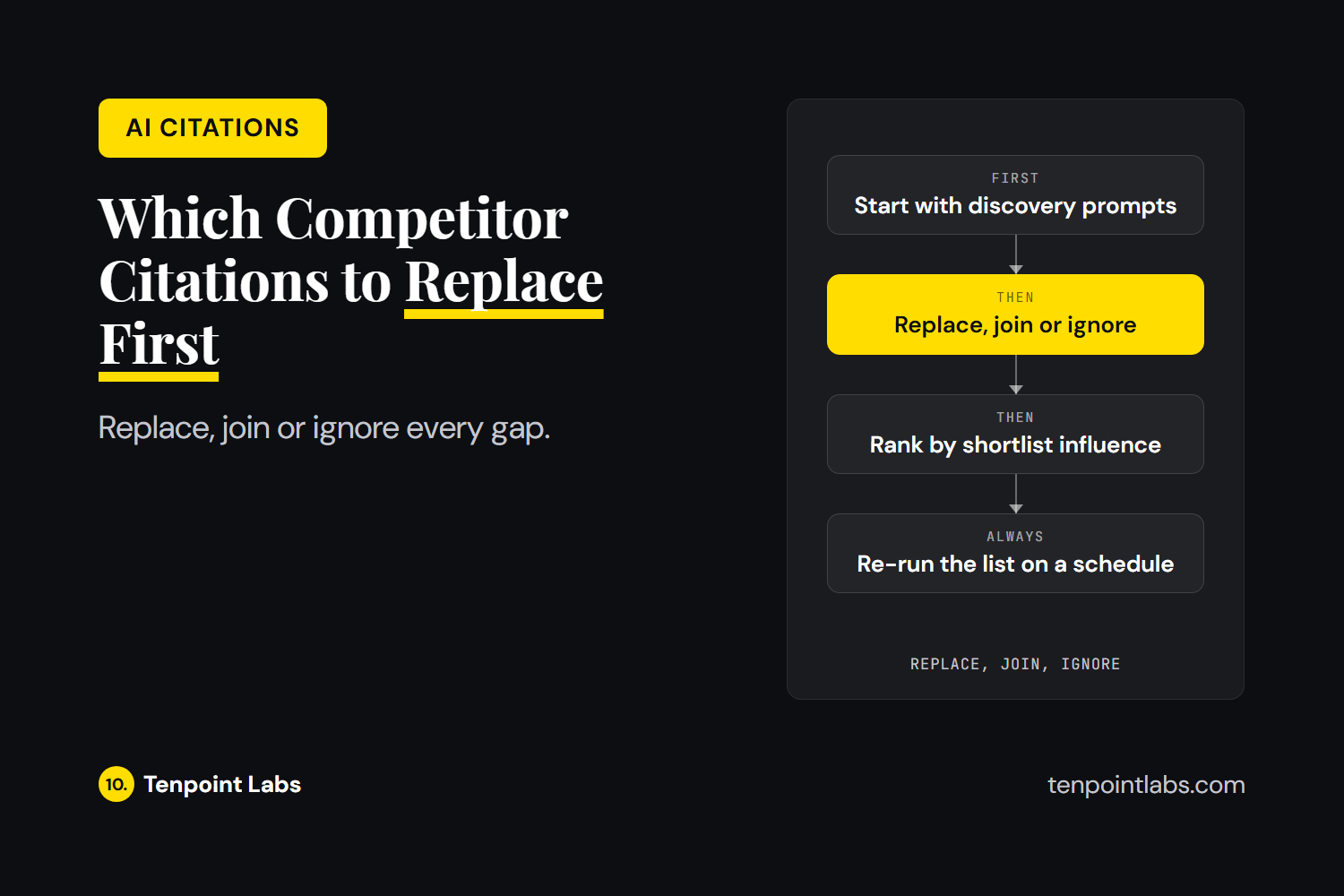
A citation gap list shows where AI cites a competitor and not you, but it doesn't say which gap to fix first. A citation is a source an AI answer links to, and a list with no order tends to stall. Tenpoint Labs finds where AI names your competitors instead of you and shows what to fix first, in a free audit delivered in 3 days.
Does AI name a competitor on the prompts a buyer types before building a shortlist? Which of those citations can you realistically take back? Which should you leave alone?
Let's look at how to rank the gaps, so your first fixes are the ones most likely to shape a buyer's shortlist.
Key takeaways
- Start with discovery prompts, where a buyer describes a problem and names no vendor.
- Sort every competitor citation into replace, join or ignore before spending effort.
- Rank each gap on shortlist influence, the move it needs, effort and time to register.
- Re-run the list on a schedule, because citation patterns drift.
What is competitor citation prioritization?
Competitor citation prioritization is ranking the sources that AI answers cite for your competitors, so the most valuable gaps get fixed first.
A gap list tells you where a competitor is cited and you aren't. Without an order, teams can end up fixing the easiest gap or the loudest one, and the prompts that shape a shortlist wait. Our guide to running a citation gap analysis covers how to find the gaps, and once you have them, the next question is which to fix first.
Which competitor citations matter most?
The citations that matter most sit on discovery prompts, the questions where a buyer can first meet a vendor.
Branded prompts contain your name, so you're often present on them, though "alternatives" and review-style branded prompts can still cite competitors. Discovery prompts are where a buyer can first meet a vendor, so a competitor citation there can shape the shortlist. Our explainer on citations versus mentions covers how the two differ.
A practical way to start is to write the questions a stranger with your problem would type, in the words your customers and sales calls use. Run them on a fixed schedule across the AI engines your buyers use, and keep discovery, comparison and branded prompts in separate groups so the gaps don't blur together. The Firemark tracker can run the prompts for you and show which sites AI cites when a competitor is named instead of you, and its interface is super easy to read and unpack, so it's simple for every team member.
The table below ranks three prompt types by what a competitor citation on each costs you.
How do you order the fix list?
Score each competitor citation on shortlist influence, the move it needs, effort and time to register, then work the list from the top.
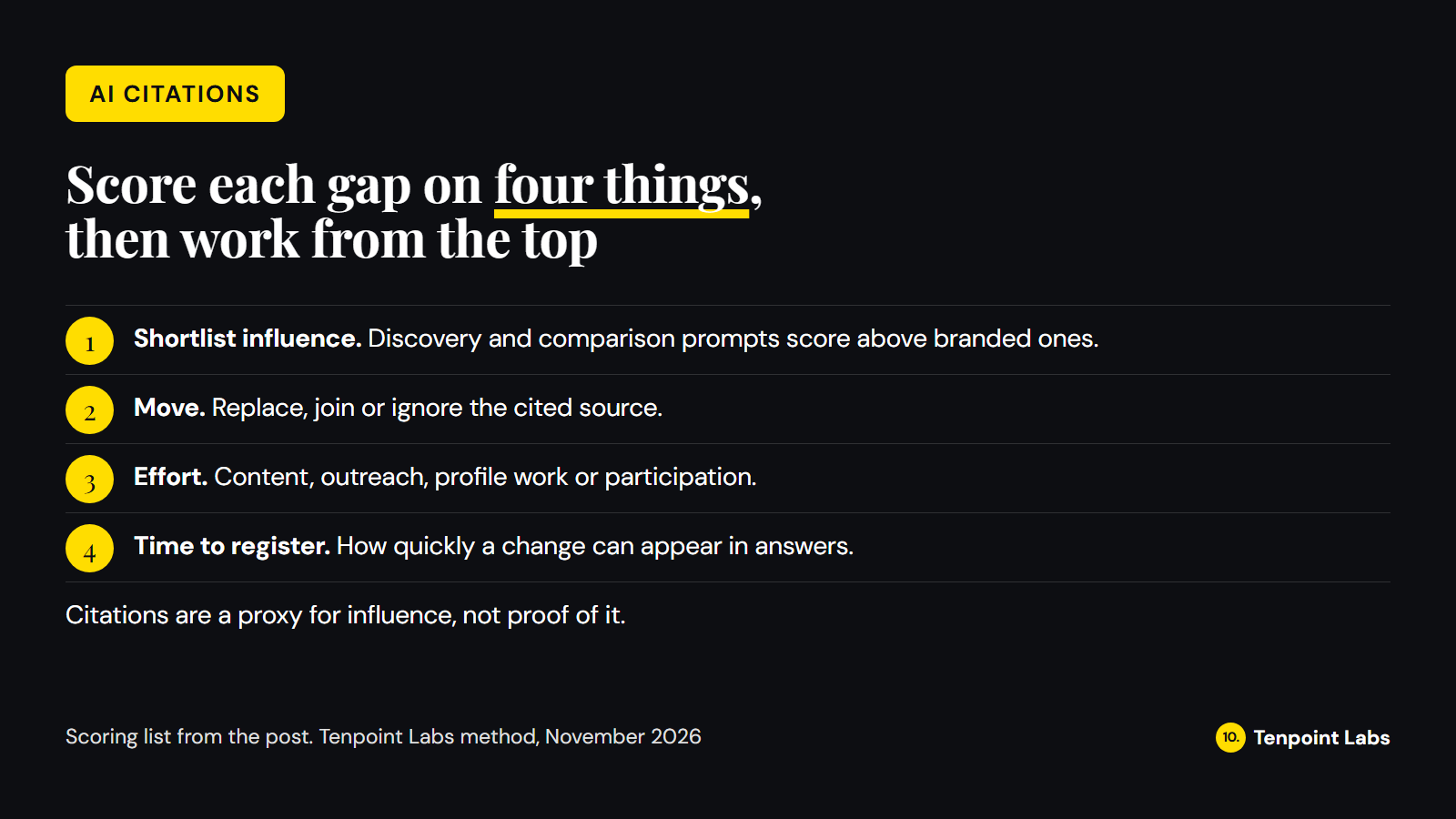
- Shortlist influence. Rate how much the prompt influences who reaches the shortlist: discovery and comparison prompts score above branded ones.
- Move. Decide whether to replace, join or ignore the cited source (more on that below).
- Effort. Estimate the work: content, outreach, profile work or participation.
- Time to register. Note how quickly a change can appear in answers. In the experiment described below, citations took from one to 18 days after a placement went live.
A scoring row looks like this. Every bracket is a field to fill from your own prompt tests, and none of them holds a figure.
In a hypothetical example, a discovery prompt returns a competitor's own comparison page, which means high shortlist influence, a replace move and a content effort. A branded prompt returns a review profile you haven't completed, which means lower influence, a join move and light effort, so the first goes to the top of the list.
Citation patterns change between runs and over time, so re-run the list on a regular schedule and read it as a snapshot. Citations are also a proxy for influence, not proof of it, so check clicks and pipeline as the fixes land.
Can you replace every citation?
You can't replace every citation, because some sit on pages you can only get onto, not outrank.
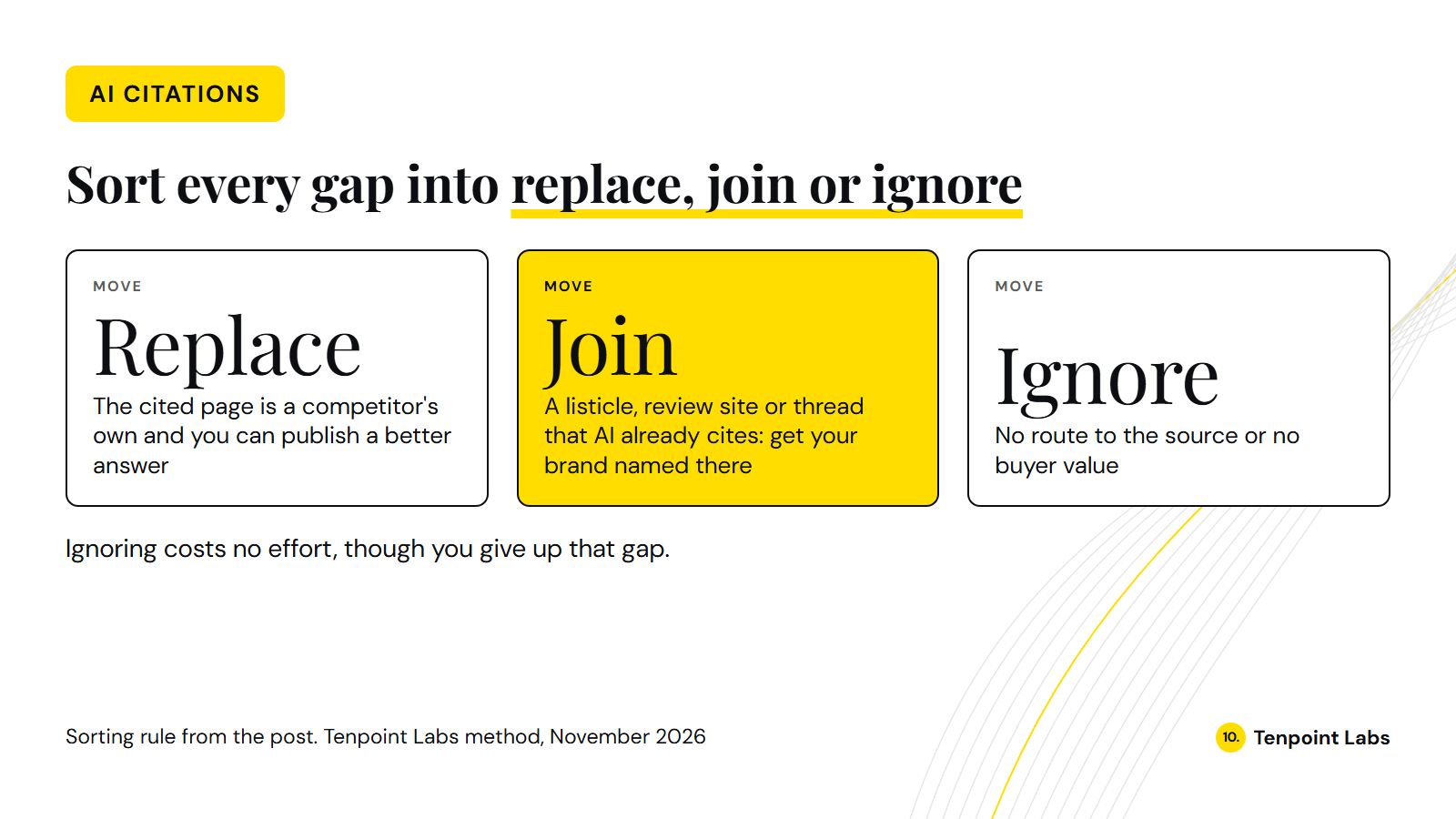
Here is how we sort them:
- Replace when the cited page is a competitor's own page and you can publish a better answer to the same prompt.
- Join when the cited page is a third-party listicle, review site or thread that AI already cites, and the move is to get your brand named there.
- Ignore when the source has no route to you or no buyer value. Ignoring costs no effort, though you give up that gap.
The table below matches each type of cited source to a move.
Does the evidence support joining?
One practitioner experiment supports the join move, though it didn't test replacing a competitor's page. Published by Search Engine Land in September 2026, the experiment found that third-party listicles generated 85.8 percent of 437 source mentions and the brand's own listicle generated 14.0 percent. Among the sources that were cited, the brand's own page took longest, at 18 days.
The author runs a digital marketing agency that sells link building and digital PR, and the brand tested was itself a link-building agency, so the result favors earned placements. The test covered one brand, 15 keywords and 30 days, so read it as one signal, not a rule.
If the citation you're replacing appears in Google's AI Overviews or AI Mode, confirm your page meets Google's Search technical requirements. Google's AI features guidance says a page must be indexed and eligible to show with a snippet to appear as a supporting link, and it lists no extra technical requirements. Google adds that specific optimization isn't required, and that existing SEO fundamentals remain worthwhile.
A low-authority domain can often get onto a page it can't outrank. That's our working hypothesis at Tenpoint Labs, and we haven't measured it, so test it on your own prompts before betting a quarter on it.
What does the free audit deliver?
The Free AI Visibility Audit shows where AI names you, where it names a competitor instead, and what to fix first.
It shows where you rank, where AI platforms surface or ignore you, where competitors get cited instead of you, and what content to build next. It arrives as a short report in 3 days, and it asks for a work email and your website domain.
Once you have the report, sort what it finds with the replace, join or ignore test above, and start with the discovery prompts.
Whichever provider you choose, four questions show whether a citation report can guide action:
- Which prompts did you test, and how were they chosen?
- Which AI engines did you check?
- Does the report separate discovery prompts from branded ones?
- Does it say which gaps you can't close, or only list them?
FAQs
How do you find which competitors AI cites?
Run a fixed set of buyer prompts across the AI engines your buyers use, record every cited source, and note where a competitor appears and you don't. Repeat the run on a schedule, because AI answers vary between runs.
How do you turn a citation gap into a content brief?
Take the gap's prompt, name the page the AI cited, and brief a page that answers the same question more directly, with your own evidence. Open with a clear answer, then link it from the pages that already rank for related questions.
Can a tool estimate the cost of closing a citation gap?
A tool can count gaps, but the cost depends on the move: replacing is a content cost, joining is an outreach or placement cost, and ignoring costs no effort. Estimate each gap by its move rather than by a tool's total.
How do you get ChatGPT to recommend your business?
Getting named on the sources it cites for your buyers' prompts is one route, alongside making your own pages answer those questions directly. Answers vary between runs, and nothing guarantees a recommendation.
How often should you re-run the list?
Re-run it on a regular schedule, because citation patterns drift between runs and over time. Quarterly is a sensible minimum, and monthly suits teams that are actively placing content.
Want to see your own gaps?
Get your free audit and we'll show you where AI names a competitor instead of you, and what to fix first. Prefer to talk it through? Schedule a Founder Call.
The next time AI names a competitor on a prompt you should own, you'll know whether to replace, join or ignore.