What Does a B2B Content Audit Service Prune, Merge and Refresh?
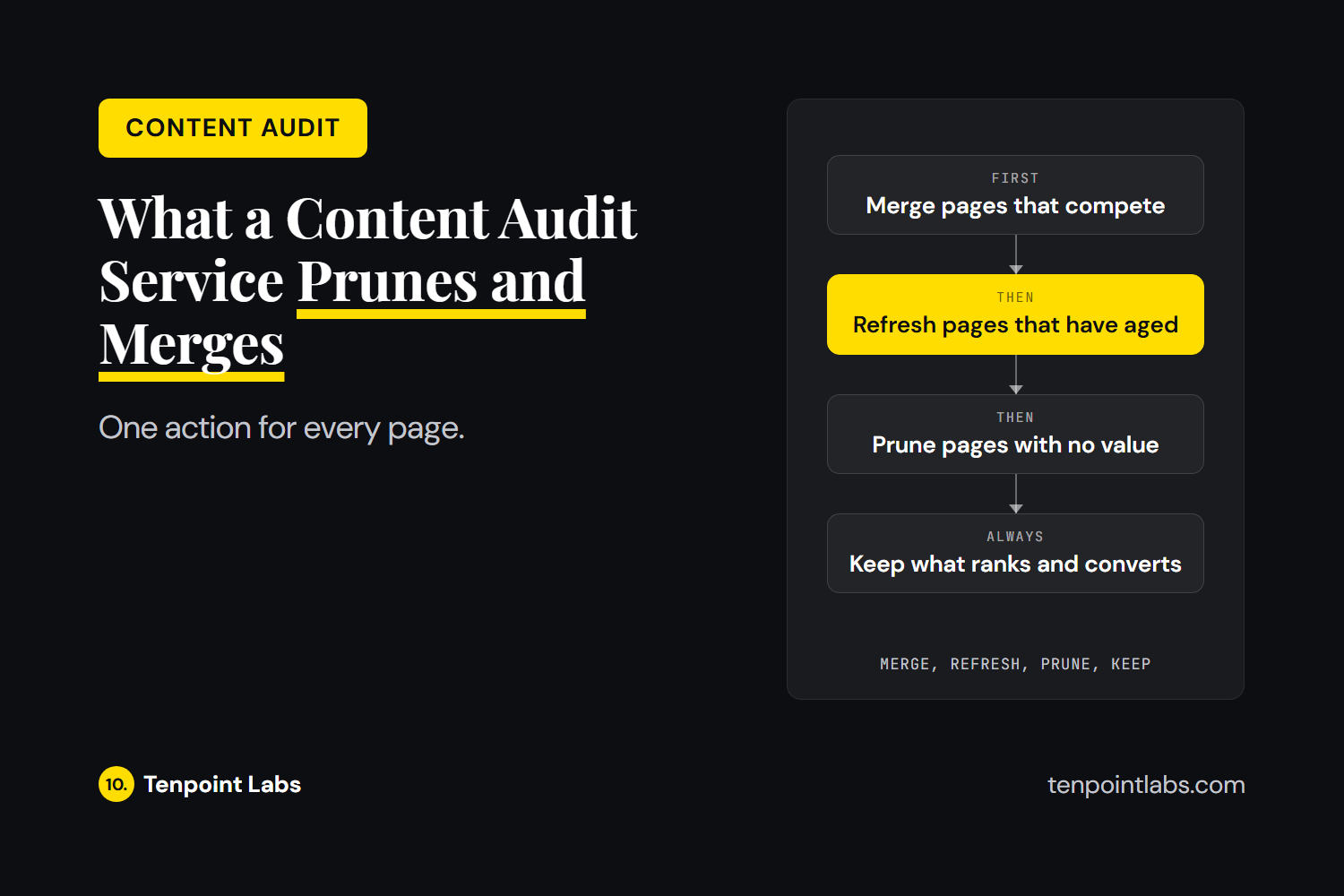
A B2B content audit gives each page in scope one action, so the pages that earn their place stay and the rest get fixed or removed. Tenpoint Labs audits your B2B content and sorts the pages in scope into keep, refresh, merge or prune, with the evidence behind each call.
Which of your pages cost you more than they earn? Which deserve a refresh before you publish anything new? Which should go?
Let's look at how each call gets made, and what to expect from someone who makes them for you.
Key takeaways
- An audit ends in one action per page: keep, refresh, merge or prune.
- Prune only pages with no buyer value and nothing to update, and redirect them where a relevant target exists.
- Merge pages that answer the same question, and redirect the weaker URL to the survivor.
- Refresh pages that already answer a buyer question before you write new ones.
What does a B2B content audit cover?
A content audit lists the pages in scope, scores each on performance, search intent and, in our method, AI citation readiness, and assigns one action.
Nielsen Norman Group's 2020 content audit guide says an audit evaluates the quality of the content in your inventory and uncovers what needs updating or removal. It recommends recording a keep, update or remove status for each piece and assigning an owner to every update. Our method splits update and remove into refresh, merge and prune.
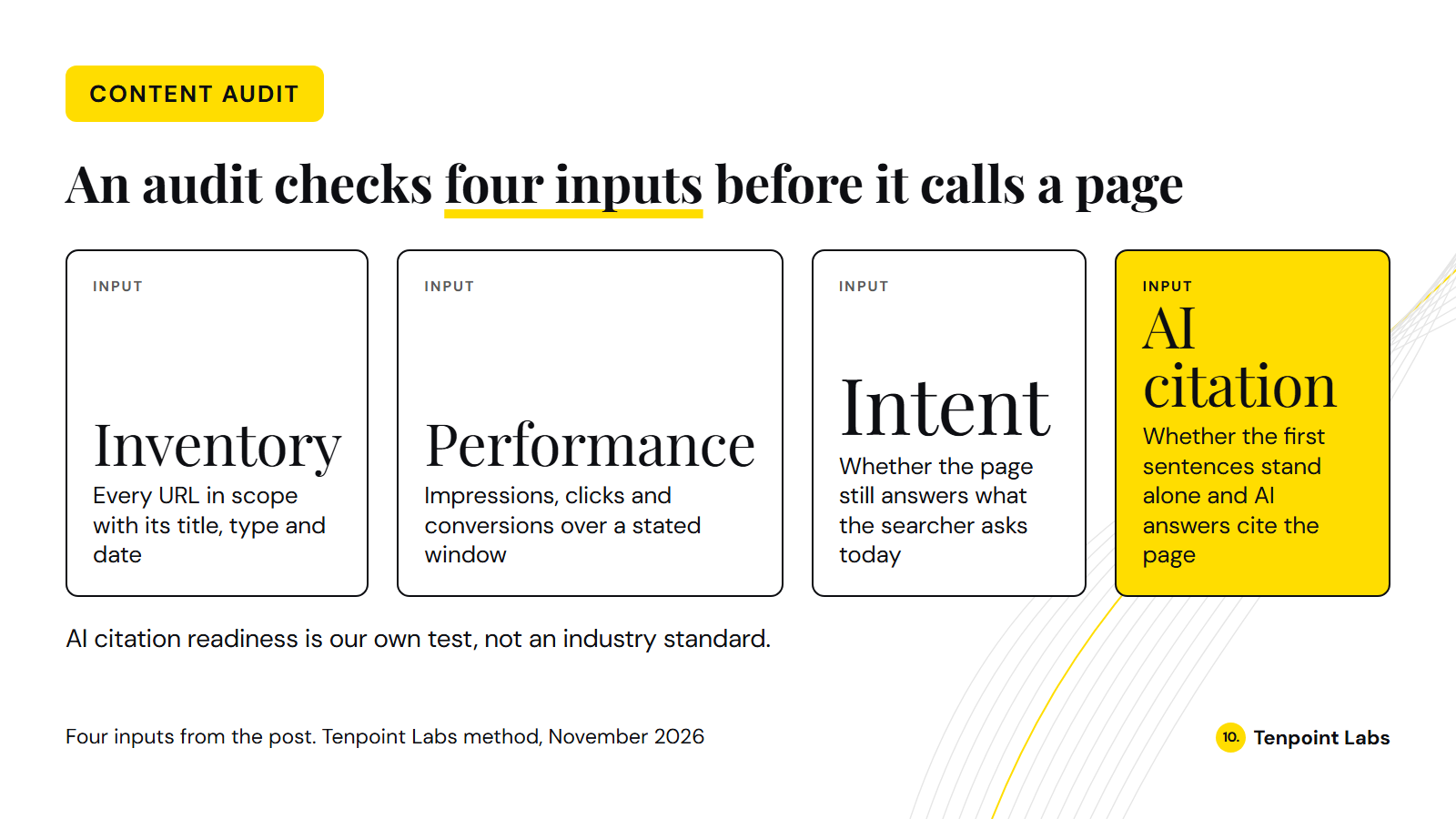
We look at four inputs:
- Inventory. A list of every URL in scope with its title, type and date, so nothing gets audited from memory.
- Performance. Impressions, clicks and conversions per page over a stated window, so each call rests on evidence.
- Intent match. Whether the page still answers the question the searcher asks today.
- AI citation readiness. Whether the first sentences stand alone and whether AI answers cite the page.
Scope is a choice: a first audit can cover one section of the site, such as the blog, and extend to the rest once the method has proved itself. For the last input we read the first sentence under each heading and ask whether it still makes sense alone, because AI answers can lift a single sentence. That test is our own, not an industry standard.
Our SEO audit service lists outdated pages and pages that compete for the same search among its checks.
When should you prune a page?
Prune a page when it has no buyer value, no valuable links and nothing a refresh could fix.
Buyer value depends on your business, so define it per page type before the audit, for example a page that supports a sales conversation or answers a question buyers ask.
Pruning means removing the page, or redirecting it to the closest relevant page if one exists. When a URL changes, Google recommends a permanent server-side redirect whenever possible. If no page is a close match, a removed URL can return a 404 or 410 instead.
Run three checks before you cut:
- Does any page link to it, from inside or outside the site?
- Does it bring visits, or help demos along the way?
- Does it sit on a path buyers follow, such as an internal link route?
Duplicate posts, thin announcements and pages about retired products are the usual candidates to check first, but each still has to pass the same test. A duplicate with its own links is a merge, not a prune.
"Accurate but forgettable" is our own extra test, and a subjective one. Use it to decide between refresh and merge, and prune only if the page also fails the no-value and no-links test. Our guide to content governance covers how content is maintained, updated and removed.
When should you merge pages?
Merge pages when two or more of them answer the same buyer question, so one stronger page replaces the pair.
Start with pages that compete for the same search. Keep the stronger URL, fold in the strongest sections of the weaker page, and redirect the weaker URL to the survivor.
For duplicate or closely similar pages, Google says redirects are a strong signal that the target should become canonical, and that consolidating similar pages lets it combine signals such as links into one URL. It also says none of these methods are required. Pages that overlap in intent but differ in content are a judgment call, not a duplicate-content problem.
In a hypothetical example, a 2022 post and a 2024 post both answer "how do we score B2B leads?" Each draws a trickle of impressions and neither ranks well. You keep the 2024 URL, fold in the 2022 post's strongest examples, and redirect the 2022 URL to it.
Merge only where the intent truly overlaps. Our post on comprehensive guides explains why splitting every subtopic into its own page backfires.
Should you refresh or write new?
Refresh first when a page already answers a buyer question, because it already has links, indexing history and some visits that a new page lacks.

If the page's angle no longer fits what buyers search for today, write a new one instead. When a refresh is the right call, it changes four things:
- Facts and names. Update the figures, screenshots and product names that have aged.
- The opening. Rewrite the first sentence under each heading as a direct answer that stands alone.
- Gaps. Add the table or FAQ where buyers ask their follow-up question.
- Links. Point internal links at the pages that matter now, and fix any that broke.
Use the first row that fits, top to bottom: merge before refresh, refresh before prune, and keep what ranks and converts. The table below matches each page situation to the signal that identifies it and the move that follows.
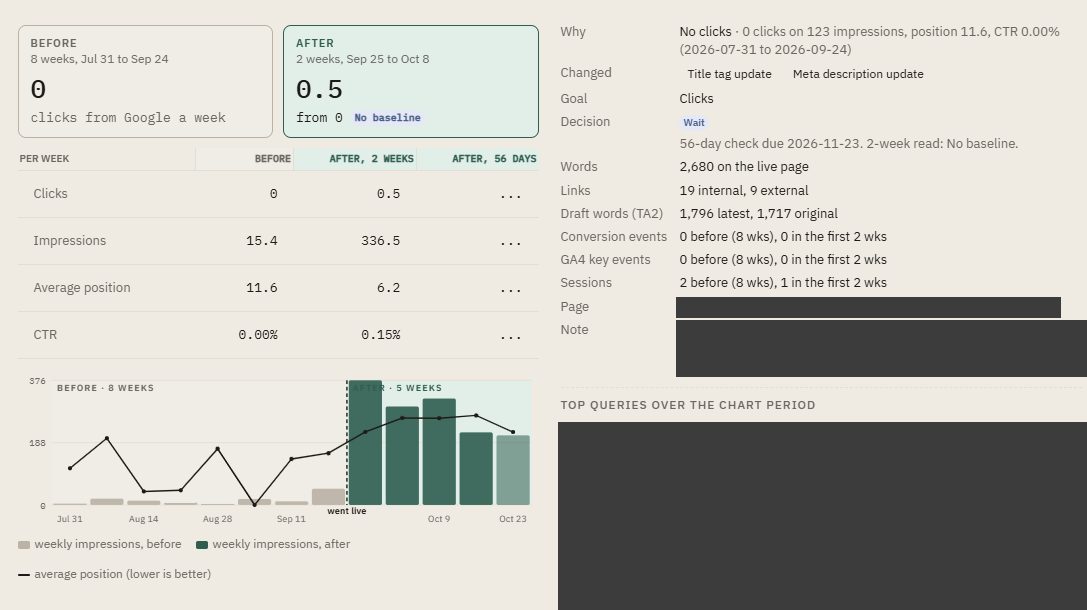
Here is one of our refresh reads, with the client, page and queries redacted. Comparing eight weeks before with two weeks after a new title tag and meta description, impressions went from 15.4 to 336.5 a week, average position from 11.6 to 6.2 and clicks from 0 to 0.5. That is too early to call, so the tracker marks the page Wait until its 56-day check.
What should an audit service hand you?
A content audit service should hand you a ranked page list with one action, one reason and one owner for every page.
The reason matters as much as the action. A list that says "refresh" without saying why leaves your team guessing, and a list without owners leaves the work undone. One row of the list looks like this:
Whichever provider you choose, four questions show whether the audit can guide action:
- How do you decide between prune and refresh for a page?
- What evidence do you show for each call?
- Do you check AI citation readiness as well as search performance?
- Who does the work after the audit?
FAQs
What is a B2B content audit?
A B2B content audit is a review of your pages that ends in one action per page, such as keep, update or remove. In our method the actions are keep, refresh, merge or prune, scored on performance, search intent and AI citation readiness.
How often should B2B companies audit content?
Review a core set of pages on a regular cycle, such as quarterly, and run a fuller audit after a site migration, a product change or a drop in organic traffic. Re-check refreshed pages once the changes have had time to register.
Should you delete old blog posts?
Delete a blog post only when it has no buyer value, no valuable links and nothing to refresh, and redirect it where a relevant target exists. A deleted URL with no replacement returns an error page, which is acceptable when no close match exists.
How do you find stale pages that lose AI citations?
Run your buyer prompts on the AI engines your buyers use several times, record which pages are cited, and compare with earlier runs. Because AI answers vary between runs, read a page that stops appearing across repeated runs as a signal, not proof.
How long does a content audit take?
Time depends on how many pages you have and how many inputs you check, so ask any provider for a timeline before you sign. A narrower scope, such as one section of the site, finishes sooner than a full inventory.
Want us to audit your content?
Get Your Free SEO Audit and we'll check technical health, content and search intent, competitors and AI visibility, with ranked fixes, delivered in 3 days. Prefer to talk it through? Schedule a Founder Call.
The next time someone asks which pages still earn their place, you'll have an action for every one.