Is the AI Search Conversion Rate Really 4.4x Higher?
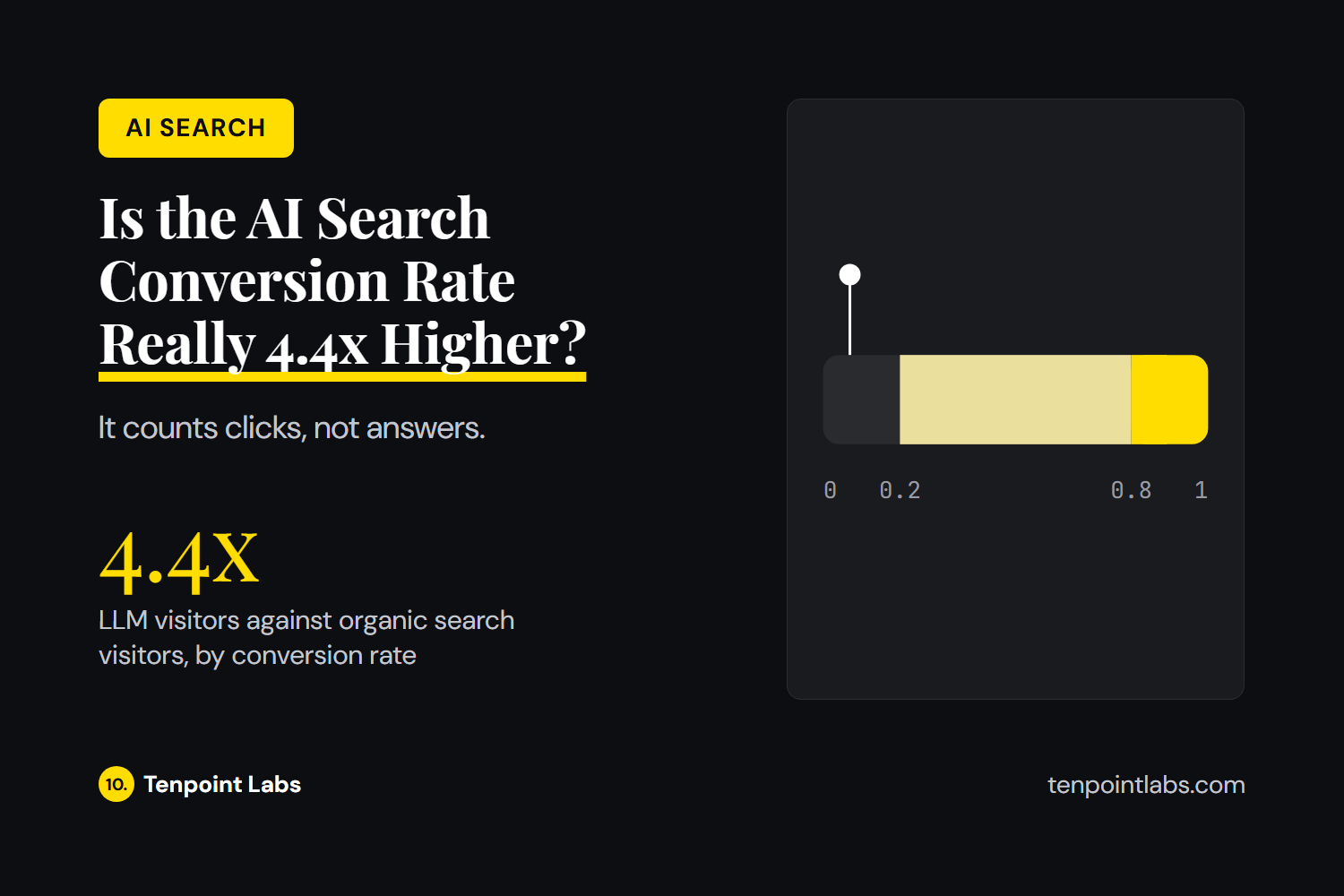
Do AI answers convert better than Google rankings? The study behind the 4.4x figure can't say. It only counted people who clicked through from an AI tool, so it can't tell you the AI search conversion rate for answers that never got a click.
The 4.4x figure comes from a 2025 Semrush study. It found that a visitor who arrives from an AI tool such as ChatGPT is worth 4.4 times a visitor from regular organic search, judged by conversion rate. People often repeat it as if it described AI answers.
So who did the number actually count? How many buyers read an AI answer and never click? And what can you track on your own site by next week?
If a slide in your deck says 4.4x, the footnote matters more than the headline.
Key takeaways:
- The 4.4x figure compares people who clicked from an AI tool with regular organic search visitors, by conversion rate (Semrush, 2025)
- Studies disagree: five found AI visitors converting about 1.6x to 23x better than comparison traffic, and a peer-reviewed study of 973 e-commerce sites found ChatGPT referrals converting worse than organic search
- Buyers say they often check Google or visit a brand's site after an AI mention, so your reports may miss some of the AI's influence
- Track your own AI conversion rate, with the session counts behind it, instead of borrowing someone else's multiple
What Did the 4.4x Stat Measure?
The 4.4x stat measures how well visitors from AI tools convert, compared with visitors from regular organic search. Semrush's AI search study says the average visitor tracked to a non-Google AI source such as ChatGPT is 4.4 times as valuable as the average organic visit, based on conversion rate. It first appeared in June 2025, and the live page now shows July 2025.

Visitors from Google's own AI features aren't in the AI group. The study as a whole is based on more than 500 digital marketing and SEO topics, which is Semrush's own industry. For the 4.4x itself, it doesn't publish a sample size, a definition of conversion or the underlying rates, so nobody can check the number against a base.
The version people repeat, "AI answers convert 4.4x better than Google results," swaps visitors for answers. The study doesn't support that claim. It's an easy mix-up, because GEO, SEO and AEO each measure something different, as our guide to GEO, SEO and AEO explains.
Do AI Answers Convert Better Than Google?
The 4.4x stat doesn't show that AI answers convert better than Google, because it only counts people who clicked. Behind any AI answer are three groups: readers who click through, readers who never click, and readers who arrive later through another channel. The 4.4x describes the first group only.
Semrush's own notes say its traffic and value projections, not the 4.4x itself, also modeled the other groups, because that traffic gets filed as direct or unknown. The notes name people who click an AI link without referrer data, people who visit a site after reading an AI response, and people who come back later through a channel such as branded search. So the authors treat tracked clicks as an incomplete picture when they project value.
The clickers are also a small group. Semrush's April 2026 analysis of more than 50,000 sites found AI referrals made up 0.14% of visits in its dataset, even after 66% growth in 2025. A high rate on a tiny base is still a small number.
What Is the AI Search Conversion Rate?
The AI search conversion rate has no single answer: six studies disagree, from AI visitors converting about 23x better than comparison traffic to ChatGPT visitors converting worse than organic search. Each one measured different people on a different outcome, so the table keeps the sample and the comparison beside each result.
The multiples are our own arithmetic from each study's rates, unless the study states one. The measured events differ too: signups, subscriptions, purchases and GA4 key events aren't the same event.
The sixth study points the other way. In a peer-reviewed paper, Kaiser and Schulze found that ChatGPT referrals converted below organic search, and the authors say AI referrals don't yet work as a broad conversion channel. It covers ChatGPT and e-commerce only, and an earlier period than Adobe's July 2026 data.
Adobe's numbers moved over time. A year before Adobe's latest report, non-AI traffic was still out-converting AI visitors in US retail. In travel, Adobe puts the gap at about 1% in July 2026, so travel is roughly level.
Ahrefs adds a wrinkle. Its study of 81,947 sites in May and June 2025 found AI visitors bounced more often than search visitors, 67.8% against 63.7%. That's a different dataset from the 23x on its own site, and a bounce can also mean the visitor got what they needed.
A 23x ratio built on 0.5% of traffic makes a great story and a small spreadsheet.
What Does Your Dashboard Miss?
Your dashboard may miss buyers who read an AI answer and then arrive some other way. Semrush's December 2025 survey of 1,030 US shoppers who had tried AI tools found that when an AI tool mentioned a brand, 40% searched Google for more information and 28% went straight to the brand's website.

The same survey found 94% click links in AI answers at least sometimes, so clicks are real, and 86% verify AI brand recommendations at least sometimes, most often on Google at 68%. These are self-reported habits, not tracked sessions, so treat them as direction and never as a multiplier. A visit to a brand's site can also carry a referrer, so the survey can't tell you how many visits get filed under the wrong channel, or how many buyers converted.
In your reports, a visit that followed an AI answer can read as organic or direct, so Google may get the credit. AI may have played a part, and the dashboard can't say how much. We cover the same gap in B2B content for the zero-click era.
What Can You Measure Instead?
Instead of borrowing the 4.4x, you can measure three separate things on your own: how AI referrals convert, whether branded search is moving, and how often AI answers name you against competitors. Each one answers a different question.
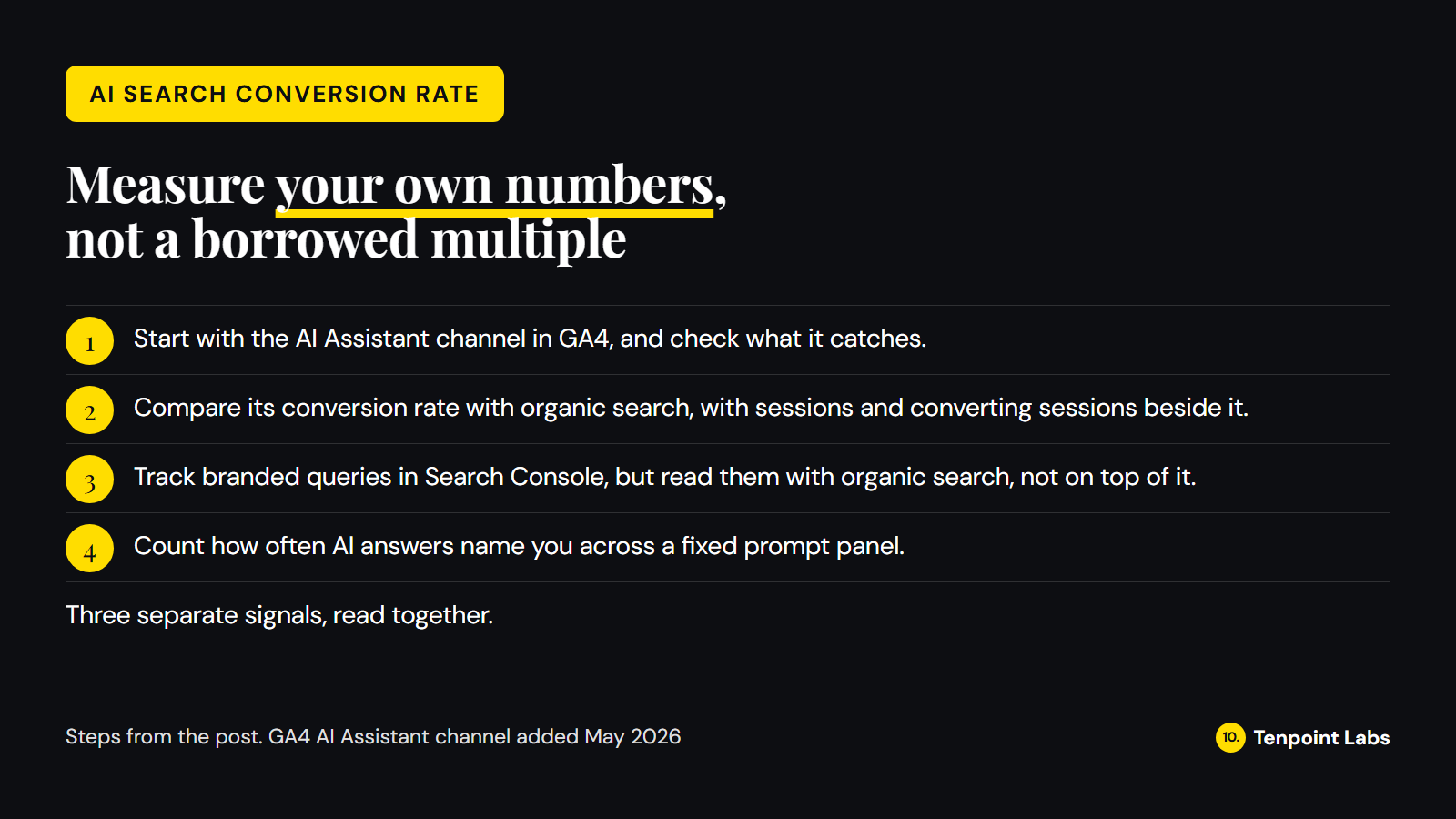
- AI referral conversion rate: start with the AI Assistant channel in your GA4 default channel group, added in May 2026, and check what it catches. Compare its conversion rate with organic search, and remember that Ahrefs notes search traffic in analytics can include clicks from Google's AI Overviews and AI Mode
- Branded search trend: track branded queries in Search Console month by month. Branded search is part of organic search, so read it beside your AI numbers and never add it on top. A lift after new AI coverage may be a signal, but PR, ads and seasonality can cause one too
- AI share of voice: count how often AI answers name you against tracked competitors across a fixed set of prompts. It measures your visibility within that set of prompts, not your total AI audience, and you can use the free share of voice method
Read these as three separate signals, not one pie chart. Next to every rate, report the sessions, the converting sessions, what counts as a conversion and the date range. A high rate on a small base is a lead to follow up, and your board will ask about the base within a minute.
What Should You Tell Your Board?
Tell your board that studies disagree: several found AI-referred visitors converting better than comparison traffic, by about 1.6x to 23x, while one found ChatGPT referrals converting worse than organic search, so you'll report your own rate. Boards forgive a range. They don't forgive a number that falls apart at the first follow-up question.
Then say what you can't measure: answers that influence buyers who arrive through Google or direct. Name the three metrics you'll track each quarter. Keep mentions and citations separate, because they support different claims, as we explain in mentions versus citations.
How We Do This at Tenpoint Labs
The playbook
We report AI search in three layers: how AI referrals convert on the client's site, how branded search moves, and how often AI answers name the brand across a fixed set of prompts. We don't present another study's multiple as a forecast for a client's site.
The data behind it
The inputs are the client's own GA4, Search Console and CRM data, plus scheduled AI answer runs across five engines. Every figure carries its base and its date.
What you see in your seat
Clients see the AI search visibility and pipeline attribution views their strategist uses in Tenpoint Analytics.
Frequently Asked Questions
Does AI search traffic convert better than organic search?
AI search traffic doesn't always convert better than organic search, and the studies disagree. Semrush, Ahrefs, Microsoft Clarity and Adobe reported AI-referred visitors converting at higher rates, while a peer-reviewed study of 973 e-commerce sites found ChatGPT referrals converting below organic search. Adobe's own data showed the reverse in US retail a year before its latest report.
Is the Semrush 4.4x figure wrong?
Semrush published the figure, but it measures visitors and not answers. It compares LLM visitors with organic search visitors by conversion rate. The study page doesn't publish its sample size or underlying rates for the 4.4x.
How big is AI search traffic?
AI search traffic is small. Semrush's April 2026 study of more than 50,000 sites put AI referrals at 0.14% of visits in its dataset.
How do I track AI search conversions?
Start with the AI Assistant channel in GA4 and compare its conversion rate with organic search. Report the sessions and converting sessions beside the rate, so readers can see the base.
Want Help Reading Your AI Numbers?
Your AI-referred visitors may convert well, but the multiple belongs to your data, not to a vendor's study. If you'd like a second set of eyes on your source mix, book a founder call.