Which Buyer Intent Keywords Is Your Content Plan Missing?
Your content plan is missing buyer intent keywords, and they usually sit one buying decision away from the topics you already cover. The most reliable way we've found to surface them is to start from the buying decision and skip the list of magic words. Buyer intent keywords are search terms whose wording shows the searcher is choosing, comparing, pricing, or buying something, as opposed to learning about it. That's the whole definition.
Now the part content teams tend to avoid. Which of your last ten posts was written for someone picking a vendor? When you added "pricing" to a heading, did the page rank, and did it convert?
If you winced at either, the fix is below.
Key takeaways
- Eight buying-decision patterns do more work than a 60-term modifier list, because they say why the searcher is searching.
- The best BOFU keywords for your business are usually one step from an educational topic you already rank for, so start from the plan you have.
- A keyword with buying modifiers isn't an opportunity until you've checked what page type Google ranks for it, whatever the difficulty score says.
- Some topics have no useful buying-stage sibling. Saying so is a feature of a good plan.
Why do buyer intent keyword lists fail in practice?
Buyer intent keyword lists fail because they treat modifier words as guarantees, start from a blank seed instead of your existing plan, and never check what page type the results page rewards. Each habit produces pages that rank and don't convert, or pages that never rank at all.

Take the modifier problem first. "Integration" looks like a buying signal, and sometimes it is: a prospect checking whether your product talks to their ERP. Often it's an existing customer looking for setup docs, and "cost" is a buyer with a budget or a student with an essay due.
The word is a clue. The results page is the evidence.
The second habit is starting from zero. The standard method, laid out in the Semrush buyer keywords guide and repeated by most of the guides that rank for the term, is to type a seed keyword and filter for buying words. By the time you have a content plan built on proper B2B keyword research, you have forty educational topics, and the real question is which of those has a buyer standing one decision behind it.
The third habit is the expensive one, and the Search Console data shows it. Across 90 days to 14 September 2026, one B2B site we analyzed held a top-10 average position for 384 non-brand queries, yet those rankings earned only about one click between them. In that window, 282 of those queries averaged positions 4 to 10 and collected 3,683 impressions that never turned into a visit.
Our read is that those pages weren't outranked so much as the wrong shape. When we opened 50 of those results pages, Google wanted a free tool or a service page, and searchers went to the right shape elsewhere on the page. A ranking on the wrong page type is a trophy for a sport your customers aren't playing.
One site is a sample of one, and thin clicks at an average position of 4 to 10 can also mean tiny query volume or a weak title. The page-type pattern held on all 50 results pages we opened, though, which makes it the first thing we check on any plan.
The buyer intent keywords list, by buying decision
A buyer intent keywords list works best when it's organized by the decision the searcher is making, because the decision tells you what page to build and the modifier only tells you what word they typed. The eight decisions below are templates: fill in your own category, product, and competitors.
Paid-search teams tend to say "high intent keywords" for the transactional end of this list, the pricing, demo, and buy terms. Content teams say "bottom of funnel," "lower funnel," or BOFU keywords for the whole of it, shortlists and comparisons included.
The same journey appears as solution-aware and product-aware searching in the Keyword Insights guide, and the labels roughly map. Fit, shortlist, and compare rows are solution-aware; cost, compatibility, switching, and action rows are product-aware. Row two is where persona keywords earn their keep, because "[solution] for [industry]" only converts when the industry is one you sell into.
Which patterns carry the highest intent?
Compare, cost, and switching patterns typically carry the highest intent per search, because the searcher has already named a product or a budget. In our experience they also carry the least volume, which is why most plans skip them and then wonder where the pipeline went.
"Best [category]" sits at the other end: usually the most volume, the most competition, and a review site or directory at the top with a domain rating you won't match this year. "Near me" and "buy" belong mostly to physical products and local services, and B2B software teams can usually drop both.
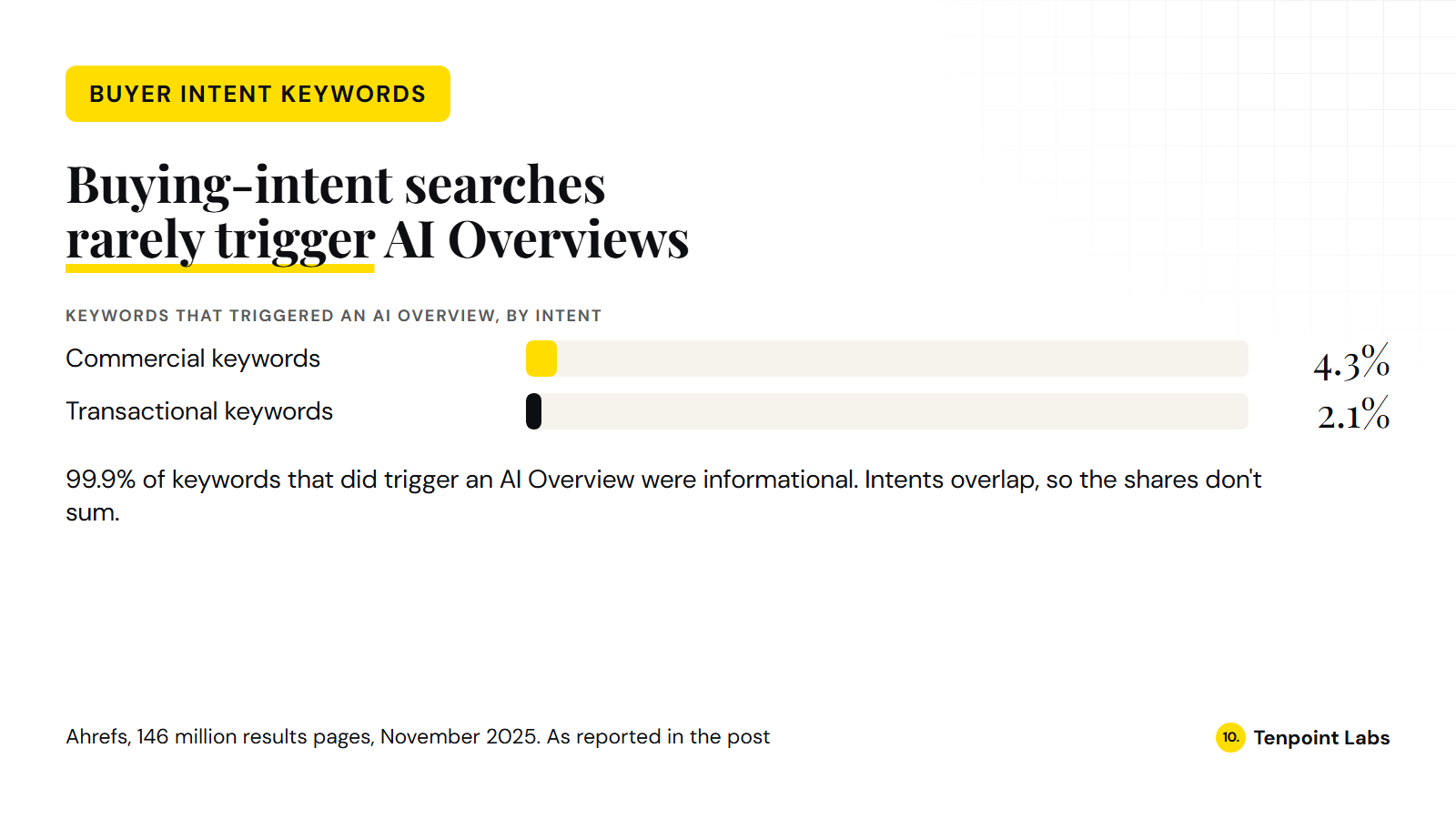
The decision rows also sit where AI Overviews appear least often. In a November 2025 study of 146 million results pages, 99.9% of keywords that triggered an AI Overview carried informational intent, and only 4.3% of commercial and 2.1% of transactional keywords triggered one at all, as documented in the Ahrefs AI Overview study.
Intents overlap, so the shares don't sum, and comparison-style questions are the exception that triggers AI Overviews above the average.
“99.9% of AI Overviews appear on informational intent queries. Transactional, navigational, and local searches are almost entirely AIO-free.”
Tim Soulo, CMO at Ahrefs
How do you turn an educational topic into a BOFU page?
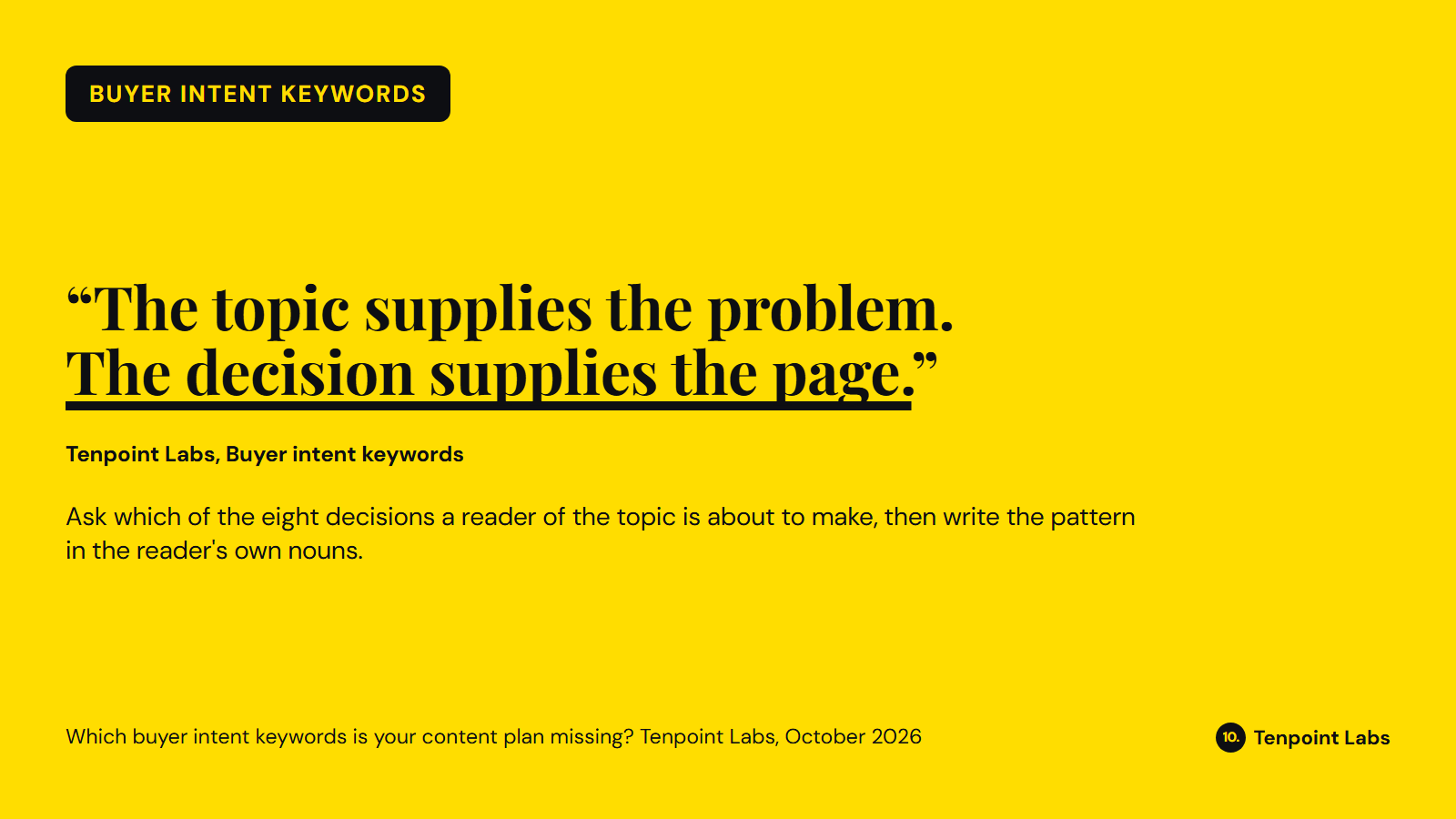
You turn an educational topic into a BOFU page by asking which of the eight decisions a reader of that topic is about to make, then writing the pattern for that decision in the reader's own nouns. The topic supplies the problem. The decision supplies the page.
Here's the chain on an inventory software company; every row is illustrative:
The last row is the one most lists leave out, including the Tomba buyer intent list, which is otherwise the closest thing to a usable pattern library among the pages ranking for the term in October 2026. Forcing it produces "Just-In-Time Manufacturing Software Pricing," a heading your buyers have never searched, and a page at position 40 confirming your suspicion that BOFU content doesn't work.
It does work. That topic doesn't have any.
Run the compare row against your rivals first. Their comparison and alternatives pages are terms they already judged worth a page, which is the premise of competitor keyword research.
Services businesses follow the same chain: an accounting firm's "What is R&D tax relief" explainer sits one decision from "R&D tax credit consultant for software companies," a service page with a named partner. Write the decision in the margin before you write the keyword. If you can't name the decision, you've found a topic with no extension, and you can move on without guilt.
How do you choose keywords for bottom-of-funnel pages?
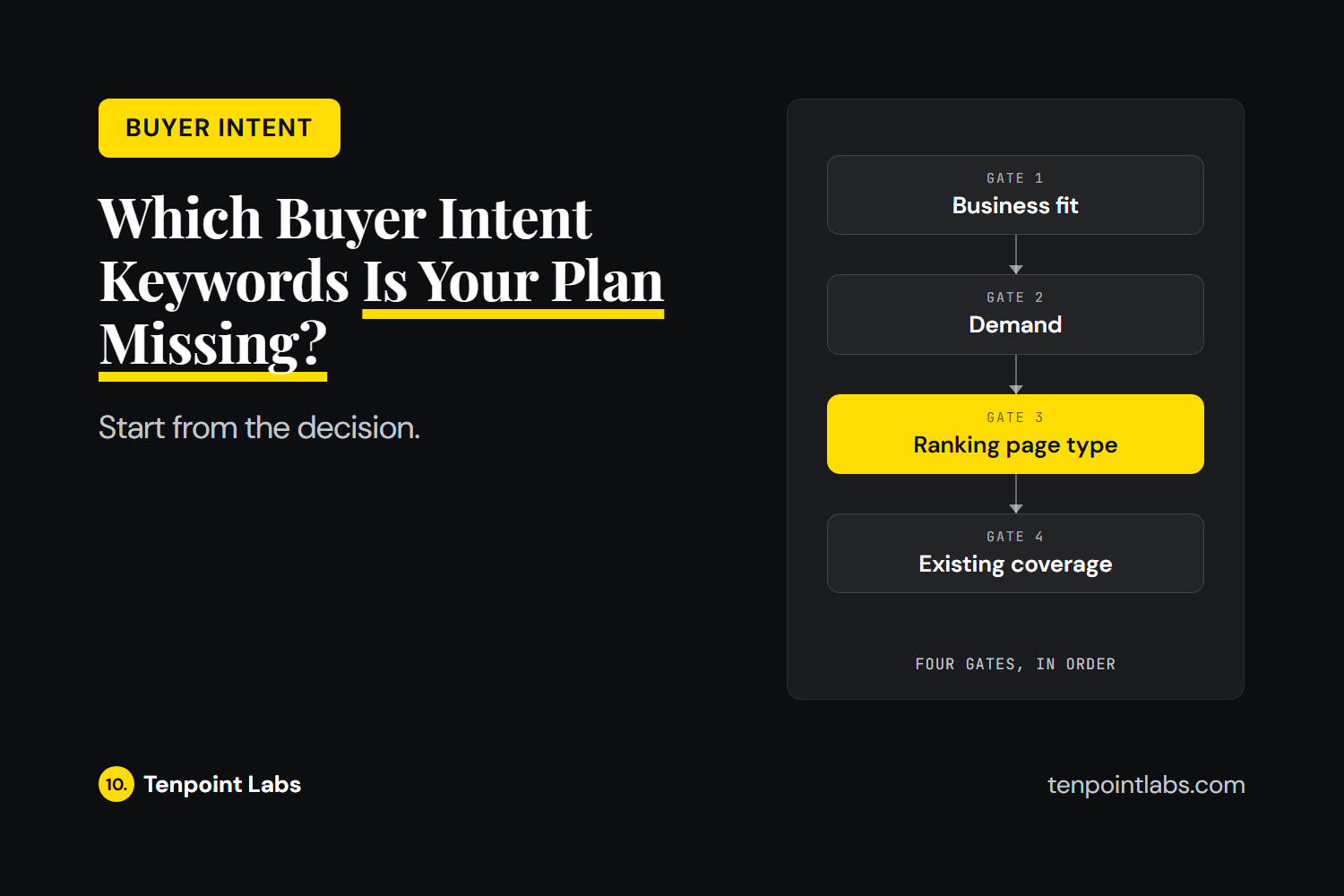
You choose keywords for bottom-of-funnel pages by running every candidate through four gates in order, and dropping it at the first gate it fails. The gates separate ideas you generated from opportunities you can act on, and most candidates won't clear all four.
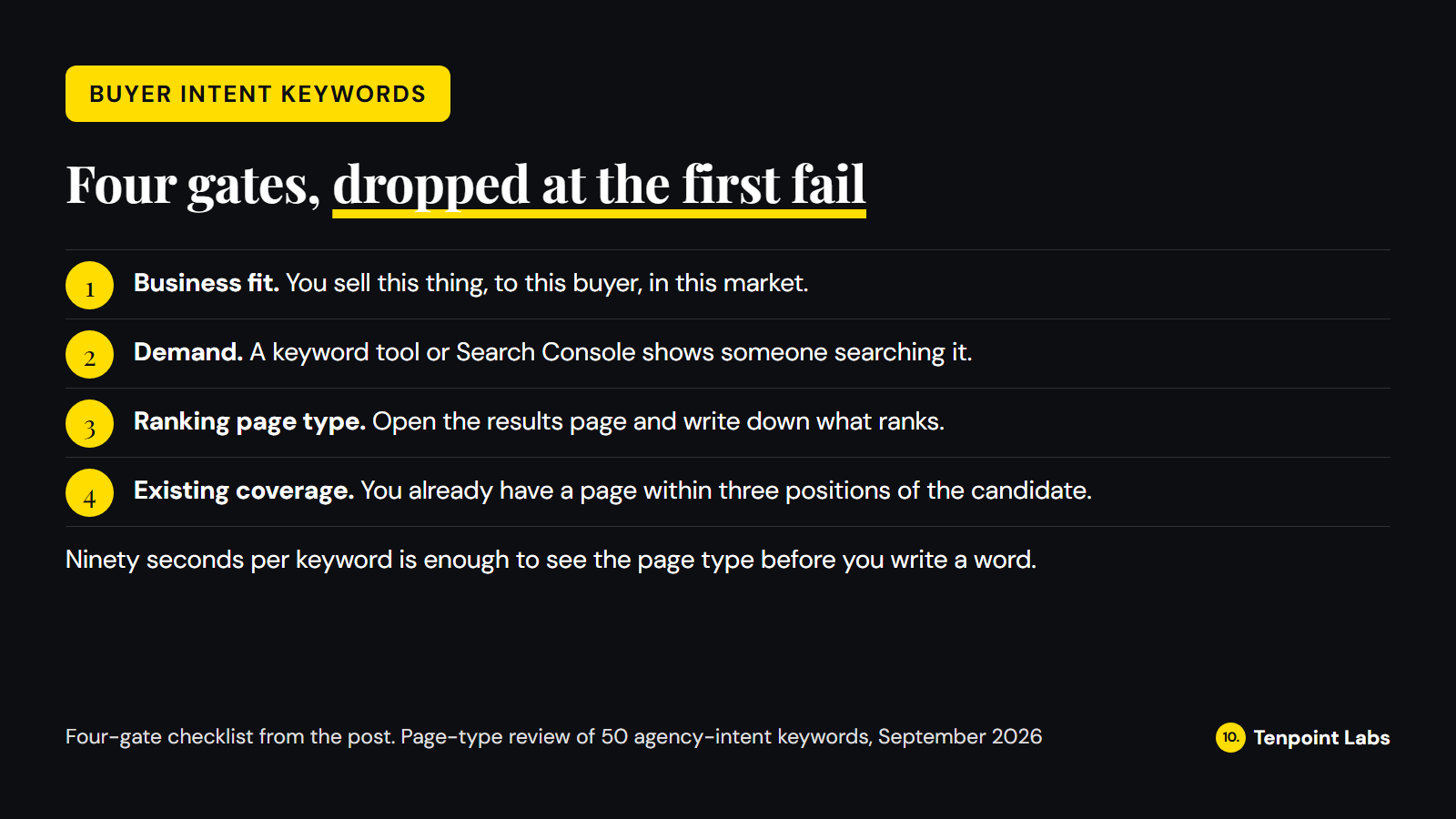
- Business fit. You sell this thing, to this buyer, in this market. "Inventory software for manufacturers" fails here if your product is built for retailers.
- Demand. A keyword tool or Search Console shows someone searching it. Unconfirmed isn't the same as zero, so a term with no tool data goes on a watch list rather than in the bin.
- Ranking page type. Open the results page and write down what ranks: service page, free tool, comparison article, category page, marketplace listing. Checking the purpose of the top-ranking pages is the intent test in the Ahrefs buyer intent guide too; in our experience the page-type half of it is the part teams skip. If you can't build that type, the keyword isn't yours yet.
- Existing coverage. You already have a page within three positions of the candidate, which the query and page filters in the Search Console performance report will show you. Refreshing it beats publishing a second page that splits the signal.
Gate three is where lists go wrong. In a September 2026 review of the results pages for 50 agency-intent keywords, the highest-volume provider terms ranked service pages, the "best agency" terms ranked roundups, and the cost terms ranked guides. For most of them, the page that ranked was a different shape from the blog post a content plan would default to.
Ninety seconds per keyword is enough to see that before you write a word.
Gate four matters more as a plan matures. A plan with sixty published posts has covered more decisions than its owner remembers. The same content gap analysis tools that find what you're missing will also show what you've already covered twice.
FAQs
What are buyer intent keywords?
Buyer intent keywords are search terms whose wording shows the searcher is choosing, comparing, pricing, or buying a product or service rather than learning about a subject. They include commercial-investigation terms such as "best," "vs," and "alternatives," and transactional terms such as "pricing," "demo," and "buy."
Is "integration" always a buying signal?
"Integration" isn't always a buying signal, because a prospect checking compatibility and an existing customer looking for setup instructions type the same word. If help-center pages rank, the searcher is a customer; if comparison and vendor integration pages rank, the searcher is a buyer.
Where do I find buyer intent keywords for my market?
You find buyer intent keywords for your market by running the eight decision patterns against the topics you already rank for. Then check your competitors' comparison pages, the filters buyers use on review sites in your category, and the words prospects use on sales calls.
What is the difference between buyer intent keywords and intent data?
Buyer intent keywords are the words people type into a search engine, while intent data is account-level behavioral data that platforms such as Bombora and Demandbase aggregate from third-party sources and their own networks. Intent data is mostly a sales-tooling decision rather than a content-planning one.
How many buyer intent keywords should a content plan have?
A content plan should have as many buyer intent keywords as clear all four validation gates, and no fixed number beyond that. Eight validated BOFU pages built in the right page type are a better bet than forty generated headings that were never checked against a results page.
What does a BOFU plan look like when it's done properly?
A BOFU plan done properly has fewer rows than the brainstorm that produced it, and every surviving row names its decision, page type, and the gate it cleared last. The upkeep is one decision row a week, run against ten topics.
This is the method we run for clients, with Tenpoint Analytics holding the coverage checks once we connect it for you. See how it played out in our case studies, or schedule a founder call and bring the plan.
Stop writing pricing pages for topics with no buyer behind them. Start from the decision.