What Is a Content Marketing Agency?
A content marketing agency builds and runs your company's content programme. Strategy, research, production, performance measurement. The agency owns the system. You approve the output and use it to grow.
That is the simple version. The other version is that not every agency calling itself a content marketing agency is actually delivering that system.
Key takeaways:
- A content marketing agency owns your content strategy, editorial process, and performance loop. Not just the word count.
- There are four distinct types of content marketing agencies. Picking the wrong type is as costly as picking the wrong agency.
- Content marketing agencies and SEO agencies are not opposites. The best B2B agencies operate as both.
- Most B2B companies have four ways to build a content programme: agency, in-house team, freelancer, or embedded operator. Each has a different cost, activation speed, and strategic depth.
- Mid-market B2B programmes typically cost $5,000 to $15,000 per month for strategy plus production.
- Content marketing shows meaningful traffic growth within six months. Pipeline contribution typically follows in the next quarter.
What does a content marketing agency do?
The work spans five areas: strategy, research, production, editorial management, and performance reporting.
The day-to-day work includes:
- Researching the questions your buyers search for at each stage of the purchase decision
- Writing or commissioning content that answers those questions with authority
- Managing an editorial calendar that balances SEO targets, thought leadership, and sales enablement needs
- Tracking which pieces drive traffic, leads, and pipeline, then adjusting based on what the data shows
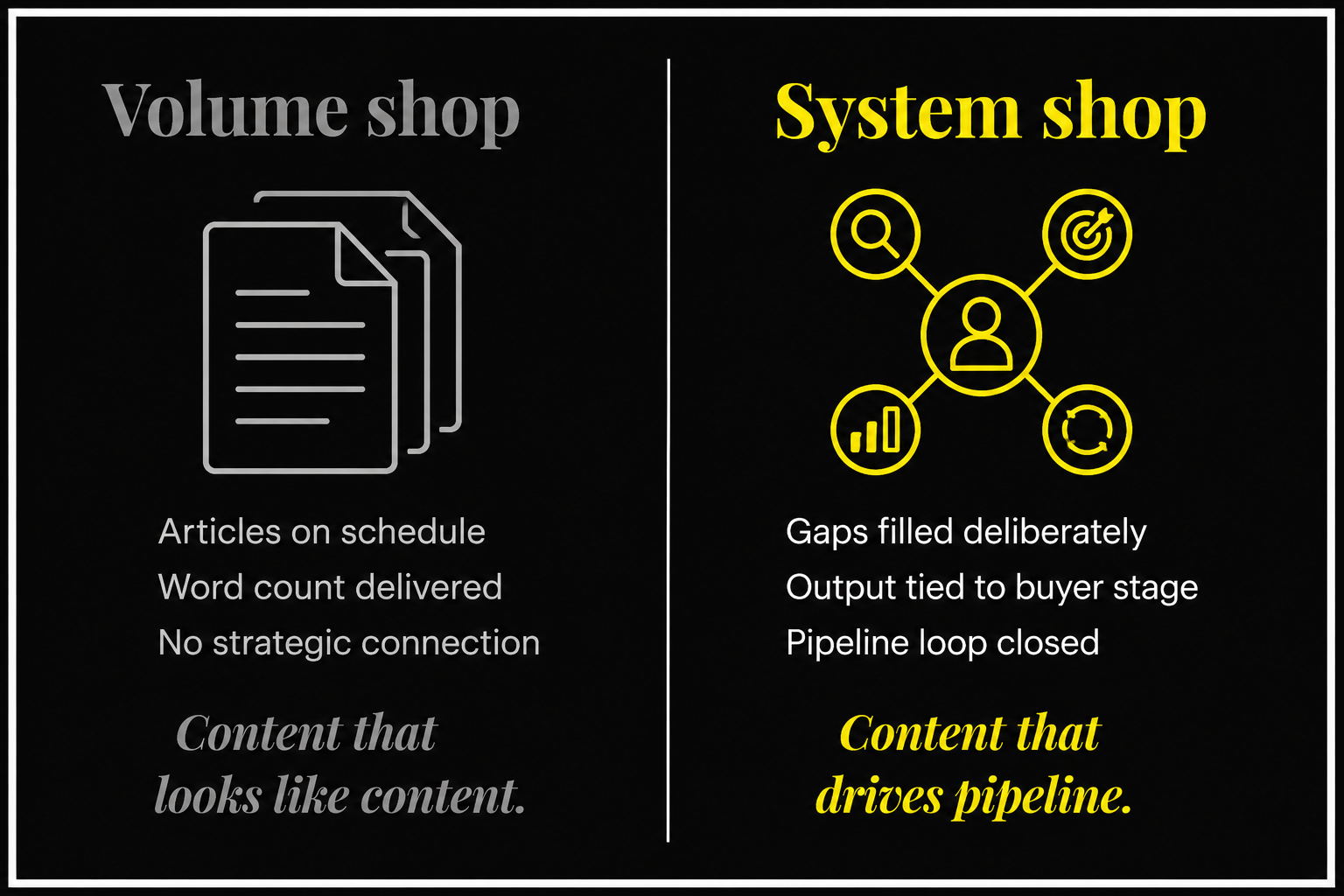
The distinction that matters most in B2B: volume shops and system shops are not the same product.
A volume shop sells you articles. Twenty per month, delivered on schedule.
A system shop sells you a content programme where each piece serves a specific strategic purpose, coverage gaps get filled deliberately, and the output connects to what your sales team needs to close deals.
We have worked with B2B companies that published 50 articles in a year and generated zero pipeline from them. We have also worked with companies that published eight articles and closed six-figure deals through organic within the first quarter. The difference was never volume. It was always whether the content was built as a system or assembled as a queue.
Before engaging any agency, it helps to understand what B2B content creation services actually include so you can evaluate proposals on deliverables, not pitch language.
What types of content marketing agencies exist?
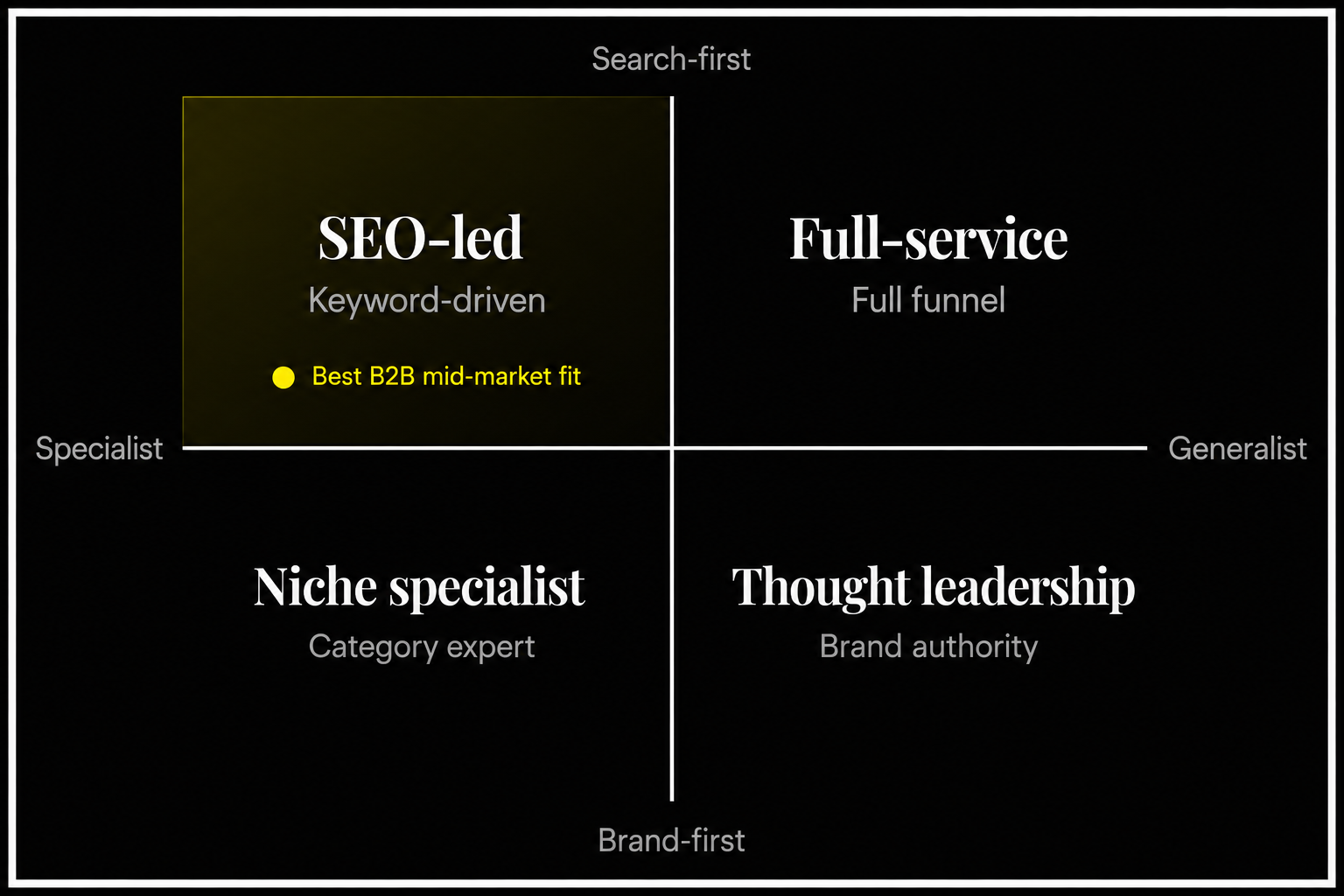
There are four distinct types of content marketing agencies, and picking the wrong type is as costly as picking the wrong agency.
SEO-led content agencies are research-first and keyword-driven. They begin with search data, build content clusters around keyword gaps, and measure success primarily through traffic and rankings. Strong choice for companies prioritising organic search growth. Less strong on brand voice, executive positioning, and thought leadership depth.
Thought leadership and editorial agencies focus on brand narrative, executive interviews, and long-form content that builds category authority. They produce the kind of content that gets cited, shared, and remembered beyond the article's first week. Strong choice for companies building market reputation. Less strong on keyword research and search infrastructure.
Full-service inbound agencies combine content with email nurture, social distribution, and marketing automation. They build the full funnel, not just the top of it. Strong choice for companies with an established content programme that needs a broader distribution engine. Often expensive and too broad for companies just beginning to invest in content.
Niche and vertical specialists serve a single industry or buyer type: B2B SaaS, fintech, healthcare, logistics, professional services. Deep subject matter expertise means faster onboarding, better content quality, and stronger buyer trust signals out of the gate. The tradeoff is limited availability and typically higher rates.
For many B2B companies with 50 to 500 employees, an SEO-led agency with genuine B2B editorial capability is the right fit. Ask any agency you are evaluating to explain how they brief a writer. If the answer does not include keyword intent, buyer stage, and a clear commercial outcome the piece should drive, they are not actually the thing they are selling.
How are content agencies different from SEO agencies?
The difference between a content marketing agency and an SEO agency is smaller than most agency websites suggest. Both are trying to drive qualified traffic and pipeline through search. Where they start is different.
SEO agencies are analytical-first. They begin with technical audits, keyword data, and ranking gaps. Content is the output of that analysis.
Content marketing agencies are editorial-first. They begin with your buyer, your positioning, and the questions your ICP is actually asking. SEO is the mechanism that gives that content reach.
The best B2B agencies do both. The clean separation between content and SEO is a legacy of how the industry was structured a decade ago, not how effective programmes actually work. An agency that cannot do keyword research is not a content marketing agency. It is a writing service. An agency that cannot brief a writer is not an SEO agency. It is a spreadsheet operation.
The useful question is not content or SEO.
It is this: does the agency start with the buyer or start with the keyword? Starting with the buyer produces better content. Starting with the keyword produces more traffic. The answer you want does both.
If you are comparing content agencies against inbound or SEO-first firms, the full breakdown of how inbound marketing agencies differ from SEO agencies is worth reading before you begin outreach.
Agency, in-house, or freelancer: which fits?
A content marketing agency is one of four ways to build a B2B content programme. Here is how the options compare on the dimensions that matter most.
In-house gives you full strategic control and deep institutional context. According to Indeed salary data from 413 US job records, senior content marketing managers average $131,000 per year, with total compensation including benefits and management overhead pushing that figure higher. Specialist roles in this discipline typically take three months or more to fill. The right choice when you have the content volume to justify a dedicated team.
Agency gives you faster activation, breadth of expertise, and a structured process you do not have to design yourself. The tradeoff is context — agencies take time to understand your business, your buyer, and your sales dynamics. The right choice when you need external capacity and a repeatable programme.
Freelancers give you execution capacity at the lowest cost, but they rarely own the strategy. You are managing them, briefing them, and quality-checking their work. The right choice for specific tasks when you have a strong content strategist in-house.
Embedded operators sit between agency and in-house. A senior content strategist works inside your team, owns the strategy and the production process, and carries the same accountability as a full-time hire without the hiring timeline or overhead. That is how we operate at TenPoint Labs. The right choice for B2B companies that need strategic ownership but are not yet ready to hire a full content team.
What services does a content agency deliver?
Content marketing agencies deliver six core services: strategy, research, production, optimisation, distribution support, and reporting.
Strategy covers content roadmap design, topic cluster architecture, and quarterly prioritisation. A strong strategy phase produces a 12-month publishing plan mapped to your keyword targets and buyer journey. It also identifies what not to publish, which is at least as valuable as the plan itself.
Research covers keyword analysis, competitive gap audits, buyer intent mapping, and SERP analysis. This is where agencies identify what your buyers search for, what your competitors rank for that you do not, and where quick wins exist inside your current domain authority.
Production is the writing, editing, and formatting of the content. The quality of production depends on two things: brief quality and editorial governance.
An agency that produces without a structured brief is ghost-writing. An agency that uses AI without editorial oversight is an automation tool with a monthly invoice. With 80% of marketers now using AI for content creation, according to HubSpot's 2025 State of Marketing report, the question for buyers is not whether an agency uses AI — it is whether their editorial process governs it. The right approach pairs research-led briefs with structured editorial oversight: AI handles drafting; human editors verify facts, apply brand voice, and make every piece accountable to the brief. That combination delivers consistent quality at the volume B2B programmes require.
Optimisation covers on-page SEO, internal linking, structured data, and updates to existing content that is underperforming. A good agency maintains a refresh backlog alongside its publishing queue. Most content programmes leave significant ranking gains on the table by only creating new content and ignoring existing pages.
Distribution support varies widely. Some agencies help with email newsletter formatting, LinkedIn repurposing, or paid content amplification. Most do not own these channels. Clarify scope before signing.
Reporting closes the loop: what is ranking, what is driving traffic, what is converting, what to publish next. The best agencies tie content performance back to demo requests and closed deals — not just traffic dashboards.
Strong research methodology now includes competitive gap analysis for AI search: identifying what your competitors rank for that you do not, and what AI tools are surfacing that your content has not yet addressed.
How much does a content agency cost?
Content marketing agency pricing for B2B falls into three tiers, and they are not the same product at different scales.
Execution-only: $2,000 to $5,000 per month. You are buying writing capacity against briefs someone else creates. This works when you have a strong content lead in-house and need output, not strategic oversight.
Strategy plus production: $5,000 to $15,000 per month. The most common model for B2B companies between 50 and 500 employees. The agency owns the roadmap and the output. You review and approve. Budget at this tier often covers four to eight long-form articles per month, keyword research, editorial management, and performance reporting.
Full-programme management: $15,000 per month and above. Everything above plus distribution support, content refreshes, paid amplification, and integrated pipeline reporting. This model fits companies treating content as a primary demand generation channel, not a secondary one.
These ranges reflect what the market actually charges. Agency listing data on Clutch shows minimum engagement sizes for leading content marketing firms typically start at $5,000, with most projects running between $10,000 and $50,000 per engagement. Siege Media's published pricing benchmarks put the floor for quality content services at around $3,000 per month, scaling upward with scope and strategic involvement.
Before signing, ask one specific question: what percentage of the monthly fee goes to strategy and what percentage goes to production? If the agency cannot separate those two things clearly, strategy is not actually included in what you are buying.
How do you measure content marketing ROI?
Content marketing ROI is measured across three time horizons, with different metrics at each.
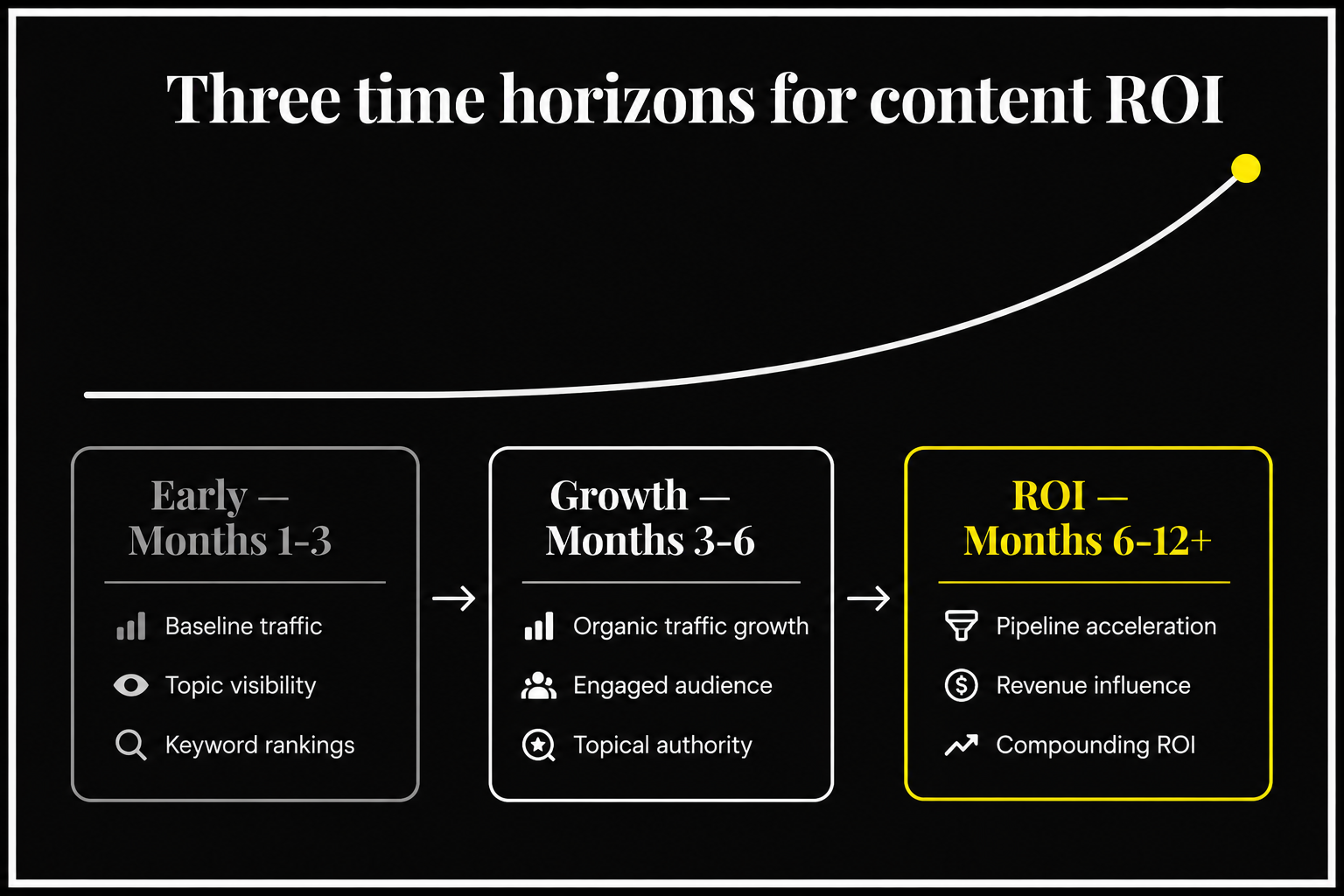
Early indicators (months 1 to 3): Content velocity, brief quality, keyword coverage progress, and indexed pages. You are measuring process quality, not market results. Do not draw ROI conclusions from this window.
Growth indicators (months 3 to 6): Organic impressions, ranking positions, returning visitors, and topic cluster completeness. Traffic growth should begin here. First Page Sage's B2B content marketing benchmarks show meaningful traffic growth typically appears within six months of consistent publishing — a timeline consistent with Ahrefs' survey of 3,680 SEO practitioners, which found three to six months is the most commonly reported window for organic search results to materialise.
ROI indicators (months 6 to 12 and beyond): Organic leads, pipeline contribution, and sales cycle velocity for content-sourced prospects. This is where content marketing proves its commercial value.
The five KPIs that matter for B2B content:
- Organic traffic — total sessions from search, broken down by content piece and cluster
- Keyword rankings — positions for primary and secondary targets, tracked weekly
- Organic leads — form submissions, demo requests, and trial signups attributed to organic search
- Pipeline contribution — value of deals where organic content was part of the path to first sales conversation
- Content ROI — pipeline influenced by content divided by total content programme cost
Only 19.1% of B2B marketing teams track pipeline contribution as a key performance metric, according to Pipeline360's 2026 State of B2B Marketing Content report, which surveyed 555 marketing professionals across six countries. The agencies worth working with help you close that gap through proper UTM tracking and CRM integration, not just Google Analytics dashboards.
What happens in the first 90 days?
The first 90 days of a content agency engagement set the programme's trajectory. Here is what good onboarding looks like.
Weeks 1 and 2: Onboarding and discovery. The agency audits your existing content, reviews your ICP, maps your sales process, and identifies keyword opportunities. You align on tone, voice, topic restrictions, competitor positioning, and what "high quality" means in your category.
Weeks 3 and 4: Strategy and briefs. The agency delivers the content roadmap and first batch of article briefs. You review and approve. Brief quality at this stage is the single most reliable predictor of article quality. Understanding what a strong content brief includes before you evaluate agency briefs is worth the read.
Month 2: First articles published. The first two to four articles go live. The agency monitors early indexing signals, gathers your feedback on tone and format, and adjusts the briefing process accordingly. Expect revisions. That friction is the process working, not failing.
Month 3: Process is established. Publishing velocity is steady. The feedback loop is tight. Early keyword positions are tracked. The agency begins identifying refresh and optimisation opportunities in existing content alongside the new publishing queue.
By month three, you should have a clear view of how the agency operates, what the content quality ceiling looks like, and whether the programme is building toward the right keyword targets. If any of those three things are unclear, ask for a programme review before committing to the next quarter.
When should a B2B company hire a content marketing agency?
Three conditions make a content marketing agency the right move: a defined ICP, a working sales process, and no internal capacity to run the programme consistently.
A defined ICP means you know who you are selling to and can describe their specific problems. A working sales process means leads generated by content have somewhere to go. No internal capacity means no one qualified can run the programme properly.
When NOT to hire a content marketing agency:
- Your product positioning is still unsettled. Content marketing amplifies your message. If your message is unclear, you will spend $10,000 a month producing content that confuses the market rather than attracting it.
- Leadership will second-guess every topic. Agencies cannot produce good content inside approval processes driven by internal politics rather than buyer insight.
- You expect results inside six months. Content marketing compounds. The first six months build the foundation. The next six build momentum. Companies that cancel at month four pay for the setup and skip the return.
- Your budget is under $2,000 per month. Below that threshold, you cannot afford a writer with real B2B expertise. You will get output that looks like content and performs like nothing.
What should you look for when choosing?
Four criteria separate good content marketing agencies from agencies that look good in a pitch.
B2B vertical experience. Content for a fintech SaaS buyer reads differently from content for a logistics software buyer. Agencies with experience in your category understand the buyer's language and objections without a six-month learning curve. Ask for samples from your vertical or an adjacent one.
Pipeline-first measurement. Look at their case studies. Do the results show traffic and rankings, or pipeline and leads? The agency optimises for what it measures. If their case studies never mention pipeline, that is what they are deprioritizing in your programme too.
Editorial process — including how they use AI. This is the criterion most buyers miss. The distinction is not whether an agency uses AI — it is whether their editorial process governs it. Ask specifically: what does your process look like from brief to publish, and where does AI sit in that chain? A clear, specific answer signals a structured production model. Vague language about "AI-assisted workflows" without describing the oversight layer signals the opposite.
Senior involvement after the contract is signed. Ask who will actually work on your account. If the answer is a junior writer managed by an account manager, that is the product you are buying. The senior strategist who ran the pitch is not.
Red flags to end the conversation:
- They cannot name a B2B client in your industry or an adjacent vertical
- They pitch you a content calendar on the first call before asking a single question about your buyer
- They cannot explain how content would connect to leads in your CRM
- They guarantee rankings in a specific timeframe
- They want a six-month contract before you have seen a single piece of work
Questions to ask before signing:
What does your content brief look like? A strong brief covers keyword intent, target audience, key questions to answer, competitive gaps, and the commercial outcome the piece should drive. A weak brief says: write 1,500 words on topic X.
How do you define success at 90 days, six months, and 12 months? The answer should include lagging indicators like traffic and rankings, and leading indicators like content velocity and cluster coverage.
What happens when a piece does not perform? Good agencies maintain a refresh and optimisation process for underperforming content. Agencies that move to the next piece and forget the last one are selling output, not outcomes.
Can we speak with a B2B client at a similar stage or in a similar industry? Reference calls reveal what the working relationship looks like when a deadline slips or a revision goes four rounds.
The one question that cuts through any proposal: "Can you show me a client whose pipeline you can trace to specific content?" Agencies that answer this with specifics are building the right programme. Agencies that redirect to a rankings dashboard are not.
FAQ