What is a Content Brief? The B2B Marketer's Complete Guide (With Template)

A content brief is the document that tells a writer exactly what to produce and why, before they write a single word. It sets the keyword, the audience, the angle, the structure, and the goal in one place. Think of it as the blueprint a builder works from, not the inspection they get afterward.
Most B2B content fails at the brief, not the draft. A vague brief produces a vague article, and no amount of editing rescues a piece that was aimed at the wrong target. Get the brief right and the draft mostly writes itself.
This guide covers what a content brief is, what belongs in one, a template you can copy, and the parts that matter most for B2B.
Key takeaways:
- A content brief is a pre-writing document that defines the keyword, audience, intent, structure, and goal of a piece.
- A good brief cuts revisions, aligns the team, and decides whether the content ranks.
- The non-negotiable fields: primary keyword, search intent, audience, outline, word count, and links.
- B2B briefs carry extra weight because they juggle multiple stakeholders, subject-matter input, and a long sales cycle.
What is a content brief?
A content brief is a short document that gives a writer everything they need to produce the right piece on the first try. It captures the target keyword, the reader, the search intent, the structure, and the success metric. The brief is written before the content, which is the entire point.
A brief covers more ground than an outline or a style guide. An outline is one part of a brief: the section structure. The brief wraps that structure in context, telling the writer who the reader is, what they are trying to do, and what the finished piece needs to achieve.
The format stays lean. A strong brief fits on a page or two, because a brief nobody reads is worse than no brief at all.
Content brief vs. creative brief
A content brief guides a specific piece of content; a creative brief guides a campaign or design project. The two get confused because both set direction up front. The difference is scope: a creative brief covers visual identity, channels, and campaign goals, while a content brief drills into a single asset's keyword, structure, and reader.
Why does your content depend on it?
Your content depends on the brief because the brief is where strategy meets execution. Every decision that determines whether a piece ranks and converts gets made in the brief, not the draft. Skip it, and you are paying a writer to guess.
A good brief does three jobs at once:
- Cuts revision cycles by aligning everyone before work starts.
- Acts as a single source of truth, so the writer, editor, and stakeholder are not arguing from three different mental versions of the piece.
- Bakes in search intent, which is what actually earns the ranking.
The cost of a bad brief is invisible until it is not. You see it as a draft that misses, a deadline that slips, and a writer who did exactly what you asked and still got it wrong.
What should a content brief include?
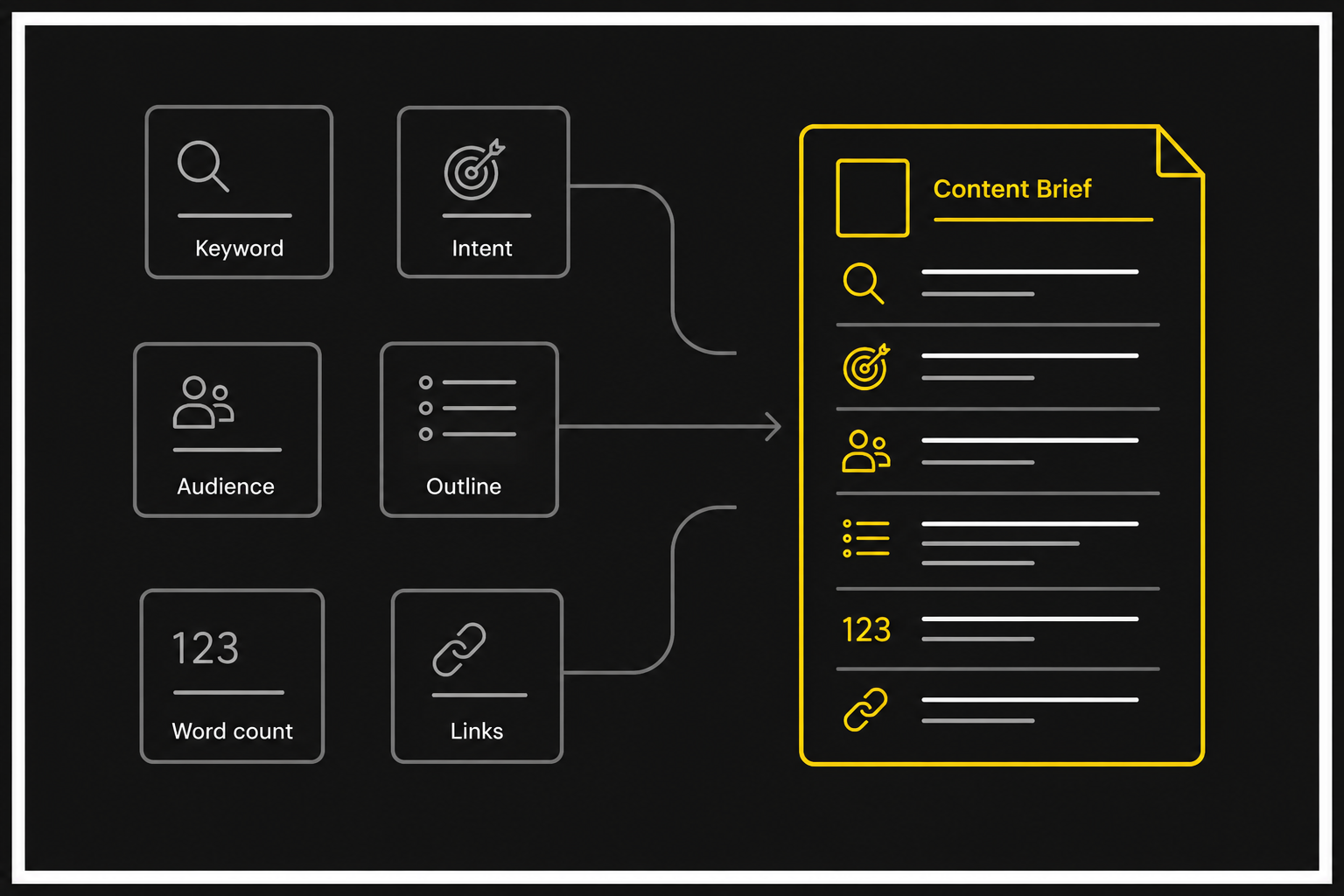
A content brief should include six non-negotiable elements. Everything else is optional. These six are the floor:
- Primary keyword — the term the piece targets.
- Search intent — the job the reader is hiring the page to do.
- Target audience — the persona that sets voice and depth.
- Outline — the heading structure the writer follows.
- Word count — the scope, based on what already ranks.
- Links — the internal and external URLs to include.
SEO and on-page elements
The brief carries the on-page details a writer should not have to guess:
- Primary keyword and two to four secondary keywords
- Working title and meta description direction
- URL slug
- Heading structure (H2s and H3s)
- Exact internal links with their anchor text
Specify those links precisely, rather than a vague instruction to "add some links."
Audience and intent
The brief names the reader and what they came to do. Define three things:
- The buyer persona
- Their stage in the funnel
- The single question the piece must answer
Search intent is the spine here: a reader typing "what is a content brief" wants a definition and a template, not a sales pitch.
What essentials should be in a content brief?
A solid content brief template organizes those elements into fields a writer fills against. You build it once, then reuse it for every piece. Here is the template we use at Tenpoint Labs, stripped to what earns its place:
| Field | What to put there |
|---|---|
| Working title | A draft H1 that signals the angle. Refine later. |
| Primary keyword | One target term, plus search volume and difficulty. |
| Secondary keywords | Two to four related terms to weave in naturally. |
| Search intent | The job the reader is hiring this page to do. |
| Audience | The persona and funnel stage the piece serves. |
| Outline | H2 and H3 headings, ideally phrased as questions. |
| Word count | A target range based on what already ranks. |
| Links | Exact internal and external URLs with anchor text. |
| Goal | The one metric this piece is meant to move. |
These nine are foundational. The downloadable template expands them into 21 fields across seven sections, adding the research, on-page, and AI-citation pieces a complete brief needs.
Grab the free content brief template
A reusable Word template with all 21 fields and why each one matters. No email required.
Download the template (Word, .docx)How do you write a content brief?
You write a content brief by working from the search result backward to the outline. Start with the data the search engine already gives you, then shape it into a structure a writer can follow. The process takes 30 to 45 minutes once you have a template.
Start with keyword research and intent
Pick one primary keyword, then read the results it returns. The top pages tell you what Google believes the searcher wants, which is your intent. A query like "content brief template" wants a downloadable asset, so a 3,000-word essay would miss on purpose.
Analyze what already ranks
Open the top three to five results and note what they cover and what they skip. The shared topics are your table stakes. The gaps are your opportunity, and they belong in the brief as required sections.
Build the outline
Turn that research into H2 and H3 headings, phrased as the questions readers actually ask. Assign each section a rough word count and the points it must hit. A writer who gets this outline is no longer guessing about structure.
What makes a B2B brief different?
A B2B brief carries more weight because B2B content answers to more people and a longer sales cycle. A consumer post can chase a quick click. A B2B piece often needs to satisfy a practitioner, survive a stakeholder review, and still be working months later when the deal finally closes.
Three things change the B2B brief:
- Subject-matter input, because B2B topics are technical and a writer cannot fake depth.
- A funnel stage, because a brief for a top-of-funnel explainer is nothing like one for a bottom-of-funnel comparison.
- Named stakeholders who will review it, so feedback is built in rather than bolted on.
This is also why the brief is the natural starting point when you bring in outside help. Our guide to what to expect from B2B content creation services walks through how a strong brief separates a strategic partner from a content factory.
Where do most content briefs fail?
Most content briefs fail because they hand a writer a keyword and a prayer. A title, a target term, and a word count make a guess dressed up as direction, and the draft that comes back will reflect exactly that.
The failure has a tell: the brief describes the topic but never the intent. It says "write about content briefs" instead of "the reader wants a definition and a template they can copy." Topic tells the writer what to mention. Intent tells them what to deliver. Confusing the two is the single most common reason B2B content underperforms.
The fix is cheap. Add one line naming the job the reader hired the page to do, and most briefs improve overnight.

How do briefs power SEO and AI?
A brief powers SEO and AI visibility by locking in search intent and clean structure before the writing starts. Search engines reward pages that match intent, and generative engines pull from content that is well-organized and genuinely useful. Both depend on decisions the brief makes.
Intent is the SEO lever. When the brief defines what the searcher wants, the writer can answer it directly, which is what Google's guidance on search intent rewards. The structure is the AI lever: clear headings and self-contained sections are easier for models to extract and cite. Research from Princeton and Georgia Tech found that well-structured, citation-ready content can lift visibility in AI answers by up to 40%.
Readers benefit from the same structure, because people scan before they commit. Nielsen Norman Group research on how users read online confirms that most skim in an F-shaped pattern, which a brief's heading structure is built to serve. The discipline that helps a model also helps a human, and that overlap is the reason briefs matter more now, not less. A brief that bakes intent and structure in is the same work we break down in our guide to GEO vs SEO vs AEO.

How we do this at Tenpoint Labs
At Tenpoint Labs, content supports the SEO and AEO strategy, so every brief starts from data. We pull the target query from Search Console, check how visitors behave on the page in GA4, add the language buyers use on sales calls and in the CRM, and compare it with what competitors publish and what AI answers cite. A strategist drafts the brief, the client reviews it in Slack or email, and nothing goes to a writer until the client approves it.
The data behind it
The target query and its intent come from the Query Intelligence view in Tenpoint Analytics, which lists striking-distance queries ready to win. These are queries where a page already earns impressions and sits within reach of page one. The top one becomes the brief's primary keyword, and the results it returns tell us what job the page has to do.
What you see in your seat
Every engagement includes a seat in the same workspace our strategists use. You can open Query Intelligence and see the exact queries behind each brief, then watch clicks and rankings for the finished page in Page Performance. First changes to your website go live within 15 days. See how it works in Tenpoint Analytics.
FAQs
What is the difference between a content brief and a content outline?
A content outline is the heading structure of a single piece. A content brief contains the outline plus the keyword, audience, intent, word count, and links. The outline is one section of the brief, not a replacement for it.
How long should a content brief be?
One to two pages. A brief should give a writer enough direction to start without reading like an essay itself. If it runs longer than the content it guides, it has stopped being useful.
Who writes the content brief?
Usually a content strategist, SEO lead, or content manager. The person who writes the brief owns the strategy; the writer owns the execution. On small teams, one person often does both, but the two jobs stay distinct.
Is an SEO content brief different from a regular one?
An SEO content brief adds search-specific fields: primary and secondary keywords, search intent, competing URLs, and on-page elements like the meta description and slug. The core structure is the same, but the SEO version is built to rank, not just to inform.
Can AI write a content brief?
AI can draft the structure and surface keyword ideas, which saves time on the mechanical parts. It still needs a human to set the intent, verify the data, and add the strategic angle. Treat AI as a fast first pass, not the final brief.
A content brief is cheap insurance against expensive, off-target content. The 30 minutes it takes to write one is the highest-leverage half hour in your content process, because it is the only point where a single decision still changes everything downstream. Write the brief first. Always.
If you would rather hand the whole process to a team that briefs, writes, and optimizes as one motion, that is the work we do at Tenpoint Labs.
Grab the free content brief template
A reusable Word template with all 21 fields and why each one matters. No email required.
Download the template (Word, .docx)