Inbound Marketing Agency vs. SEO Agency: What's the Difference (And Which Does B2B Need)?

An inbound marketing agency builds demand across your entire funnel. An SEO agency improves one channel: your visibility in search. That single distinction is the reason so many B2B teams sign with the wrong partner and wonder six months later why the pipeline never moved.
The two get sold as rivals. They are not. One is a strategy. The other is a tactic that lives inside it. Confusing them costs B2B companies real budget, because the agency you hire should match the problem you actually have, not the one that sounds most urgent on a sales call.
This guide draws the line cleanly, then helps you decide which your business needs right now.
Key takeaways:
- An inbound marketing agency runs the full buyer journey: attract, convert, and retain. An SEO agency optimizes one channel.
- SEO is a component of inbound marketing, not a competitor to it.
- A traffic problem points to SEO. A pipeline or conversion problem points to inbound.
- AI search is quietly rewriting both definitions, and most agencies have not caught up.
What is an inbound marketing agency?
An inbound marketing agency attracts qualified buyers by creating content and experiences mapped to every stage of the purchase decision. It owns the whole journey, not one slice of it. The goal is demand: turning strangers into leads, leads into customers, and customers into people who stay.
The model runs on three stages: attract, engage, and delight, a framework documented by HubSpot. You attract the right people with useful content. You engage them with offers and nurture sequences timed to their intent. You keep them with service and content that earns renewal.
That scope is wide on purpose. A full-service inbound marketing agency typically runs content strategy, blog and asset production, email marketing, marketing automation, conversion rate optimization, and yes, search engine optimization. SEO sits in the toolkit. It is not the whole kit.
What services does it include?
Most inbound agencies bundle a core set: content creation, SEO, email and lead nurturing, landing pages, and reporting tied to pipeline. The B2B versions go further into sales enablement, account-based plays, and CRM work. The defining trait is integration. The channels are built to feed each other, not to run as separate line items.
What is an SEO agency?
An SEO agency improves how well your site ranks in organic search. That is the entire mandate: more qualified visibility on Google, more organic traffic, better positions for the terms your buyers type. The work is technical, on-page, and link-driven.
A good SEO agency audits your site architecture, fixes crawl and indexing issues, optimizes pages against search intent, and earns authoritative backlinks. These teams work to the rules search itself publishes, documented by Google. They are specialists, and the best ones are very good at the thing they do.
The limit is also the point. An SEO agency brings people to the door. It rarely builds the thing that convinces those people to walk through it. Content creation, nurturing, and conversion strategy usually sit outside the scope, or get treated as someone else's job.
How inbound marketing and SEO work together
Inbound marketing and SEO are not rivals. They are two halves of the same engine: SEO brings the right people to your site, and inbound marketing gives them a reason to stay, convert, and come back. One drives the traffic; the other turns it into pipeline.
That split breaks down into four moving parts:
- SEO attracts demand by making you findable for the terms your buyers already search.
- Content converts demand by answering the question that brought them there.
- Inbound marketing creates the journey from first visit to closed deal.
- SEO is one component of an inbound strategy, not a separate strategy that competes with it.
Hold that relationship in mind for the rest of this guide, because it is the reason the agency choice is rarely a clean either/or.
How do the two actually differ?
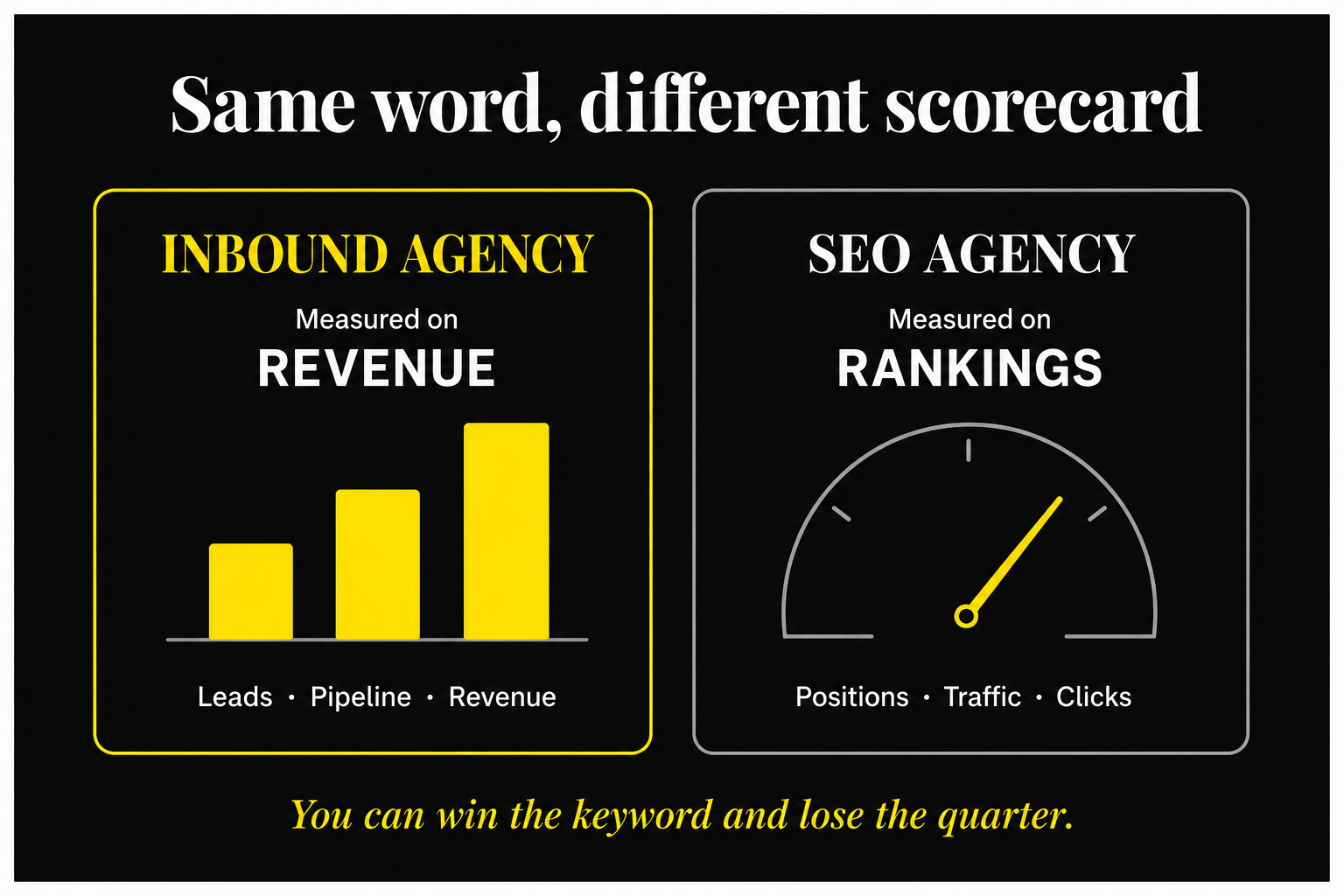
The difference comes down to scope and what success is measured against. An SEO agency is measured on rankings and traffic. An inbound marketing agency is measured on leads, pipeline, and revenue. One optimizes a channel. The other builds a system.
Content is where the gap shows most. SEO agencies are strong at optimizing content that already exists. Inbound agencies are built to create it. That sounds minor until you realize a page can rank beautifully and still convert no one, because ranking and persuading are different skills.
Here is the comparison in full:
Goals and metrics
SEO agencies report on positions. Inbound agencies report on pipeline. The risk with a rankings-only scope is real: an agency can chase positions that look good on a dashboard and drive traffic that never buys. You can win the keyword and lose the quarter.
Content, created versus optimized
SEO teams sharpen what you give them. Inbound teams build what you do not have yet. For B2B companies with thin content libraries, that distinction decides everything, because there is nothing to optimize until something exists.
Is SEO part of inbound marketing?
Yes. SEO is one of the channels an inbound strategy uses to attract buyers, which makes the "versus" framing slightly misleading. Asking whether you need SEO or inbound is like asking whether you need an engine or a car. The engine is part of the car.
SEO is inbound by nature, not outbound. It pulls people who are already searching toward your content, rather than interrupting people who are not. So an SEO agency does inbound work. It just does one part of it, very deeply, and leaves the rest on the table.
The practical takeaway: a strong inbound program already contains SEO. A standalone SEO engagement does not contain inbound. The arrow only points one way.
Which does your B2B company need?
Start by naming the problem, not the service. If buyers cannot find you, you have a visibility problem, and an SEO agency solves it directly. If buyers find you but do not convert, you have a demand problem, and that is inbound's job.
Most B2B companies misdiagnose this. They buy SEO because it is concrete and easy to measure, then blame the channel when traffic arrives and pipeline does not. The traffic was never the bottleneck. The absence of content that moves a buyer from curious to convinced was.
A useful test: look at where deals stall. Stalls before the site means visibility. Stalls after the visit means messaging and nurturing. The honest answer for modern B2B is usually both, sequenced correctly, which is exactly why the inbound model exists and why our own GEO playbook for B2B companies treats search as one input into a larger demand system.

Signs you need SEO first
You have a library of strong content that no one sees. Your site has technical debt: slow pages, broken structure, indexing problems. You rank on page three for terms your buyers use daily. In these cases, specialist SEO is the fastest lever.
Signs you need full inbound
Your site gets traffic that does not convert. You have few assets for buyers in the research and evaluation stages. Sales keeps asking for content that does not exist. These are demand problems, and a single channel will not fix them.
What does each one cost?
Inbound marketing agency pricing usually runs higher than standalone SEO, because the scope is wider. For B2B, monthly inbound retainers commonly fall between $2,500 and $12,000 for small companies, and $10,000 to $25,000 for mid-market firms scaling across channels. Specialist SEO engagements often sit at the lower end of that spread.
Price tracks scope, not quality. A cheaper retainer usually means fewer channels and less content, which for B2B can mean a program too thin to compound. The cheapest option rarely fits a long sales cycle that needs assets at every stage.
The better question is not "what does it cost" but "what does it need to produce to pay for itself." Anchor the budget to pipeline targets, then work backward to the scope that hits them.
Where does AI search change this?
AI search is collapsing the old line between SEO and inbound, and most agencies have not adjusted. Buyers now ask ChatGPT, Perplexity, and Google's AI overviews questions they used to type into a search bar. Visibility no longer means ranking. It means being the source the model cites.
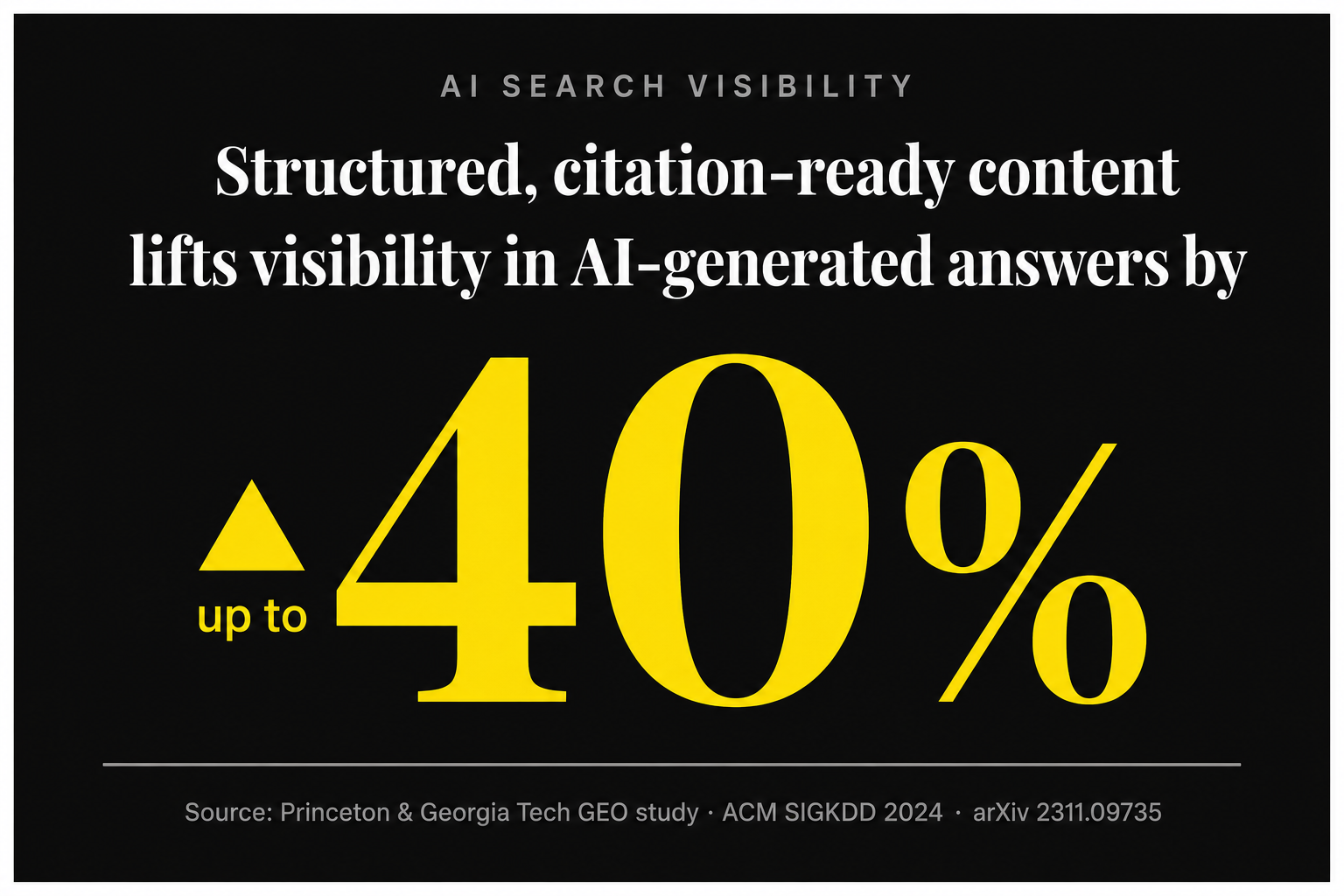
That shift rewards exactly what inbound agencies are built to do. Generative engines pull from clear, well-structured, genuinely useful content, not from pages stuffed with keywords. Structured, citation-ready content can lift visibility in AI answers by up to 40%, according to research from Princeton and Georgia Tech. Thin SEO tactics do not survive that environment.
So the agency question gains a third axis. It is no longer only inbound versus SEO. It is whether your partner understands how to get cited in AI answers at all, a discipline we break down in our guide to GEO vs SEO vs AEO. The agencies still selling rankings as the finish line are optimizing for a search experience that is already shrinking.
How do you choose the right partner?
Choose based on the outcome you need, then pressure-test for proof. Ask any agency to show pipeline results, not just traffic charts. A team that only reports rankings is telling you what it values, and it is not your revenue.
Watch for the red flags. Vague deliverables, no clear reporting on leads, content that reads like it was written for a robot, and a refusal to explain methodology are all signals to walk. A capable partner traces every recommendation back to a source you can click.
For B2B specifically, the dividing line is whether the agency creates strategic content or just fills a calendar. That distinction matters enough that it deserves its own checklist.
FAQ
The choice was never really inbound versus SEO. It is about which problem you are solving, and whether your partner can prove they solve it. Name the bottleneck first. The right agency becomes obvious once you do.
If your next question is how to vet a content partner without getting sold a calendar of generic blog posts, our breakdown of what to expect from B2B content creation services walks through the exact questions and red flags to use.