B2B Content Creation Services: What to Expect, What to Avoid, and How to Evaluate Vendors

Most B2B companies hire a content creation service expecting a content engine. What they often get is a content factory. The difference does not show up in the proposal. It shows up six months later, in pipeline reports that have not moved.
Content creation services for B2B companies span a wide range. Some are strategic partners who understand your buyers, build content around specific stages of the buying cycle, and measure what matters. Others are production shops that fill a calendar with generic articles no one reads.
This guide helps you tell them apart before you sign.
Key Takeaways
- B2B content creation services cover five distinct content types, each serving a different stage of the buying cycle
- Monthly retainers range from $4,000 to $25,000 depending on scope, vertical expertise, and whether strategy is included
- The red flags that separate strategic partners from content factories show up in their process, not their portfolio
- Five questions to ask any vendor, with the specific answers that signal a capable team
What B2B content creation services include
B2B content creation services produce the written, visual, and multimedia content a company uses to attract buyers, build authority, and move deals through the pipeline. The scope varies by vendor, but most B2B-focused agencies offer some combination of five content types.
SEO and editorial content Blog posts, long-form guides, topic cluster articles, and pillar pages designed to rank in search and build topical authority. This is the most commonly purchased service. It is also the one most frequently delivered poorly.
Pipeline and sales enablement content Case studies, ROI calculators, battle cards, comparison pages, and sales decks. These assets live lower in the funnel and are often undersupplied relative to top-of-funnel blog content. They do more work per dollar in an active deal cycle.
Thought leadership and authority content Whitepapers, research reports, bylined articles for trade publications, and executive ghostwriting. This category builds brand credibility over time rather than driving direct search traffic.
Social and short-form content LinkedIn posts, newsletters, short-form video scripts, and email sequences. According to available data, 80% of B2B social media leads come through LinkedIn, making it the primary channel by a significant margin.
Technical and product content Integration guides, product documentation written for buyers rather than engineers, and feature explainer content. This requires writers with genuine domain fluency, not just general B2B experience.
A full-service content creation agency will offer all five. Specialist content shops often focus on one or two. Neither is inherently better. What matters is which category your company actually needs to move pipeline.

Why B2B content costs more than B2C
B2B content is not B2C content aimed at businesses. The production requirements are structurally different, which is why the pricing is structurally different.
1. Buying cycles are longer. A B2C customer reads a product review and buys the same day. A B2B buyer reads twelve pieces of content over six to eighteen months, involves three to seven stakeholders in the decision, and still might not convert. Buyers consume an average of 13 pieces of content before contacting a vendor, a pattern tracked in Improvado's analysis of B2B versus B2C buying behaviour. Content for this environment has to hold up under scrutiny from technical evaluators, financial gatekeepers, and end users at the same time.
2. The subject matter is harder. A content writer can produce a serviceable review of a standing desk with minimal research. Producing credible content about cloud security compliance for mid-market SaaS companies requires a writer who either has relevant experience or is willing to do deep research. That research takes time, and time costs money.
3. You are writing for a committee, not a person. B2B content often needs to satisfy multiple reader types within the same piece. The practitioner wants technical specifics. The manager wants ROI framing. The executive wants strategic context. Getting that balance right is a skill most generalist content teams do not have.
4. The content itself needs to be longer. B2B blogs typically run 1,500 to 3,000 words to support topical authority. B2C blogs perform at 800 to 1,500 words with stronger visual formatting and direct CTAs. The research burden per piece is proportionally higher on the B2B side.
5. Multiple decision-makers need multiple formats. A CFO evaluating a software purchase and a VP of Operations evaluating the same software have different concerns. The CFO wants ROI data and risk exposure. The VP wants implementation timelines and integration specs. A content agency that produces generic articles without distinguishing by role and decision stage is producing content for no one in particular.
A single high-quality technical whitepaper can cost more to produce than a full month of B2C blog content. In a high-value deal cycle, a single well-executed piece can move a prospect from evaluation to decision. The math is different when your average deal size is six figures.
The volume vs. quality tradeoff vendors never raise
This is the conversation most vendors avoid at the proposal stage. You end up having it after three months of deliverables that did not move the needle.
More content increases search surface area and gives your team more distribution assets. But lower-quality content erodes trust with both readers and search engines. 58% of B2B marketers credit content as a direct contributor to revenue generation, a figure from Genesys Growth's content marketing ROI benchmarks — but that outcome only materialises when quality is maintained at volume. In B2B, where your buyers are subject matter experts, generic content actively damages your brand.
The right balance depends on three variables.
1. Your sales cycle length. If your average deal closes in two weeks, high-volume top-of-funnel content keeps you visible. If your cycle is six to twelve months, you need fewer, deeper pieces that build credibility across multiple touchpoints.
2. Your competitive environment. In a crowded space with established players who have published for years, a high-volume approach produces mediocre articles competing against entrenched authority. A focused, high-quality strategy is more likely to find ranking opportunities in specific subtopics.
3. Your deal size. If each new customer is worth $5,000, a $10,000/month content programme needs to generate a lot of leads to break even. If each customer is worth $100,000, a single piece of content that closes one deal pays for a year of production.
The vendor that asks you these questions before quoting is playing a different game than the one who leads with a content calendar.
How B2B content creation services are priced
Pricing models in this space fall into three categories, each with meaningful trade-offs.
Per-piece pricing
You pay a fixed fee per deliverable. Standard rates are $500 to $1,500 for a blog post, $2,000 to $5,000 for a whitepaper or long-form research piece, and $300 to $800 for a case study.
This model covers execution only. The vendor produces what you brief them on. They do not own your strategy, your results, or your editorial calendar. Best for companies that need occasional content production without a consistent volume commitment, or those supplementing an in-house team with specialist work.
Monthly retainer
A fixed monthly fee covering a defined scope of work. This typically includes a content strategy layer, a set number of assets per month, editing and SEO review, and reporting. The most common spend falls between $5,000 and $10,000 monthly, a range confirmed by a 2026 survey of 350+ businesses tracked in Column Five's annual content marketing agency pricing report.
The quality of what you get at any price point varies significantly depending on the team, their process, and how much senior talent is actually working on your account.
Project-based pricing
A fixed scope for a defined deliverable. Examples include a full content audit, a ten-article cluster build, or a sales enablement content kit. These typically range from $5,000 to $50,000 depending on scope. This model works well for one-time initiatives or for testing an agency's quality before committing to a retainer.
Pricing by tier
| Tier | Monthly investment | What is typically included |
|---|---|---|
| Boutique / specialist | $4,000 to $10,000 1 | Strategy + 4 to 8 blog posts + basic SEO |
| Mid-market full-service | $10,000 to $25,000 2 | Full-funnel strategy + multi-format production + reporting |
| Enterprise agency | $25,000 to $75,000+ 3 | Integrated content, SEO, distribution, attribution infrastructure |
Sources: 1. Column Five · 2. Windmill Growth · 3. Daydream
Three factors consistently drive cost up.
Vertical expertise. Vendors who genuinely understand your industry charge more because they are rare. A content agency that produces technically accurate cybersecurity articles without five rounds of client corrections is more expensive. It is also cheaper in the long run.
Original research and SME access. If a vendor interviews your subject matter experts, structures their insight, and builds original perspectives into the content, expect to pay for that access and the editorial work around it.
Strategy as part of the scope. Some vendors quote for content production. Others quote for content marketing: audience research, topic prioritisation, performance analysis, and ongoing optimisation. The second model costs more. It is the one that compounds.
A $500 blog post from a generalist with no vertical knowledge is content spend, not content investment. The math looks different at month twelve.
What makes a strong vendor
Strong B2B content agencies operate differently from production-focused vendors in four specific ways.
They ask about your pipeline before they ask about your keywords. A vendor who spends the first meeting asking about your CRM, your average deal size, your sales cycle length, and how marketing and sales are aligned is building toward a strategy that can be measured. A vendor who jumps straight to content types and volume is building toward an invoice.
They have an editorial process with teeth. This means subject matter expert interviews, minimum research requirements, editorial review by someone with domain knowledge, and a revision process governed by quality standards rather than client preference alone. Ask to see it in writing before signing anything.
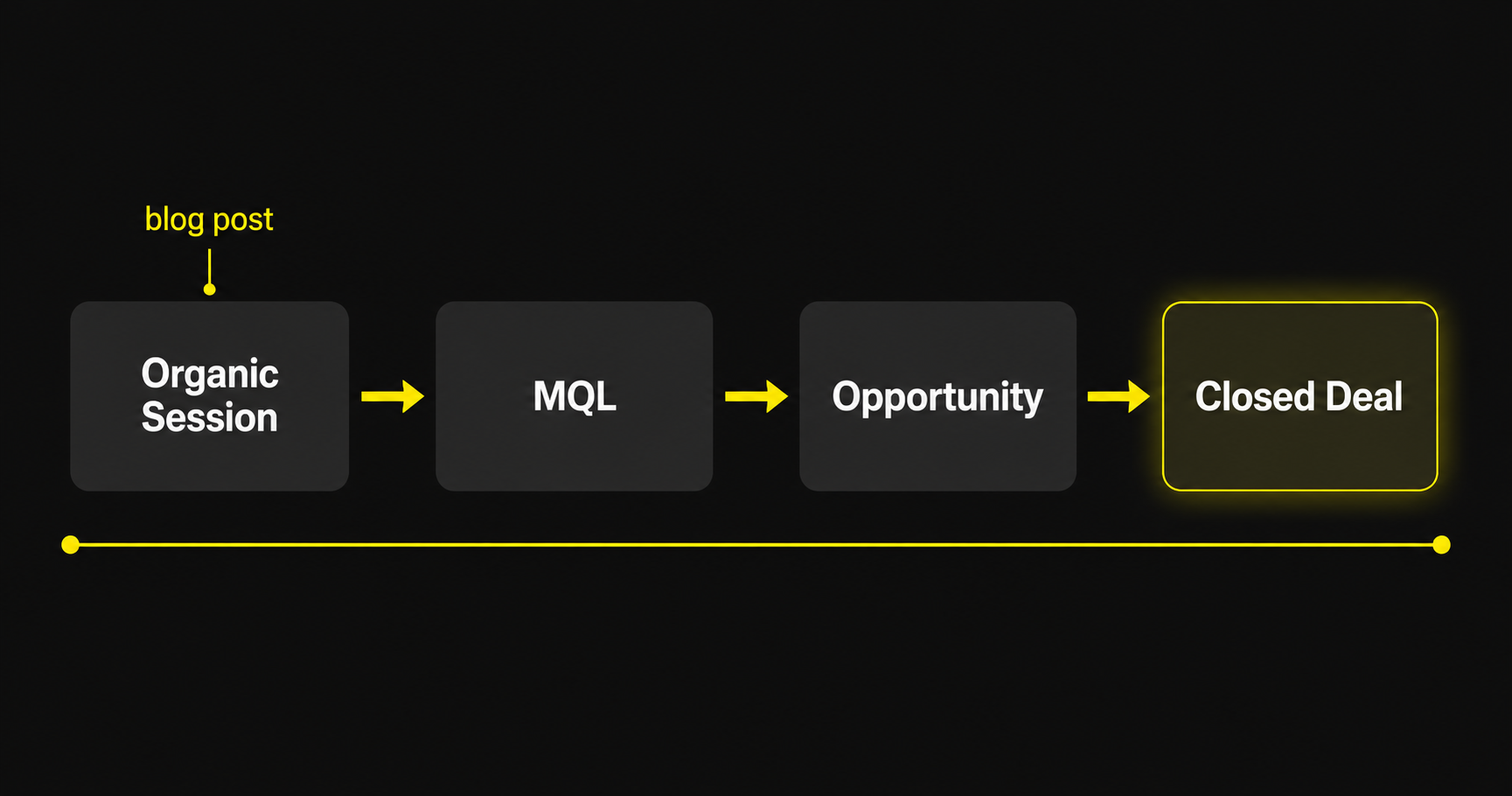
They can show you content that influenced pipeline. Not just content that ranked, and not just content that got traffic. 72% of businesses report content marketing as a meaningful driver of lead generation, a benchmark tracked in Genesys Growth's content marketing ROI research — and that number only holds for programmes with attribution infrastructure behind them. Any agency operating in this space should have at least a partial view of how their content contributes.
They have a position on AI search. A proposal in 2026 that treats Google organic as the only distribution channel and has no mention of AI Overviews, ChatGPT citations, or Perplexity visibility is a 2022 strategy with a 2026 date. Generative engine optimisation ensures your content earns citations in AI-generated answers, not just traditional search results. Your vendor should be able to explain how they approach it.
Red flags to screen for
The warning signs that a content creation service is a content factory rather than a content partner are almost always visible before you sign, if you know what to look for.
Generic writing samples. If the samples they send you could have been written for any company in your industry, that is exactly what you will get when they are writing for you. Look for samples that demonstrate genuine domain fluency, not just correct grammar and proper formatting.
Guaranteed rankings. No legitimate SEO-informed content agency promises first-page rankings on a specific timeline. Guaranteed ranking claims are one of the most consistently flagged warning signs when evaluating B2B content agencies, a pattern documented in Tiny Lever Marketing's analysis of agency red flags. Anyone making that promise either does not understand how organic search works in competitive B2B categories, or is willing to say what is necessary to close the deal.
Unedited AI output. The issue is not whether AI was used in production. The issue is whether human editorial judgment was applied to the output. Content that reads like a language model summarised the top three search results, with no original angle and no brand voice, will rank poorly and convert no one.
No review gate in the contract. A 12-month contract with no structured performance review and no off-ramp clause is worth scrutinising carefully. Strong agencies are willing to include a 90-day review gate with defined performance signals because they are confident in their work. Vendors who resist this are telling you something important about how they expect the engagement to go.
Vanity metric reporting. If the monthly report leads with pageviews, social impressions, and content pieces published, ask what happened to pipeline. If they do not have an answer, the programme is not being run with business outcomes in mind.
Generic writer pools with no vertical coverage. Some content agencies operate as talent marketplaces. They take your brief, find a freelancer, and pass through the work. This model can work if there is strong editorial oversight and genuine quality control. It breaks down when there is no senior editor accountable for the work product.
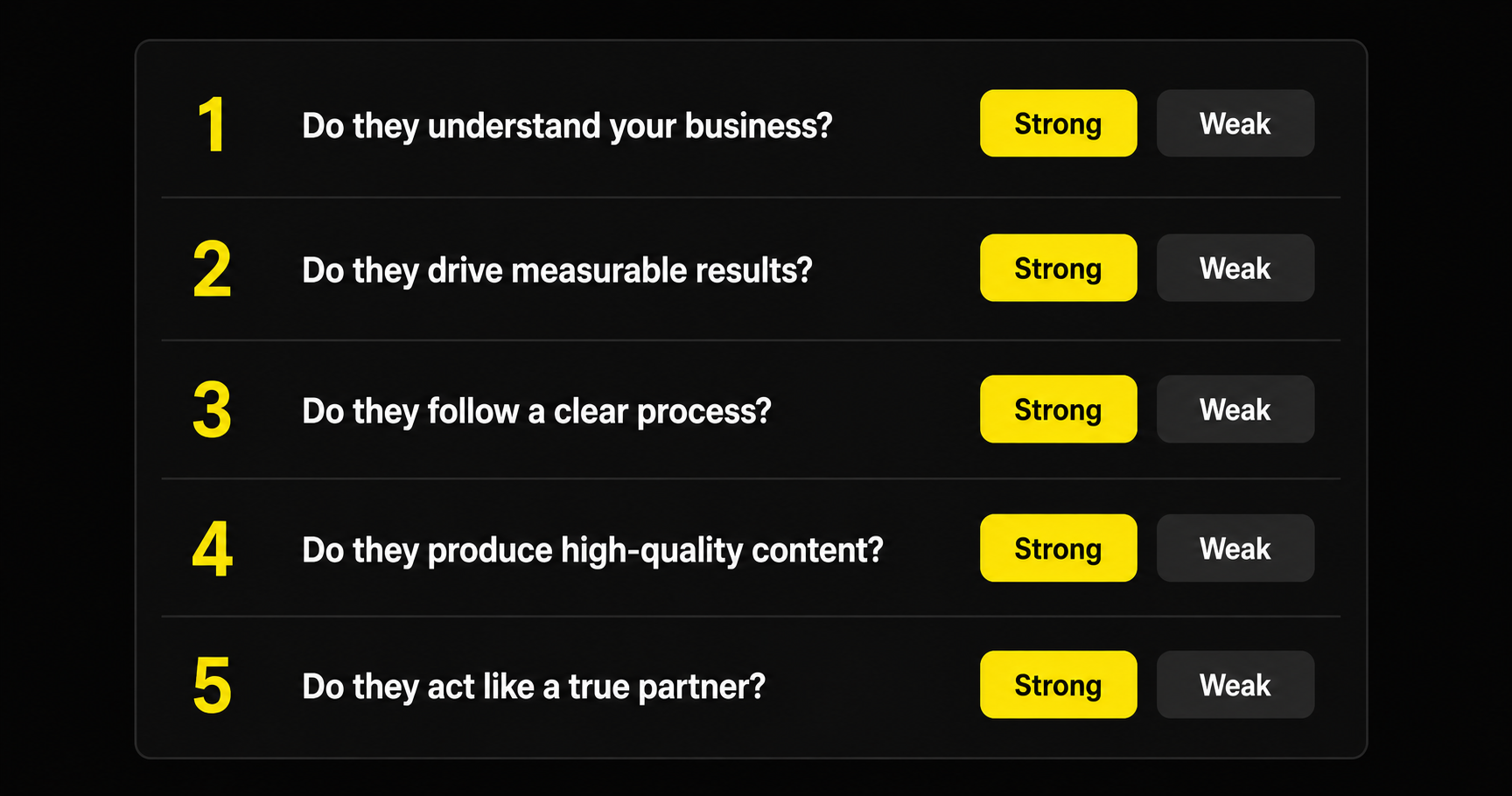
Five questions that reveal the difference
These are the questions worth asking on every vendor call. The answers, including whether the vendor can answer them at all, will tell you more than any proposal deck.
1. Show me content you produced that you can trace to closed revenue or pipeline influence.
Strong answer: A specific example with a named attribution method, even if imperfect. Multi-touch, last-touch, or self-reported deal influence all count.
Weak answer: "Our clients see great results" with no specifics, or a pivot to traffic and ranking data only.
2. Who actually writes the content, and what is their experience in my space?
Strong answer: Named writers or an editorial team with relevant domain background. A clear explanation of how they vet freelancers if they use them.
Weak answer: "We have a network of experienced B2B writers" with no specifics about who or how they are selected.
3. Walk me through your editorial process from brief to final draft.
Strong answer: A specific, documented process with named steps, responsible parties, and quality checkpoints. Ideally, they can share a sample brief or style guide. Vendor methodology is the single most predictive signal of content quality — rated ahead of past clients and team credentials in practitioner analysis from Omniscient Digital
Weak answer: A vague description of "research, writing, review, and revision" with no specifics about what each step involves or who owns it.
4. How do you approach AI search — not just Google, but ChatGPT, Perplexity, and AI Overviews?
Strong answer: A clear hypothesis about what earns AI citations, examples of content they have produced that appears in AI-generated answers, and a testing or monitoring approach.
Weak answer: Silence, confusion, or a pivot back to traditional SEO metrics only.
5. What does success look like at 90 days, and what happens if you are not hitting it?
Strong answer: Specific leading indicators (rankings trajectory, indexed pages, organic sessions trend), a defined review meeting, and a frank discussion of what "not working" looks like and what the off-ramp is.
Weak answer: A vague commitment to "working together to optimise" with no defined checkpoints or accountability structure.
In-house vs. outsourced: how to decide
Not every company should outsource content creation. The decision depends on what you actually need, not what is most convenient to buy.
Outsource when:
- You do not have a dedicated content person in-house and will not hire one in the next six months
- You need specific vertical expertise your team does not have
- You need to scale output faster than internal hiring allows
- Your in-house team is strong on strategy but needs production support
- You are entering a new topic area and need a fast-start content foundation
Keep in-house when:
- Your subject matter is genuinely proprietary and difficult to brief externally
- You have a strong content team that just needs tooling and process, not additional headcount
- Your brand voice is highly differentiated and difficult to transfer through documentation alone
- Your content depends heavily on internal data, customer interviews, or research that an outside team cannot easily access
The hybrid model most mature teams end up with: An in-house content lead who owns strategy, editorial standards, and customer knowledge, supplemented by an external team that handles production volume, specific format expertise (video scripts, technical SEO), and distribution support.
This split gives you strategic continuity and brand consistency on the in-house side, with the scale and specialisation you would otherwise need to hire for.
What to expect in the first 90 days
Understanding the realistic timeline prevents the most common early-relationship failure: expecting traffic results before the structural work has had time to compound.
Days 1 to 30: Foundation
A competent agency spends the first month in deep setup. This includes auditing your existing content, mapping your competitive landscape, building keyword and topic architecture, establishing brand voice guidelines, and producing the first set of briefs. You should see a clear content strategy document and a quarter's worth of briefs by the end of month one. You should not yet see traffic results.
Days 31 to 60: Production
The first real articles are live. The agency is iterating on voice and quality based on your feedback. You are seeing the editorial process in action. The leading indicators to watch: are the briefs getting sharper, is the writing demonstrating domain understanding, and is the team responsive to feedback.
Days 61 to 90: Early signal
Early improvements in search visibility typically appear within three to four months of consistent publishing. You may see first-page movement on low-competition terms, crawl rate improvements, and early organic session growth. You will not yet see pipeline impact. That typically takes six to nine months to materialise reliably.
The 90-day mark is the right time for a structured review meeting. What is working, what is not, whether the strategy needs adjustment, and whether both sides want to continue.
FAQs
What are B2B content creation services?
B2B content creation services are agencies or specialists that produce content designed for business buyers. They typically include blog posts and SEO articles, case studies, whitepapers, social media content, and sales enablement materials. They differ from general content services in their focus on longer buying cycles, technical subject matter, and multi-stakeholder audiences.
How much do B2B content creation services cost?
Retainer-based B2B content programmes typically range from $4,000 to $25,000 per month depending on scope, volume, and agency tier. Per-piece pricing varies from $500 for a standard blog post to $5,000 or more for a research-heavy whitepaper. Project-based work such as content audits and cluster builds ranges from $5,000 to $50,000.
What types of content do B2B agencies typically offer?
Most B2B-focused content agencies offer blog content, long-form SEO articles, case studies, whitepapers, email sequences, social media content, and video production. The strongest agencies include content strategy as part of the engagement rather than as an optional extra.
How is B2B content different from B2C content?
B2B content addresses longer buying cycles of six to eighteen months, targets multiple decision-makers at the same time, requires deeper technical and domain expertise, and is measured against pipeline metrics rather than direct conversion. It is typically longer, more research-intensive, and more expensive per piece to produce well.
Is AI-generated content acceptable for B2B?
The issue is quality and editorial oversight, not the tool. AI-assisted content that has been edited by a subject matter expert, shaped by genuine brand perspective, and enriched with original insight can perform well. AI-generated content published without a substantive editorial layer is not acceptable for B2B audiences. Technical buyers read carefully and notice when content lacks real depth.
How long does it take to see results from a content creation service?
SEO content typically takes three to six months to rank and generate measurable organic traffic. Demand generation content such as case studies, whitepapers, and targeted email sequences can influence pipeline faster, within 60 to 90 days, when it targets buyers already in an active buying cycle.
Should we use a specialist or a full-service agency?
Specialists focused on one or two content types are typically stronger if you need a specific output, such as technical blog content, case studies, or LinkedIn content. Full-service agencies are better if you need integrated strategy across multiple formats and channels with unified reporting. Specialists are cheaper and more focused but require more in-house strategic direction. Full-service agencies are more expensive but handle strategic coordination across channels.