How a B2B Compliance Software Startup Grew Its AI Visibility 77x with Tenpoint Labs
A B2B compliance software startup was fading from AI answers and had a small search footprint. Tenpoint Labs rebuilt the site, moved and refreshed the blog, built the missing bottom-of-funnel pages and went after the sources AI engines cite. Google's AI Overviews now name it 77x as often, and its visibility across five AI engines grew 24x.
The startup helps companies through a high-stakes compliance process, one they go through rarely and need done right. Its buyers now ask Google and AI assistants long, specific questions before they talk to anyone. In July 2026 the startup was hard to find in either place.
Tenpoint Labs started in the summer of 2026. The first weeks went into research and measurement, and work on the website began on 1 September. By the first week of November, Google's AI Overviews named the startup 77x as often as in August, and its visibility across all five AI engines we compared had grown 24x.
The Challenge
By the time the startup came to us, its search visibility was decaying fast, and an earlier investment in content hadn't stopped it.
- Nearly invisible in AI answers: in August, Google's AI Overviews named the startup in 0.7% of answers and AI Mode in 2.9%. Across the five AI engines we compared, it was named in 2.4% of answers, 44th among the brands AI answers mention.
- Slipping on Google: its pages sat at an average position of about 28, off page two, with around 10 organic clicks a day (4–31 August 2026).
- A lot of pages, little to show for them: a previous agency had produced a large volume of blog content. It lived on a separate platform, many posts were thin or overlapped each other, and together they had brought little traffic and almost no results.
- Almost no leads from organic search: the channel that should reach new buyers was generating essentially none.
The Approach
- Rebuilt the site on a new CMS and fixed the core pages. Titles and meta descriptions on the core pages were written for questions nobody searches. We rewrote them from the client's own Search Console queries.
- Pruned the blog and moved it onto the main domain. We moved 130+ posts with 301 redirects, merged overlapping ones and cut the thin ones, so the domain's authority went to fewer, stronger pages.
- Refreshed 26 articles. We chose them by query data: pages already getting impressions on page two and three, rewritten to answer the full questions buyers type.
- Built the bottom-of-funnel pages that were missing. Comparison, reviews, services and investor-facing pages, because AI answers were naming rivals on exactly these "which one should I use" prompts.
- Went after the sources AI engines cite. We mapped the third-party roundups and listicles that appear in AI answers for the category and prioritized placements by how often each one gets cited.
- Measured weekly, in a workspace the client can see. From 6 October we tracked 200 buyer prompts across five AI engines, and the client has a seat in Tenpoint Analytics.
The Results
In AI answers
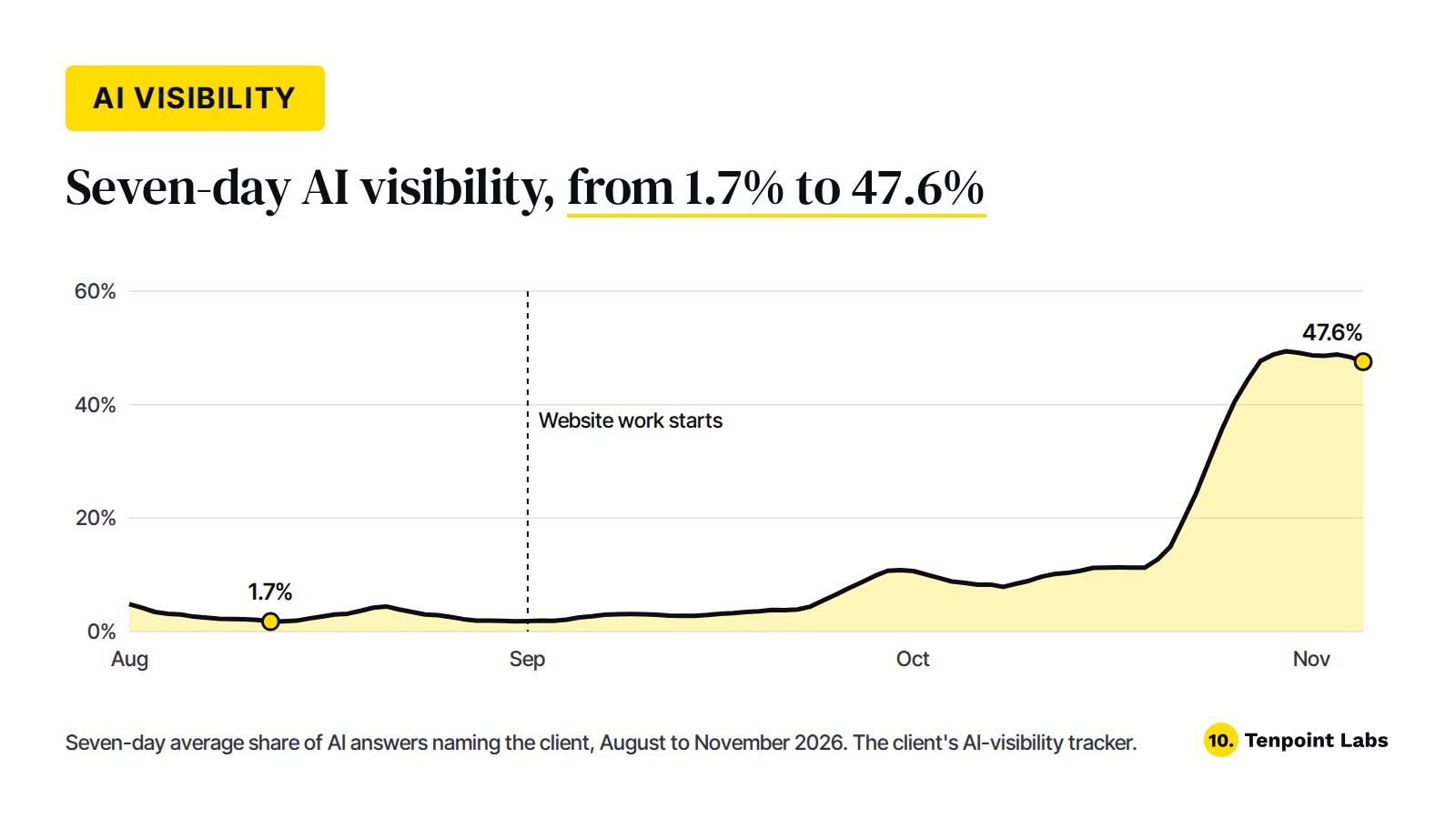
The client's own AI-visibility tracker measures the category every day across ChatGPT, Google AI Overviews, Google AI Mode, Gemini and Microsoft Copilot. Google's AI Overviews moved most, naming the client 77x as often in the week to 5 November as in August. Across all five engines together, weekly visibility grew 24x over the same stretch, and the client climbed from 49th to 3rd among the brands AI answers name.
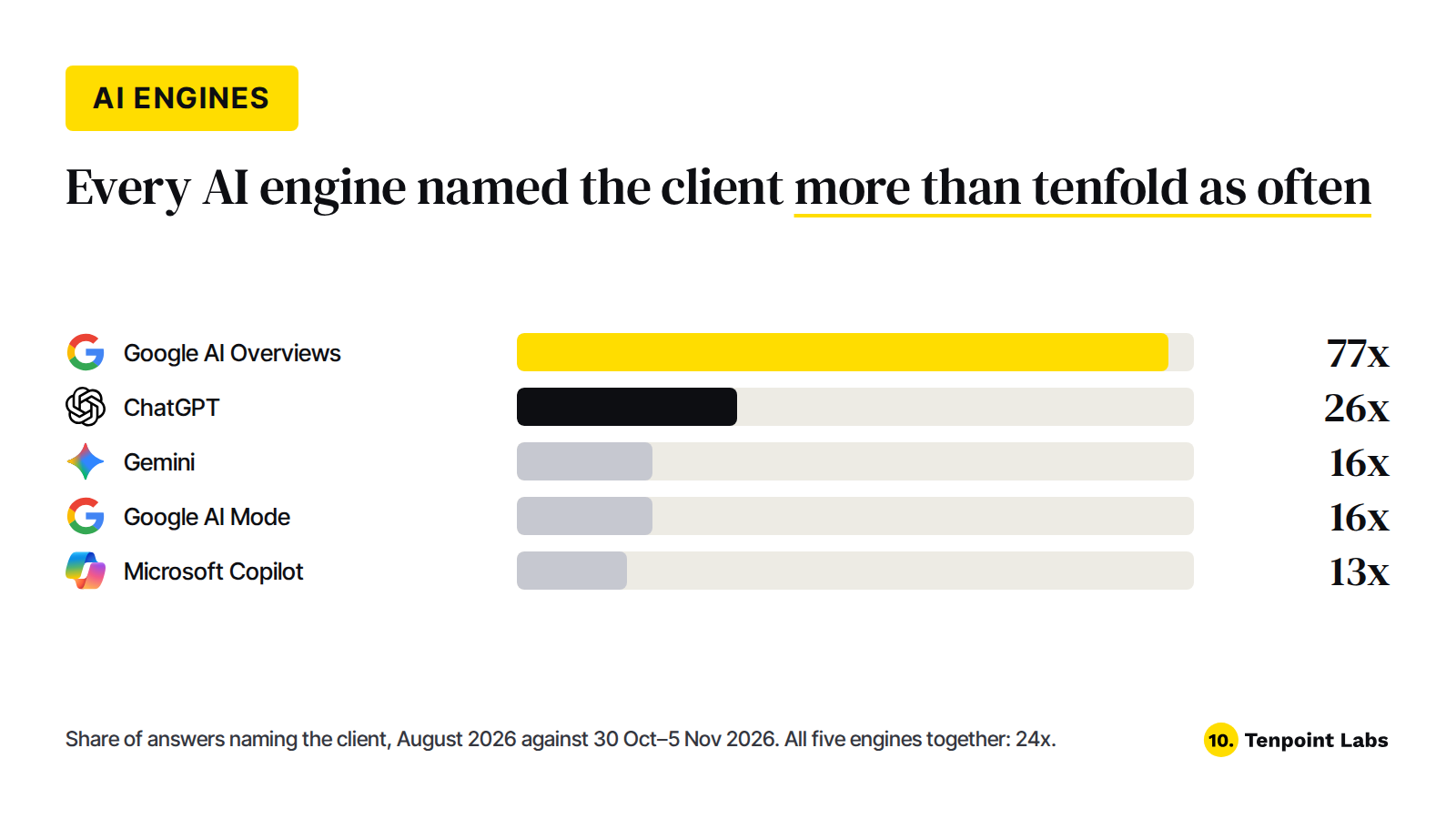
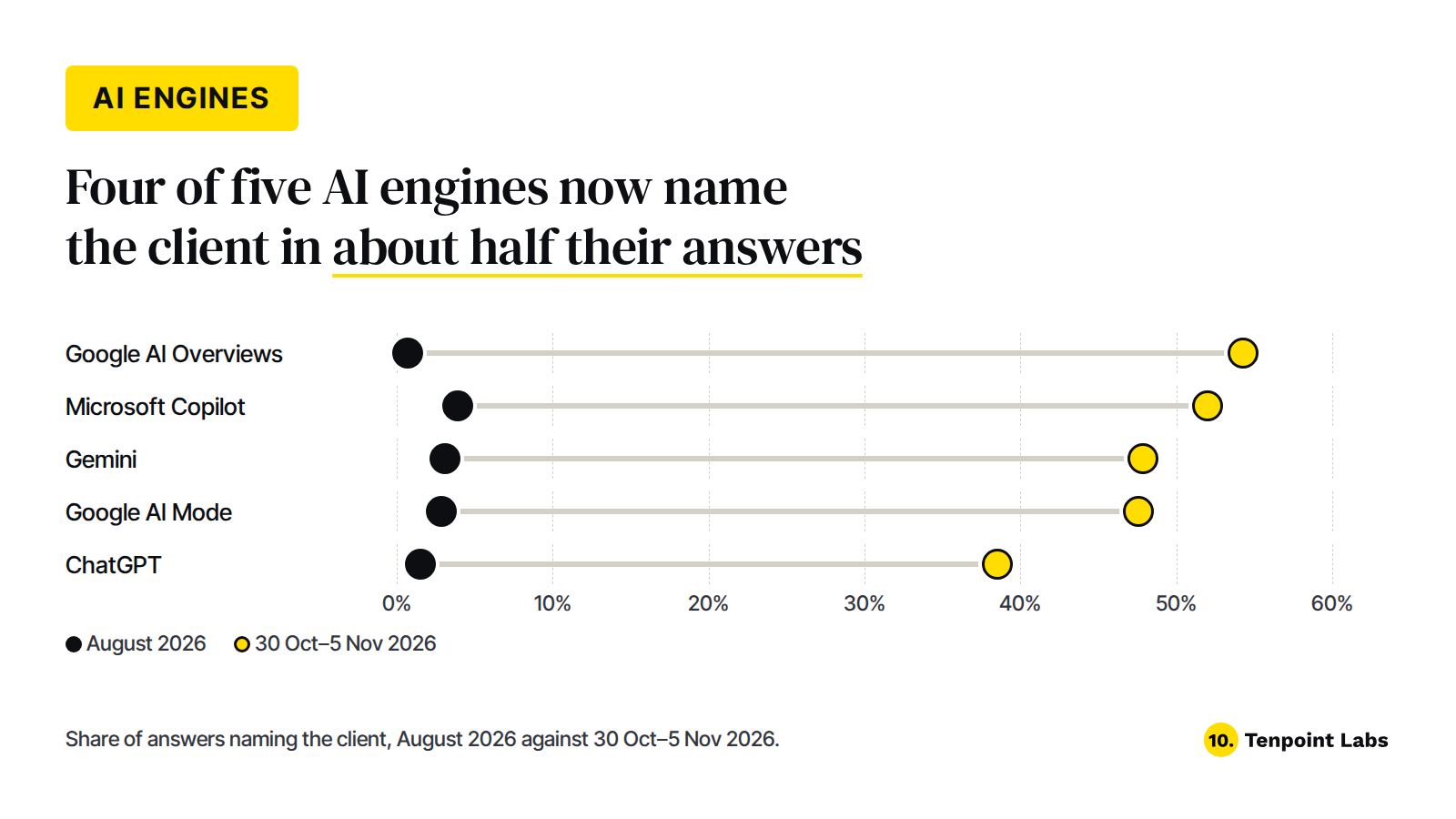
Every engine rose more than tenfold. When AI answers name the client, they now name it nearly twice as early in the list (average position 4.0 in August, 2.1 last week). Only two brands are named more often, and both are larger, better-funded companies.
Most of that happened within 60 days of starting website work. Comparing the week of 6–12 August with 25–31 October, visibility across all five engines was up 24x, the client ranked 3rd among the brands AI answers name, up from 49th, and its share of the category's AI citations had grown 16x, making it the 2nd most-cited website in the category, up from 34th.
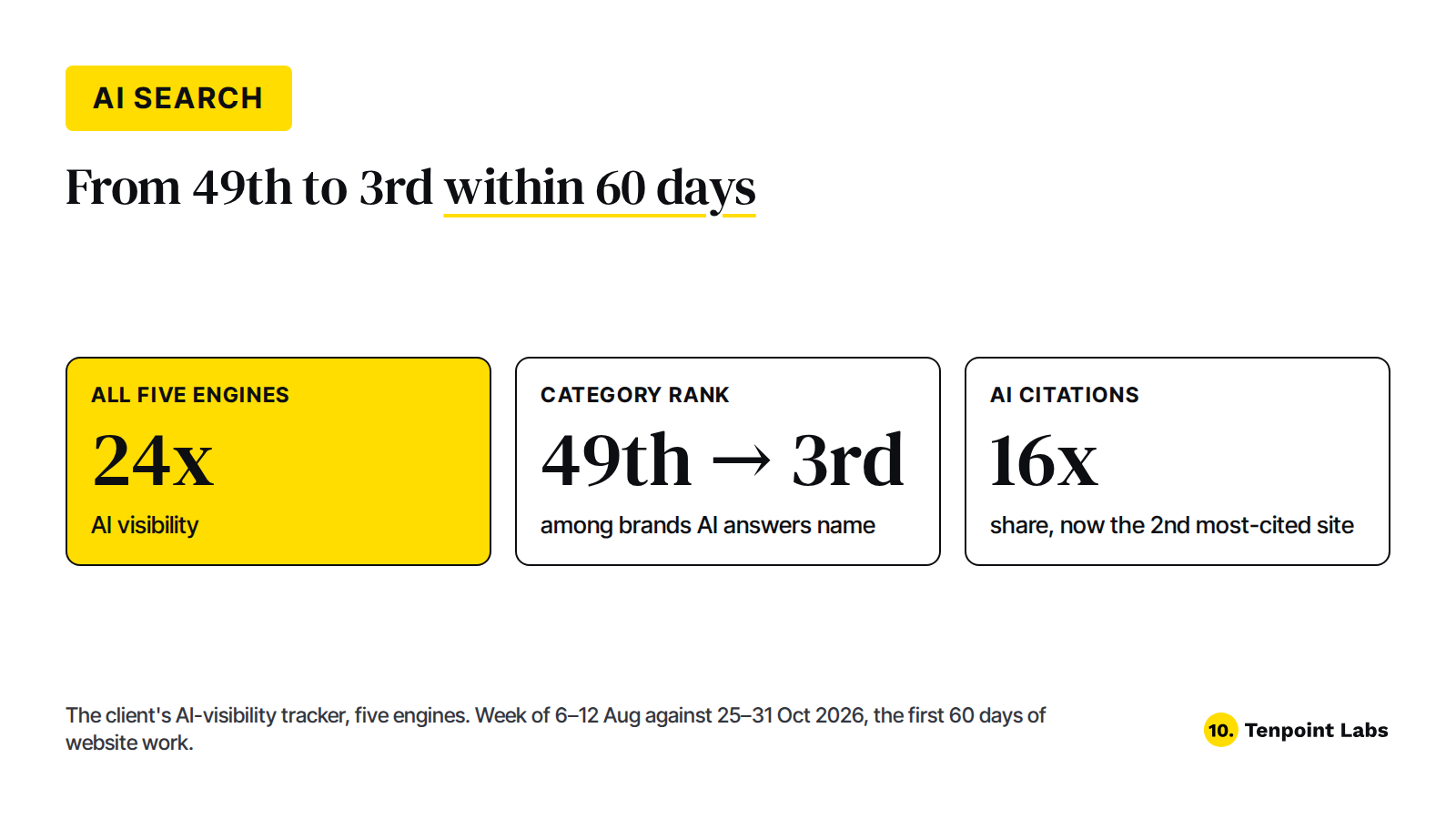
The gain holds over longer windows too. Comparing the 28 days before website work began (4–31 August) with the latest 28, visibility rose 13x and rank climbed from 45th to 3rd. Our own weekly tracking, on a different set of 180 questions, points the same way: answers naming the client grew 6.5x between 6 October and 2 November.
By the Numbers
- 77x Google AI Overviews visibility, August against the first week of November
- 24x AI visibility across five engines within 60 days of starting website work
- 49th → 3rd among the brands AI answers name in the category
- 16x share of the category's AI citations, now the 2nd most-cited site
- 6.5x likelier to start an intake when a visit comes from an AI assistant, and 5x the rate for organic search visitors
- 6x visits from ChatGPT, and 3x from all AI assistants
- 1.5x organic clicks, impressions and search sessions from Google
- 13 places higher average Google position, from about 28 to about 15
How Google and AI Answers Fed Each Other
We ran one program for both surfaces, and the results showed up on the same pages. The homepage's average Google position went from 6.1 in August to 2.3, and AI answers cited it 2.5x as often between 12 October and 2 November. A provider roundup from our bottom-of-funnel batch first appeared in AI answers on 26 October, was cited in 59 answers a week later, and was cited by all five engines. Cost and how-to articles that reached Google's first page are now cited in AI answers too.
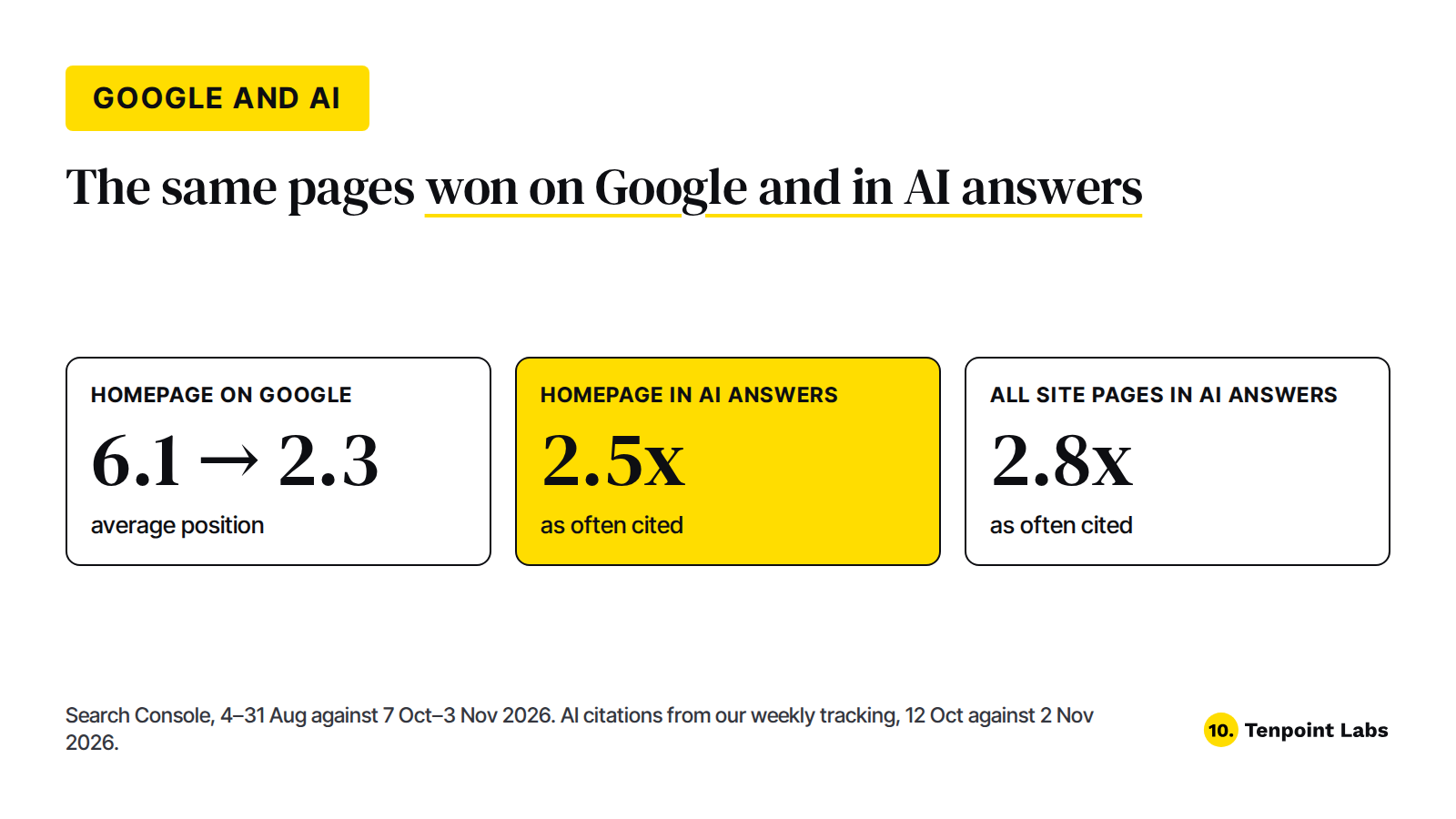
The client's tracker shows the same thing at scale. The most-cited page in the latest 28 days, cited 1,819 times, is a how-to guide we moved onto the main domain and refreshed. Two provider roundups from the bottom-of-funnel batch follow it, then comparison pages that first appeared in AI answers on 8 October. Across the site, answers citing any of the client's pages nearly tripled (2.8x) in three weeks. When ChatGPT searched the web to answer a question, the comparison pages came back in 50 answers over four weeks. That is classic SEO work being read by an AI engine. A press feature from the off-site work was cited in 31 answers, and 29 of those named the client.
The Impact
In the 60 days after website work began, a startup that AI engines had almost stopped mentioning became one of the three brands they name most in its category. Its visibility across five AI engines grew 24x, it moved from 49th to 3rd among the brands AI answers name, behind only two larger, better-funded companies, and its site became the 2nd most-cited source in the category's AI answers. By the first week of November, Google's AI Overviews named it 77x as often as in August.
The same work lifted Google: 1.5x organic clicks and an average position 13 places higher. And the new attention converts: visitors who arrive from an AI assistant are 6.5x likelier to start an intake than the average visitor. One program, built on the startup's own data, moved Google and AI search together.
Why This Case Study Is Anonymous
The client asked us not to name them. The numbers, windows and actions are real and come from the client's own Search Console property, its AI-visibility tracker and its Tenpoint Analytics workspace.

