Perplexity vs Google for SEO, and Which to Optimize First
Perplexity vs Google comes down to this: classic Google results rank pages in a list, Perplexity cites a short list of sources inside one written answer, and for most B2B sites Google comes first.
Does your Google work carry over to Perplexity? Which one sends you visitors today? What would change the order?
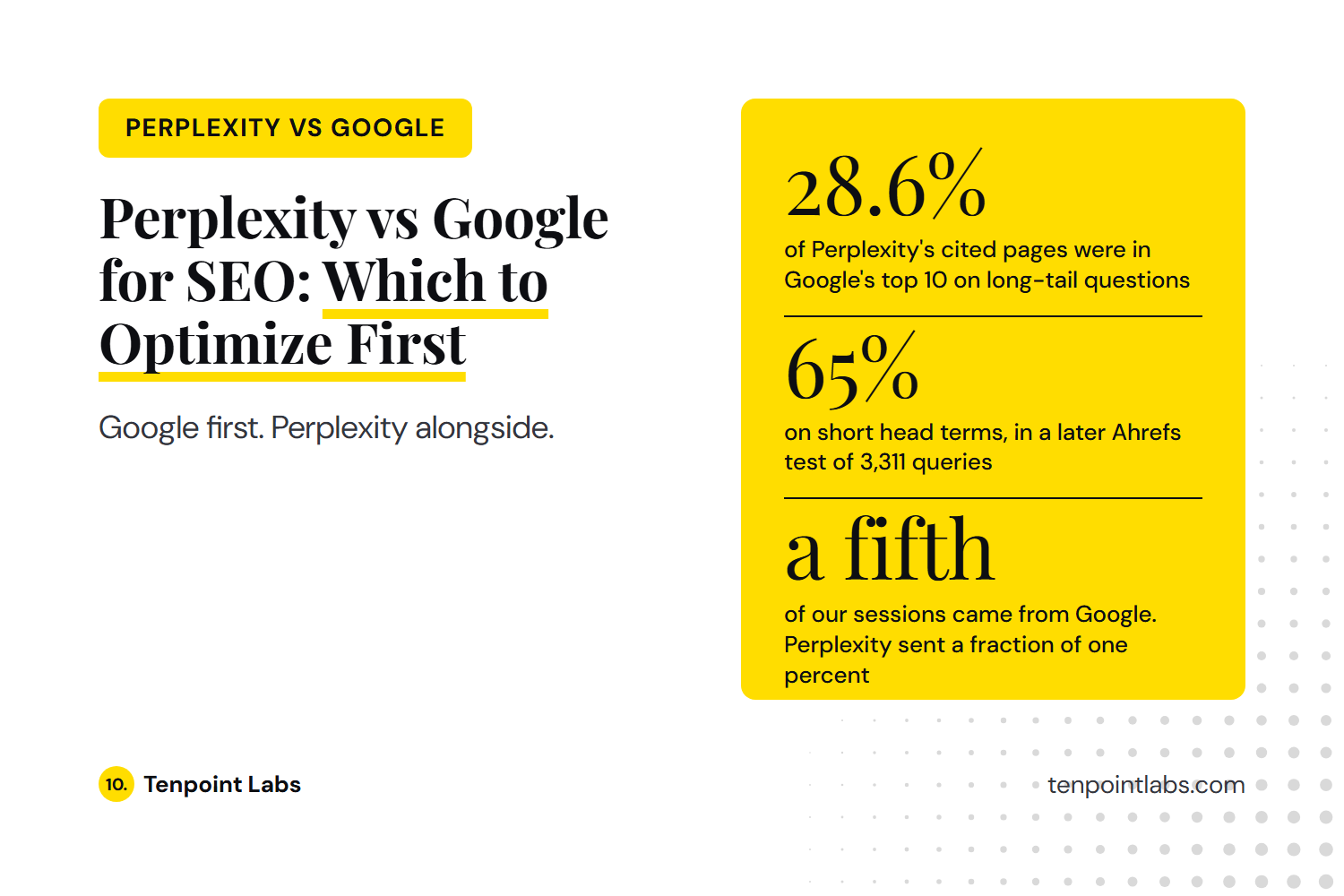
We checked our own numbers, and Google's share dwarfed Perplexity's.
Key takeaways:
- Classic Google results are a list of pages, while Perplexity writes one answer and cites its sources
- Perplexity's cited pages overlap with Google's top 10 far more on short head terms than on long-tail questions
- Most SEO basics carry over, but rank tracking works differently and click-through work likely matters less
- Google comes first for most B2B sites, and Perplexity gets a few low-cost steps alongside
What Is the Core Difference?
Classic Google results return a list of pages for you to choose from, and Perplexity writes one answer and cites its sources. Perplexity's help center says it searches the web in real time, and that each response includes citations and links to the original sources. Google's own AI Overviews and AI Mode also write answers, and Google reports them in Search Console.
Google gives you a menu. Perplexity gives you the meal, with footnotes.
This post counts a citation as a link to your page inside the answer. Our guide to AI citations versus mentions explains how that differs from being named.
Do They Use the Same Index?
Perplexity and Google don't share one index, but they do touch. Perplexity runs its own crawler, PerplexityBot, and Google builds its index with Googlebot and its other common crawlers. They meet because Ahrefs reported in September 2025 that Perplexity had been scraping Google results through a third-party provider.
A Google ranking doesn't prove Perplexity has seen your page, and a missing ranking doesn't prove it hasn't.
Perplexity's side now runs on Photon, an in-house retrieval and ranking engine it described in September 2026, and our research on how Photon orders sources found that Perplexity cited 89% of the sources it returned first and 29% of those it returned tenth.
How Much Do Their Results Overlap?
The share of Perplexity's cited pages that sit in Google's top 10 ran from about 29% to about 65% across two Ahrefs studies. The studies used different designs and datasets, so the gap may reflect the type of query, but they can't prove it.
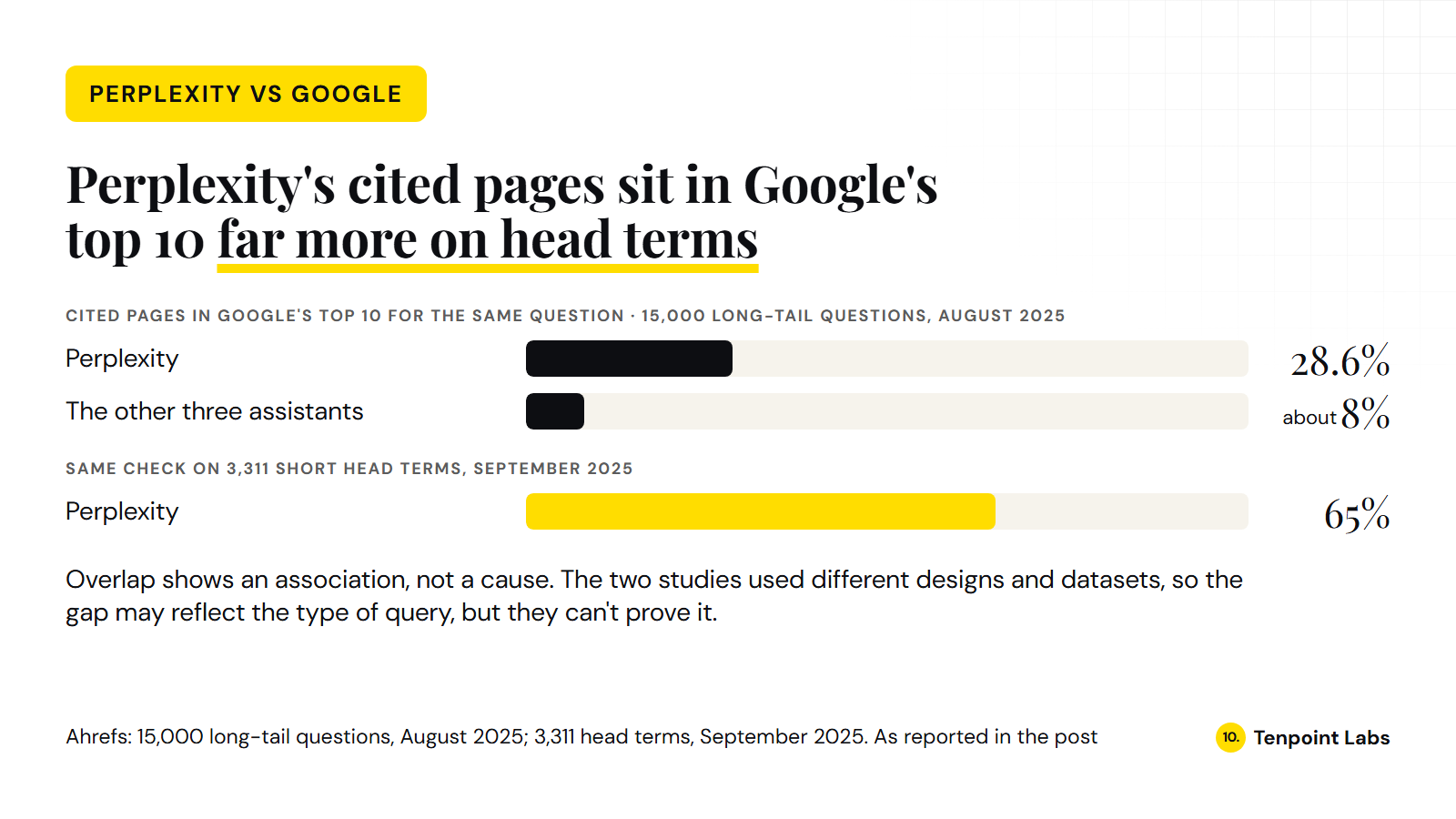
An August 2025 Ahrefs study put 15,000 long-tail questions to four AI assistants. For Perplexity, 28.6% of the cited URLs were in Google's top 10 for the same question, against about 8% for the other assistants. A September 2025 Ahrefs test of 3,311 short head terms put Perplexity at 65%.
Overlap shows an association, not a cause. It still guides your work.
On short head terms, about two thirds of Perplexity's cited pages also rank in Google's top 10, so your Google work may already be doing part of the job. On long-tail questions, most cited pages come from outside the top 10, so a Google ranking alone is a weak guide to whether you're cited. The data can't say whether ranking is the reason either way.
Perplexity vs Google Side by Side
Perplexity and Google differ in what you get back, what you compete for, where the pages come from, where you see results and what you can control. The table sets them next to each other:
Google's Search generative AI control lets you manage your site's inclusion in AI Overviews, AI Mode and Discover's AI features. It reached all sites on 31 August 2026. That gives you a setting for Google's AI answers, while robots.txt is the main lever for Perplexity.
Google's June 2026 Generative AI reports began rolling out to a subset of sites. They show impressions, with views by page, country, device and date, and Google's launch post lists no query data. If your site has the report, use it for page and date trends, because it can't tell you which prompts brought you in.
Which SEO Skills Carry Over?
Most SEO basics carry over, which fits the layered view in our SEO, GEO and AEO guide. Google's AI features guidance says there are no extra technical requirements, and that SEO fundamentals still apply. Four skills transfer to Perplexity:
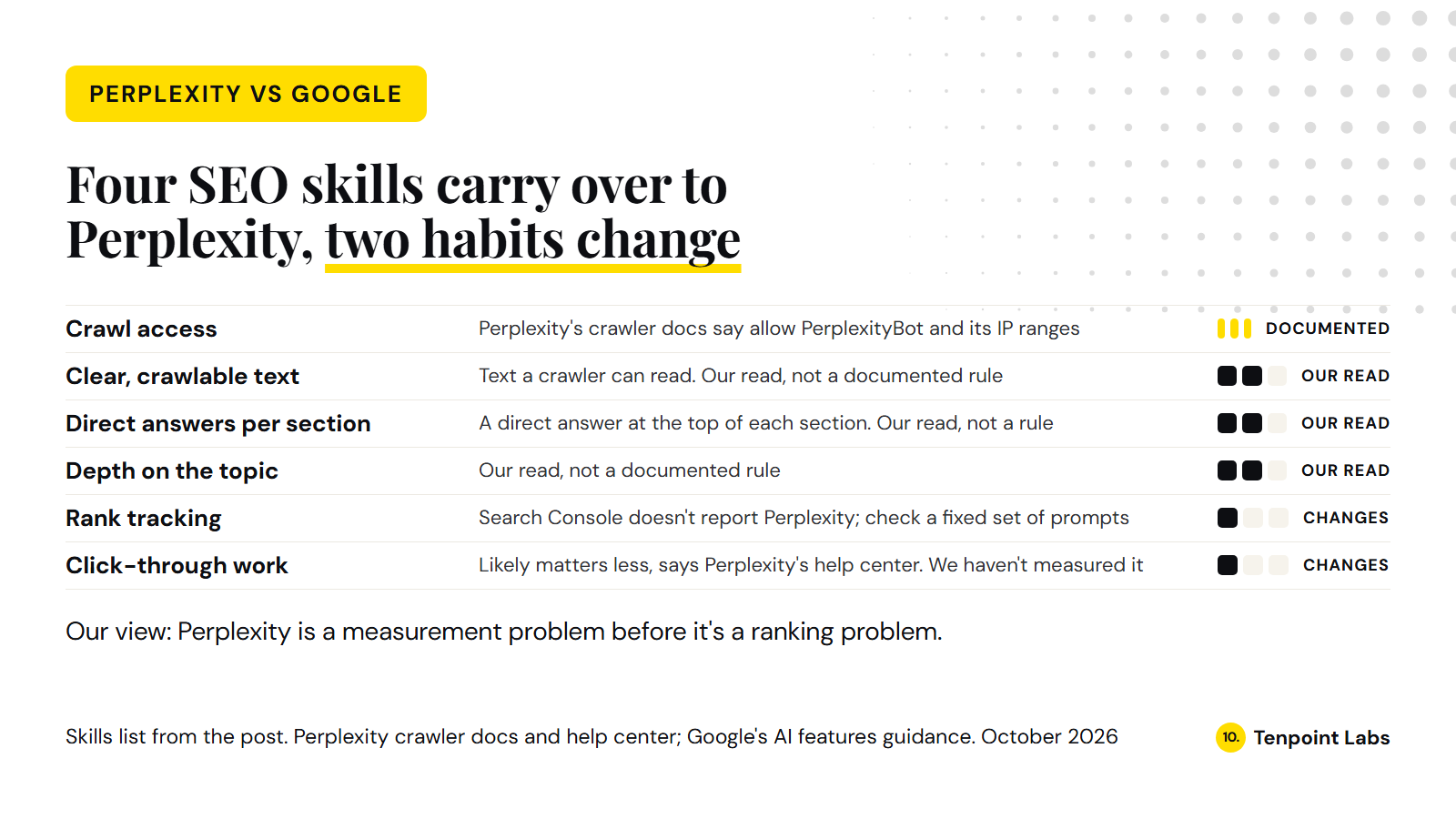
- Crawl access, because Perplexity's crawler documentation recommends allowing PerplexityBot and its published IP ranges
- Clear text that a crawler can read
- Direct answers at the top of each section
- Depth on the topic
The last three are our read, not a documented rule.
Two habits change. Rank tracking works differently, because Search Console doesn't report Perplexity at all, so you check a fixed set of prompts for citations instead.
Click-through work likely matters less, because Perplexity's help center says its answers remove the need to open many web pages. We haven't measured that effect.
Our view: for now, Perplexity is a measurement problem before it's a ranking problem, because you can't improve a number your tools don't show.
Which Should You Optimize First?
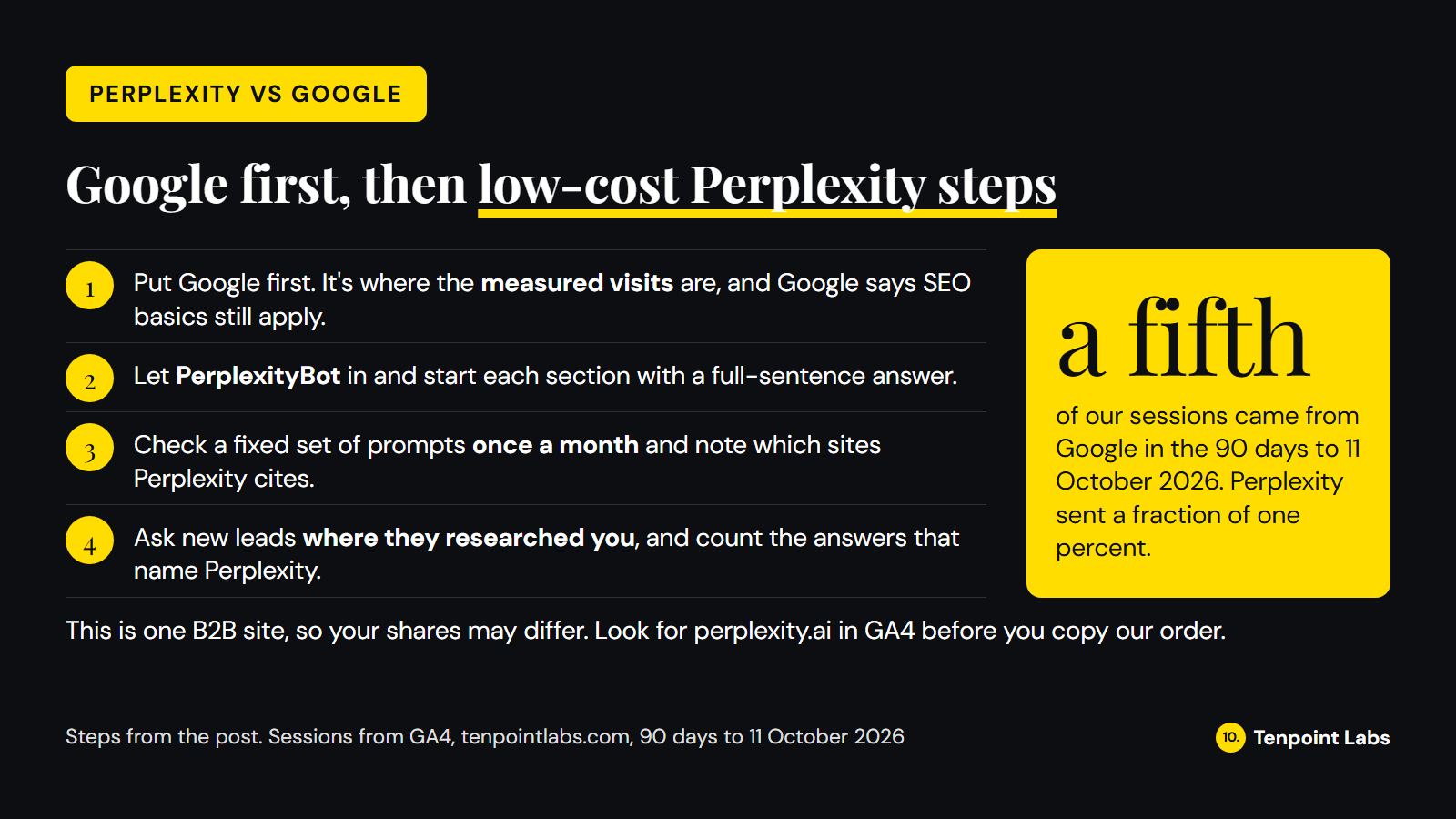
Most B2B sites should optimize Google first and add a few low-cost Perplexity steps alongside. Our own numbers show why. Over the 90 days to 11 October 2026, Google sent about a fifth of our sessions and Perplexity sent a fraction of one percent.
In our GA4 report, perplexity.ai sits in the tail of small sources, beside claude.ai and gemini.google.com. chatgpt.com sent more, and it was still under 1% of sessions. A slice that small is too small to measure with confidence.
That's the point. Google's share is big enough to measure and improve, while Perplexity's isn't, so there's no number yet to justify putting it first.
Direct visits made up more than 70% of our sessions, so some Perplexity visits may be hiding there. That's why the order comes with triggers, listed below.
Our monthly Perplexity prompt check is a small snapshot too. Putting that channel first on this evidence would be a bold use of a Tuesday.
- Put Google first. It's where the measured visits are, and Google says SEO basics still apply to its AI features.
- Add the low-cost Perplexity steps. Let PerplexityBot in and start each section with a full-sentence answer. Then check a fixed set of prompts once a month, using the prompt panel in our AI share of voice guide.
- Watch for signs to move Perplexity up. Ask new leads where they researched you, and count the answers that name Perplexity.
Move Perplexity up when one of these three signs appears:
- Buyers name Perplexity on sales calls or forms
- Referrals from perplexity.ai grow into a visible share of your sessions
- Your monthly prompt check shows rivals cited where you aren't
This is one B2B site, so your shares may differ. Open the traffic acquisition report in GA4 and look for perplexity.ai before you copy our order.
How we do this at Tenpoint Labs
We start with Google, because it's where the measured visits are, and we run a few low-cost Perplexity checks alongside.
The data behind it
We pull prompt results from Ahrefs Brand Radar and sessions from GA4, then compare the two. That's how we know Google sent about a fifth of our sessions and Perplexity a fraction of one percent.
What you see in your seat
You see the same views we plan from: AI search visibility across five engines, and the acquisition explorer for referral traffic. We connect it for you. See what's in a seat on Tenpoint Analytics.
FAQs
Is Perplexity better than Google for SEO?
Google is the better place to start for most B2B sites, because it sends far more of the visits we can measure. In our data Google sent about a fifth of sessions and Perplexity a fraction of one percent. Perplexity still matters for being cited, so the right pace depends on how your buyers research.
Does Perplexity use Google's results?
Perplexity has scraped Google results through a third-party provider, according to Ahrefs in September 2025, and it also runs its own crawler. In two Ahrefs studies, the share of its cited pages in Google's top 10 ran from about 29% to about 65%. Overlap isn't the same as copying.
Do backlinks matter for Perplexity?
We found no study showing that backlinks drive Perplexity citations. Treat them as unproven for Perplexity. Keep earning them for Google.
Can I see Perplexity traffic in Google Search Console?
Google Search Console can't show Perplexity traffic, because it reports Google's own surfaces. Google's June 2026 reports cover its own generative AI features in Search and Discover, and Google's launch post lists no query data. Perplexity visits that carry a referrer appear in GA4 as perplexity.ai, and the rest land in Direct.
Should small B2B sites optimize for Perplexity?
Small B2B sites should optimize for Perplexity lightly. Start with bot access, stand-alone sections and a monthly prompt check, and go further only when buyers say they research there.
Perplexity vs Google is a question of order: Google first, then a few low-cost Perplexity steps. This week, add "Where did you research us?" to your demo form and count the answers that name Perplexity. Tenpoint Labs is one team that tracks both for clients in Tenpoint Analytics, and you can find out more.