Perplexity Ranking Factors: What Photon and 12,805 Sources Reveal

Perplexity cited 89% of the sources it retrieved first and just 29% of those it retrieved tenth. That gap emerged from our analysis of 1,282 Perplexity answers and 12,805 retrieved sources, revealing how closely a page’s place in the source list tracks its chance of reaching the final answer.
At Tenpoint Labs, we went a step further: we examined what the pages near the top had in common. They tended to bring the question’s words together in a focused passage and use more of them in headings, a pattern that held in a second set of answers from another Perplexity model. Once we accounted for list position, most of those same features showed little additional relationship with citation.
These findings give publishers evidence to work with at a moment when Perplexity has begun revealing how its search engine works. Its 24 September account of Photon describes the information it stores about pages, including word positions and fields. Here, we connect those disclosures with our original research to show which clues hold up in the sources Perplexity actually retrieves and cites, and which page changes are worth testing.
Key findings
- Position was strongly associated with citation. Sources in the top three were cited 80% of the time, compared with 34% in the bottom three.
- Relevant wording tracked higher positions on two Perplexity models. The individual relationships were small, with the strongest within-answer correlation around 0.14.
- Freshness held on one model only. Newer pages appeared higher in sonar answers and showed almost no relationship with position in sonar-pro answers.
- Content features added little explanatory value once position was accounted for. This does not mean content is unimportant: it may help determine which pages are retrieved and where they appear.
- Tables and FAQ schema were more common near the top. The analysis does not establish that either directly improves ranking.
About the data: we analyzed 1,282 Sonar API answers to 1,007 buyer questions tracked for 16 brands between 16 September and 15 October 2026. The brands are clients and prospects and remain anonymous. The returned lists contained 12,805 source entries, covering 9,147 distinct pages; we crawled and parsed 91% of the retrieved pages. A second set of 1,406 answers from Perplexity’s sonar-pro model, collected by our audit tool between April and October 2026, serves as a cross-check.
What is Perplexity Photon?
Photon is Perplexity’s in-house retrieval and ranking engine. It finds candidate pages in the web index and orders results that can support an answer. The language model then generates the response and selects citations.
In its Photon engineering post, published on 24 September 2026, Perplexity describes replacing an adapted open-source engine that had reached limits in memory costs, slow responses and recovery time. The company reports reducing p99 retrieval and ranking latency from roughly 800 milliseconds to 65 milliseconds, while storing about 2.5 times as much data per document.
For publishers, the more revealing details concern the information Photon stores and the stages through which candidates pass. A query goes to a broker, which distributes it across shards, each responsible for part of the index. Each shard retrieves candidates, ranks them and applies a second ranking stage. The broker merges the results.

That describes how pages reach a result list. It does not disclose the scoring formula or explain every decision the answer model makes afterward.
What Photon reveals about Perplexity’s ranking factors
The engineering account describes capabilities and stored information. Those disclosures need to be distinguished from evidence that a particular page feature receives a ranking boost.
| Mechanism | What the Photon post describes | What it establishes | What our analysis found |
|---|---|---|---|
| Ranking in stages | Retrieval, initial ranking and second-stage ranking on each shard, followed by a broker merge | Ranking has multiple stages; their weights and models remain private | Not directly testable from our data |
| Query-term matching | A WAND-like traversal of index lists for query terms, without guaranteeing an exact top-k result | Query terms help identify candidates; the scoring formula is unnamed | Pages covering more question terms tended to appear higher |
| Word fields and positions | Records containing term frequencies, fields and positions within documents | Photon has information about where terms appear | Proximity and heading coverage tracked higher positions |
| Index freshness | Full rebuilds within hours and document delivery within minutes for topics with high freshness requirements | The system can make fresh material available quickly; a freshness boost is not established | Newer pages appeared higher on one of two Perplexity models |
| More data per document | About 2.5 times as much stored data, used to improve ranking quality | More information is available to ranking; the additional signals are not fully identified | Not directly testable |
| Usefulness ordering | Index lists ordered by a separate usefulness signal | Such a signal exists; its definition is undisclosed | Unknown |
| Embeddings | Precomputed embeddings prepared during index jobs | Embeddings exist; their role in retrieval or ranking is not specified | Not tested |
| BM25, link authority and a knowledge graph | Not named in the post | The post does not confirm these mechanisms | Not tested |
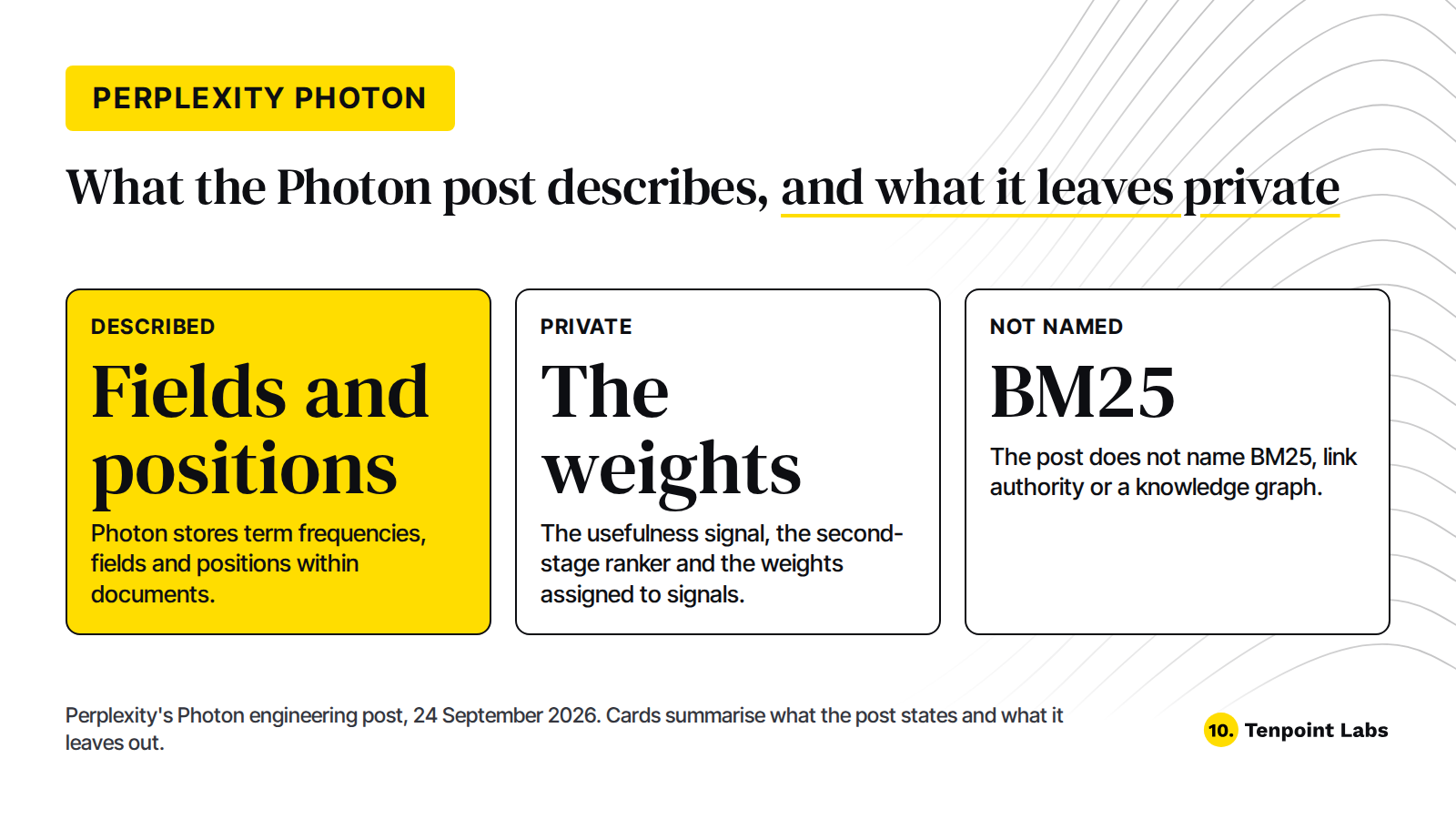
The distinction matters most for freshness and structured content. A system that indexes changes quickly does not necessarily reward a newer date. Likewise, finding more tables on higher-positioned pages does not show that adding a table will move a page up the list.
What remains private
Photon’s usefulness signal is undefined. The second-stage ranker is not described in enough detail to reproduce it. The role of embeddings and the weights assigned to individual signals remain unknown.
The post also introduces a faster Search API preset with a retrieval-quality trade-off: its reported relevance score, measured by DCG, falls from 2.45 to 2.21. It does not establish whether the consumer product uses that preset. Publishers should therefore be cautious about treating every Perplexity product or configuration as an identical ranking environment.
What 1,282 Perplexity answers showed
Our tracking runs recorded the sources returned with each Sonar answer, usually ten, and the citations in the answer text. This allowed us to compare sources returned for the same question, including those cited and those left unused.
We then measured features of the retrieved pages and compared them within each answer. This provides a closer comparison than pooling unrelated pages, although it cannot isolate the effect of a page feature from all the other reasons a source might appear higher.
Citation rates fell steadily with list position
Perplexity cited an average of 5.4 sources per answer. Its choices closely followed the order of the returned list.
| Position in returned list | Citation rate |
|---|---|
| 1 | 89% |
| 2 | 77% |
| 3 | 73% |
| 4 | 61% |
| 5 | 51% |
| 6 | 47% |
| 7 | 42% |
| 8 | 37% |
| 9 | 35% |
| 10 | 29% |

The lower positions still contributed: 62% of answers cited at least one source from positions eight to ten. But the difference between the top and bottom three was substantial: 80% versus 34%.
The same broad pattern appeared across all 16 brands. The gap between the top three and the remaining positions ranged from 24 to 44 percentage points by brand. That comparison uses a different baseline from the top-three-versus-bottom-three figures above.
Position may capture more than relevance. The answer model could favor sources presented earlier, and the public response does not let us disentangle ranking quality from presentation order. We also cannot observe every internal retrieval or reranking step through the returned list.
For a publisher, the useful finding is narrower and clear: sources appearing earlier in these API responses were much more likely to receive a citation.
Higher-positioned pages shared several content features
Five groups of features stood out in comparisons within answers.
Question terms close together. The strongest association concerned proximity. Higher-positioned pages more often contained a passage of roughly 40 words covering most of the question’s terms. Photon’s storage of word positions makes this a plausible signal to investigate, but does not confirm how it is scored.
Question terms in titles and headings. Pages using more of the question’s words in their title and subheadings tended to appear higher. This is consistent with Photon having field-level information, without proving that any specific heading receives a fixed boost.
Coverage in the body and opening. Pages covering more question terms across the body, and within the first 100 words, also tended to appear higher.
Recent publication dates, on one model. Among top-three sources in the sonar answers, 37% had been published in the previous 90 days, compared with 29% in the bottom three. Median page age was 135 days versus 200 days. In the sonar-pro cross-check, the relationship between page age and position was close to zero.
Tables and FAQ schema. Tables appeared on 48% of top-three sources and 39% of bottom-three sources. FAQ schema appeared on 34% and 26%, respectively.
| Feature (sonar answers) | Positions 1–3 | Positions 8–10 |
|---|---|---|
| Published within 90 days | 37% | 29% |
| Median page age | 135 days | 200 days |
| At least one table | 48% | 39% |
| FAQ schema | 34% | 26% |
| Cited in the answer | 80% | 34% |

The individual relationships were small. The strongest within-answer correlation with position was about 0.14, and the reported patterns were measured across more than 1,000 answers. Their consistency makes them useful hypotheses for testing, rather than a checklist of confirmed ranking factors.
The two strongest patterns also appeared in the cross-check. In 1,406 sonar-pro answers, which had longer source lists and different questions, pages with the question’s words close together and in their headings again sat higher, at similar strength, both before and after 24 September.
Tables and FAQ schema may identify a broader kind of page: structured, reference-oriented content that answers questions clearly. The data does not separate the effect of those features from the content that accompanies them.
After accounting for position, most measured features showed little additional association
Next, we compared cited and uncited sources at the same list position. Question-term coverage, headings, opening coverage and proximity showed little additional association with citation in that comparison.
Length was the exception: longer pages were slightly less likely to be cited at a given position.
This narrows the practical interpretation. The measured relevance features were associated with where a page appeared, but offered little additional explanation of citation once position was taken into account. It does not show that the answer model ignores content, that unmeasured features have no effect, or that shortening a page will improve its citation rate. Depth on one coherent question is a different thing from length, a distinction we cover in why comprehensive guides stop working.
Citation rates also varied by source type
Government sites were cited 66% of the time when retrieved, compared with 53% across all sources. Reddit threads appeared 48 times and were cited in 19% of those appearances.
These are descriptive results for this question set, not evidence of a universal preference for government domains or a penalty against Reddit. The Reddit sample is particularly small, and both figures depend on the questions and sources retrieved.
What to change on your pages
The findings support a set of focused edits to test on pages answering your buyers’ questions. They do not establish a guaranteed route to higher positions or more citations.
Answer the question in a focused passage
Give the reader a passage that answers the question directly and keeps its important concepts together. Use the vocabulary buyers use when it accurately describes the subject.
For a question such as “how do I choose a payroll provider for a small team,” a useful passage might explain which payroll-provider criteria matter for a small team and why. Aim for a complete, helpful answer that makes sense on its own; our GEO guide for B2B shows how to format a paragraph for extraction. The roughly 40-word window in our measurement is not a recommended passage length or a known Photon threshold.
Use a descriptive heading above the answer
Make the heading specific enough to tell readers what the passage covers. “How to choose a payroll provider for a small team” is clearer than “Making the right choice.”
This follows the heading association in our data and Photon’s ability to record fields. It does not require repeating the whole question in every heading or forcing exact-match wording where it reads badly.
Keep important facts current
Review pages where changing facts affect the answer. Update the substance, then make the update date visible and accurate.
The evidence on freshness is mixed: newer pages appeared higher in the sonar answers and not in the sonar-pro answers. In the sonar-pro runs, the share of retrieved pages published in the previous 90 days rose from 19% before 24 September to 24% after, which fits Photon’s faster indexing without proving a boost. The study did not test whether changing an existing page’s date improves its position. Photon’s fast indexing pipeline also does not guarantee that any individual update will be crawled or reflected within a particular time.
Use tables when readers need a comparison
A table can make options, specifications or trade-offs easier to compare. Use one when it improves the answer.
The higher prevalence of tables among top-three sources is a reason to investigate, not evidence that every page needs one. The same restraint applies to FAQ schema: this analysis does not establish a ranking benefit from adding it.
Check crawler access and measure what changes
Check whether PerplexityBot can reach the page. Our guide to how to rank in Perplexity covers crawler access step by step.
Then track retrieval, returned position and citation separately for the questions the page answers. Those measures help distinguish a page that is absent from the source list from one that appears but is rarely cited. Our guide to measuring AI share of voice covers building the prompt panel behind them.
The evidence gives little reason to pad pages with extra text or expect wording edits alone to improve citation at an unchanged position. Prioritize a useful answer and test whether the page becomes more visible for the relevant questions.
Limits of the study
The analysis covers Sonar API answers, not the consumer app. Findings about its returned lists and citation behavior should not automatically be applied to every Perplexity experience.
Other limits matter when interpreting the results:
- Returned order is an external observation. We cannot reconstruct all internal ranking stages or isolate their contribution from the answer model’s handling of sources.
- Some pages were crawled after the answers were collected. The reported lag was up to four weeks, during which content may have changed.
- Page measurements cover the successfully parsed subset. We crawled and parsed 91% of retrieved pages; inaccessible pages may differ from those measured.
- The questions lean commercial. They cover software choices, service providers and practical questions with a purchase behind them, across 16 tracked brands.
- The cross-check differs from the main sample. The sonar-pro answers use a different model, longer source lists and different questions, so they confirm the direction of the patterns rather than their size. They also cannot show whether Photon changed anything, because Perplexity has not said when the rollout began.
- The findings are observational. Topic, source type, page format and other unmeasured characteristics could help explain the associations.
The size of the position gap and the page features associated with higher positions also varied by brand. Category-level analysis is therefore useful before choosing which changes to prioritize.
FAQs
What are Perplexity’s ranking factors?
Perplexity has not published a complete list or weights. Its Photon post describes query-term matching and storage of term frequencies, fields and positions, alongside an undefined usefulness signal. In our data, higher-positioned pages on two Perplexity models tended to have question terms close together and greater heading coverage.
How does Perplexity choose sources to cite?
Retrieval and ranking supply sources that an answer model can use. In our Sonar API sample, citation was strongly associated with returned position: 89% of first-position sources were cited, compared with 29% of tenth-position sources. This analysis does not reveal every internal source-selection decision.
Does content freshness matter in Perplexity?
Possibly, and it depends on the model. In sonar answers, top-three sources had a median age of 135 days, compared with 200 days for bottom-three sources; in sonar-pro answers, the relationship was close to zero. This is an association, not proof of a direct freshness boost or a benefit from changing a date alone.
Does Perplexity use BM25?
The Photon post does not name BM25. It describes a WAND-like method for selecting candidates, but that does not identify the scoring formula. BM25 remains unconfirmed by this source.
Apply the findings to your buyers’ questions
At Tenpoint Labs, we track which pages Perplexity returns for your buyers’ questions, where those pages appear and which receive citations. We compare the pages above yours to identify differences worth investigating, such as an incomplete answer, a vague heading or outdated information.
For related context, see Perplexity vs Google for SEO, how ChatGPT and Perplexity differ and what AI citations and mentions measure.
Talk to Tenpoint Labs to review the sources Perplexity returns for your category and identify the page changes worth testing.