What Does a Technical SEO Agency Do? (And the Invisible Issues Most B2B Sites Don't Know They Have)
Key Takeaways
- Technical SEO covers crawlability, JavaScript rendering, Core Web Vitals, structured data, and site architecture, which goes well beyond page speed.
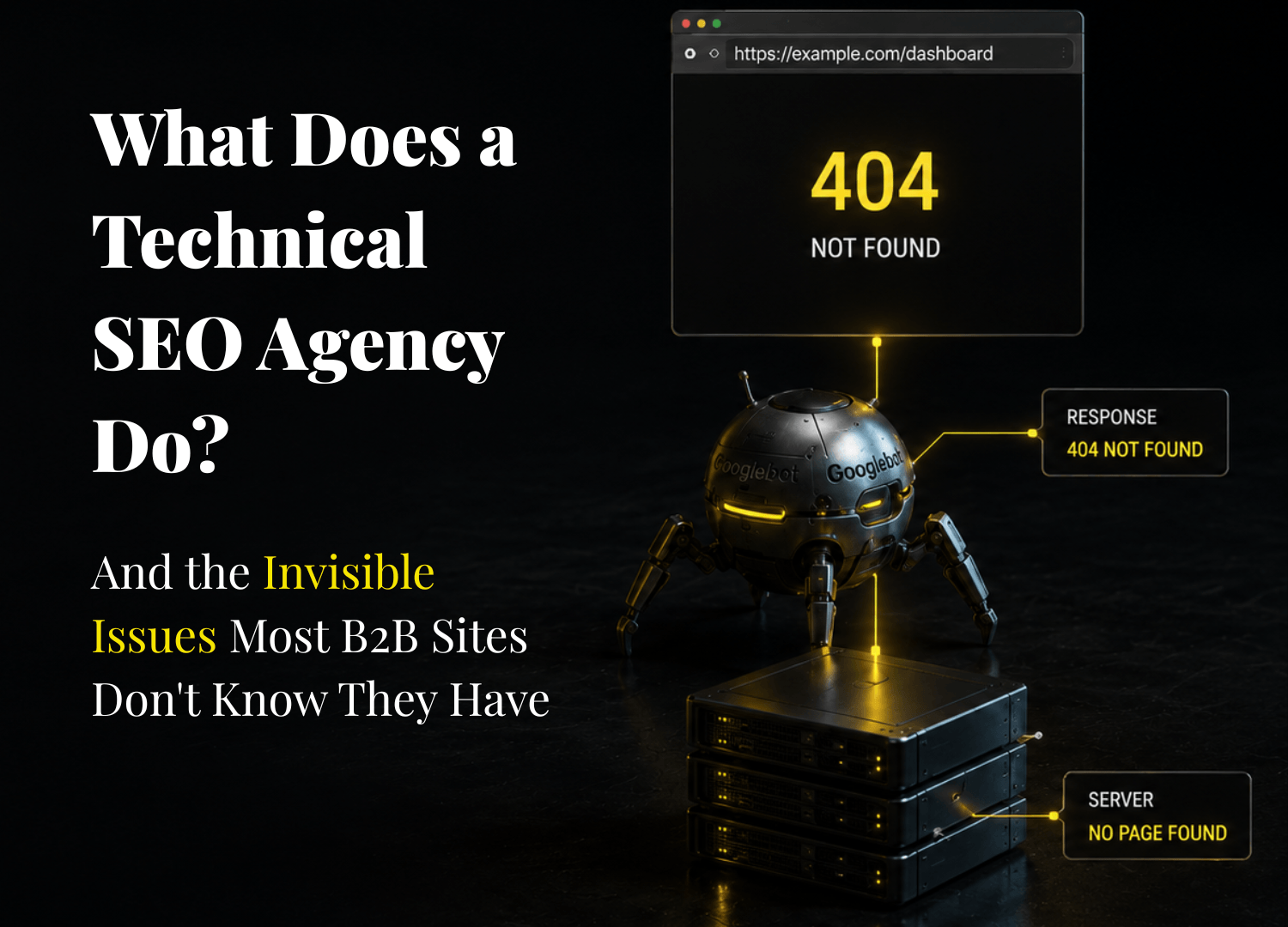
- Many B2B sites have invisible technical problems: pages that load for users but return 404 errors for Googlebot on direct URL access.
- Structured data is now the bridge between technical SEO and LLM citation, and most technical audits skip it entirely.
- A good technical SEO agency tells you which errors are costing you traffic and in what order to fix them.
Andrea Saez built Forma PM, a product management SaaS, using Lovable. The site looked great. Pages loaded instantly. Users navigated without a hitch. But after seeing complaints from other Lovable builders on Reddit, she ran a crawl test — and found something she hadn't expected: Googlebot was receiving an empty HTML page with a JavaScript bundle. No content to index. Nothing.
She audited the codebase and found 20 instances across 11 public-facing files where Lovable had built navigation using onClick button handlers instead of proper link elements. The main CTA on her homepage. Every product page link in the "How it works" section. Every "Start free trial" button. From a user's perspective, the site worked. From Google's perspective, it was invisible.
The site worked, but Googlebot could not crawl it. And nobody knew.
That's the problem with technical SEO failures. They're often invisible until they're costing you traffic.
This is what a technical SEO agency is for.
What does a technical SEO agency actually do?
A technical SEO agency audits and fixes the infrastructure layer of your website: the parts search engines interact with before they ever evaluate your content. When technical issues exist, Google may crawl fewer pages, render them incorrectly, or choose not to index them at all. Great content on a technically broken site is like a well-written book in a locked room.
The work spans six main areas:
Most in-house teams can diagnose the obvious issues through Google Search Console. What a technical SEO agency brings is the depth to find what Search Console doesn't surface: rendering gaps, crawl budget leaks, and structured data gaps that affect AI citation as well as rankings.
What crawlability problems does your site have that you don't know about?
The Lovable example above is more common than it sounds. Any site built with React, Next.js, Angular, or similar JavaScript frameworks can fall into the same trap if server-side rendering isn't configured correctly.
The underlying issue is the JavaScript rendering gap: what a browser renders for a human user versus what Googlebot can process. Googlebot renders JavaScript, but it queues rendering separately from crawling. Pages that rely entirely on client-side JavaScript to load their content can appear blank or broken to crawlers, even if they look perfect in your browser.
Specific crawlability problems a technical SEO agency audits for:
Client-side routing without server-side fallback. URLs only resolve after in-app navigation. Googlebot hits a 404 on direct access.
Crawl budget leaks. Faceted navigation, URL parameters, and session IDs create thousands of near-duplicate URLs. Googlebot wastes crawl budget on pages that will never rank.
Crawled but not indexed. The "Crawled - currently not indexed" status in Google Search Console is often a sign of thin content, near-duplicates, or quality signals Google doesn't like. A site with hundreds of these pages may be sending quality signals that suppress the rest of the domain.
Redirect chains and loops. Every hop in a redirect chain costs crawl budget and dilutes link equity. A chain of three or more redirects is a red flag in any technical audit.
Misconfigured robots.txt. Blocking CSS or JavaScript files forces Googlebot to crawl blind. A single misplaced Disallow directive has blocked entire product catalogues on large B2B sites. (For authoritative detail on robots.txt syntax and configuration, see Google's robots.txt documentation.)
Does technical SEO include Core Web Vitals?
Yes. Core Web Vitals are a confirmed Google ranking signal and a key part of any technical SEO audit. They measure three dimensions of page experience:
- Largest Contentful Paint (LCP): How long it takes for the main content to load. Under 2.5 seconds is the target.
- Cumulative Layout Shift (CLS): How much the page visually jumps as elements load. Affects usability and trust.
- Interaction to Next Paint (INP): How quickly the page responds to user interactions.
For B2B sites, LCP is the most common failure point. Large hero images, unoptimised fonts, and render-blocking JavaScript all push LCP above the 2.5-second threshold established in Google's Core Web Vitals framework. These are fixable, but they require developer involvement beyond an SEO plugin setting.
A technical SEO agency bridges the gap between the audit finding ("your LCP is 4.2 seconds") and the fix ("here's the specific image compression, lazy-loading, and critical CSS implementation your dev team needs to implement"). The audit without the fix is just a report.
Why does structured data now affect AI citation?
This is the part most technical SEO audits miss entirely, and it's becoming the most commercially important part of the stack.
Structured data (schema markup) tells search engines and AI systems what your content is as well as what it says. A page about pricing with PriceSpecification schema tells Google the values are prices. A page with FAQPage schema gives Google pre-packaged question-and-answer pairs it can surface in AI Overviews.
The connection to AI citation is direct. AI models like ChatGPT, Perplexity, and Google's AI Mode retrieve content in chunks and evaluate those chunks for semantic clarity. Schema markup reduces ambiguity about what the content represents. It formalises entity relationships: who wrote it, what it's about, who it's for.
Schema markup and entity modelling explicitly clarify what a piece of content is, who is involved, and how its elements relate to one another. Where writing implies meaning through context, schema states it directly, and that explicitness is what AI retrieval systems need to process content with precision rather than inference.
A technical SEO agency that understands this layer audits whether the schema is accurate, complete, and aligned with the entities your content is trying to establish.
For a deeper look at how AI citation works and what affects it, see GEO vs SEO vs AEO: A Plain English Guide and GEO for B2B: Getting Cited in ChatGPT and Perplexity.
How do you evaluate a technical SEO agency's audit process?
Not all technical audits are equal. A crawl report from Screaming Frog is only the starting point of a technical SEO audit.
Questions worth asking any technical SEO agency before you hire them:
What does your audit cover? A serious audit includes crawl analysis, rendering analysis (checking how Googlebot sees pages versus a browser), indexability review, Core Web Vitals assessment, structured data review, and site architecture analysis. If the scope stops at "crawl errors and page speed," that's a surface-level audit.
How do you prioritise findings? A site with 400 technical issues needs a ranked list. Ask how they distinguish between issues that are actively suppressing rankings and issues that are cosmetic.
How do you work with our dev team? A technical SEO agency's recommendations are useless if they can't be implemented. Ask whether they provide developer-ready tickets, technical specifications, or direct dev consultation. Implementation failure is the most common reason technical SEO audits produce no results.
Can you show us what a rendered page looks like to Googlebot? This is a specific, answerable question. If they can't show you (using Google Search Console's URL Inspection tool or a rendering tool) they probably haven't checked.
What monitoring do you put in place after fixes are deployed? Technical issues recur. New deployments break old fixes. An agency without post-fix monitoring is an agency that bills for the same problems twice.
What happens when you engage a technical SEO agency?
The engagement typically follows a predictable sequence.
Week 1–2: Audit. A full technical audit across all six areas above. The output is a prioritised findings document.
Week 3–4: Briefing. The agency translates findings into developer-ready specifications. The best agencies run a joint session with your dev team to walk through the priorities and answer implementation questions.
Month 2–3: Implementation and QA. Fixes get deployed. The agency QAs each fix to confirm it resolves the underlying issue beneath the surface symptom. A redirect fix that introduces a new chain is not a fix.
Ongoing: Monitoring. Technical SEO is ongoing work. New content, CMS updates, and platform changes introduce new issues continuously. Monthly crawl monitoring, Search Console alerting, and Core Web Vitals tracking are the minimum.
The timeline for results varies. Crawlability fixes can produce indexing improvements within weeks after Googlebot recrawls the affected pages. Core Web Vitals improvements can take longer to reflect in rankings. Structured data changes that improve AI citation can show up faster. AI systems update their content pools more frequently than Google's indexing cycle.
Technical SEO agency vs. in-house: when does outsourcing make sense?
In-house SEO teams are excellent at content production, keyword research, and day-to-day monitoring. They're often under-resourced for deep technical work, since technical SEO diagnosis requires specialised tooling and pattern recognition that takes years to develop.
Outsourcing makes sense when:
- You've had a rankings drop and can't identify the cause
- You're planning or recovering from a site migration
- You've launched a new CMS, front-end framework, or URL structure
- Your Search Console is showing a growing "Crawled - currently not indexed" count
- You're moving into AI search visibility and don't know whether your technical setup supports it
It makes less sense when:
- Your technical fundamentals are clean and you need content volume
- You have a strong in-house developer who understands SEO rendering requirements
- You're an early-stage company with a simple site and no indexing issues
For a detailed look at when to bring in an agency versus building in-house, see Enterprise SEO: What It Is, What It Costs, and Whether Your B2B Company Needs It.
How we do this at Tenpoint Labs
As an AI SEO agency, we run technical SEO by template and directory. We pull in your Search Console, GA4 and CRM data, group URLs by page template and directory, and look for crawl, indexing, rendering and schema issues where the data shows they cost you clicks and pipeline. We fix what the data flags first, and the fixes ship alongside the content work, with developer-ready tickets for your dev team and a QA pass after each deployment. We audit structured data with AI citation in mind; see AI Publisher Licensing Deals and Brand Visibility in AI Search for context on how AI systems decide what to cite.
The data behind it
The Page Performance view in Tenpoint Analytics shows clicks and rankings for every URL and pipeline per directory. A directory with strong impressions and weak clicks, or a template whose pages sit in "Crawled - currently not indexed," shows up there, tied to the exact URLs. Query Intelligence lists the striking-distance queries, so we can see which fixes unlock queries that are already close to page one.
What you see in your seat
Every engagement includes a seat in Tenpoint Analytics, the same workspace your strategist uses. You can open Page Performance, pick a directory, and check the clicks, rankings and pipeline on the URLs we fixed. The first changes to your website go live within 15 days. You can explore the views on the Tenpoint Analytics page.
If you have a site with technical issues you haven't been able to identify, or if you know the issues exist but can't get them prioritised internally, get in touch. We'll tell you within the first conversation whether technical SEO is the bottleneck or whether something else is holding your rankings back.
FAQs
What is a technical SEO agency?
A technical SEO agency audits and fixes the infrastructure layer of your website: crawlability, indexability, JavaScript rendering, Core Web Vitals, structured data, and site architecture. These are the factors that affect whether search engines can find, render, and index your pages correctly, independent of content quality.
How much does a technical SEO audit cost?
A basic crawl audit from a freelancer starts around $300–$1,500. A comprehensive technical SEO audit from an agency, covering rendering analysis, Core Web Vitals, structured data review, and site architecture, typically runs $3,000–$15,000 for a mid-size site. Enterprise-scale audits are quoted separately. The cost of the audit is rarely the limiting factor; implementation time usually is.
How long does it take to see results from technical SEO fixes?
Crawlability fixes can show results within weeks — the main variable is how frequently Googlebot recrawls your site, which depends on crawl budget and site authority. Core Web Vitals improvements are reflected in Google's field data (CrUX) on a rolling 28-day basis, so changes typically become visible in rankings within one to three monthly update cycles. If your site has pages stuck in "Crawled - currently not indexed," resolving the underlying quality issues and requesting recrawl can produce indexing improvements within days.
Can a technical SEO agency work with our CMS and dev team?
Yes, this is standard. Most B2B sites run on WordPress, Webflow, HubSpot CMS, or custom-built stacks. A competent technical SEO agency works with whatever CMS and front-end framework you use, translates findings into developer-ready specifications, and works within your existing sprint or project management process. Ask specifically whether they QA fixes after deployment.
Does technical SEO affect AI search visibility?
Yes. Structured data schema is the most direct technical lever for AI citation. AI systems retrieve content in chunks and use schema markup to understand what that content represents. A site with well-implemented FAQ, Article, and Organization schema gives AI systems cleaner, less ambiguous content to retrieve and cite. JavaScript rendering issues can also affect AI citation: if Googlebot and AI crawlers can't render your pages, the content doesn't exist in their indexes.